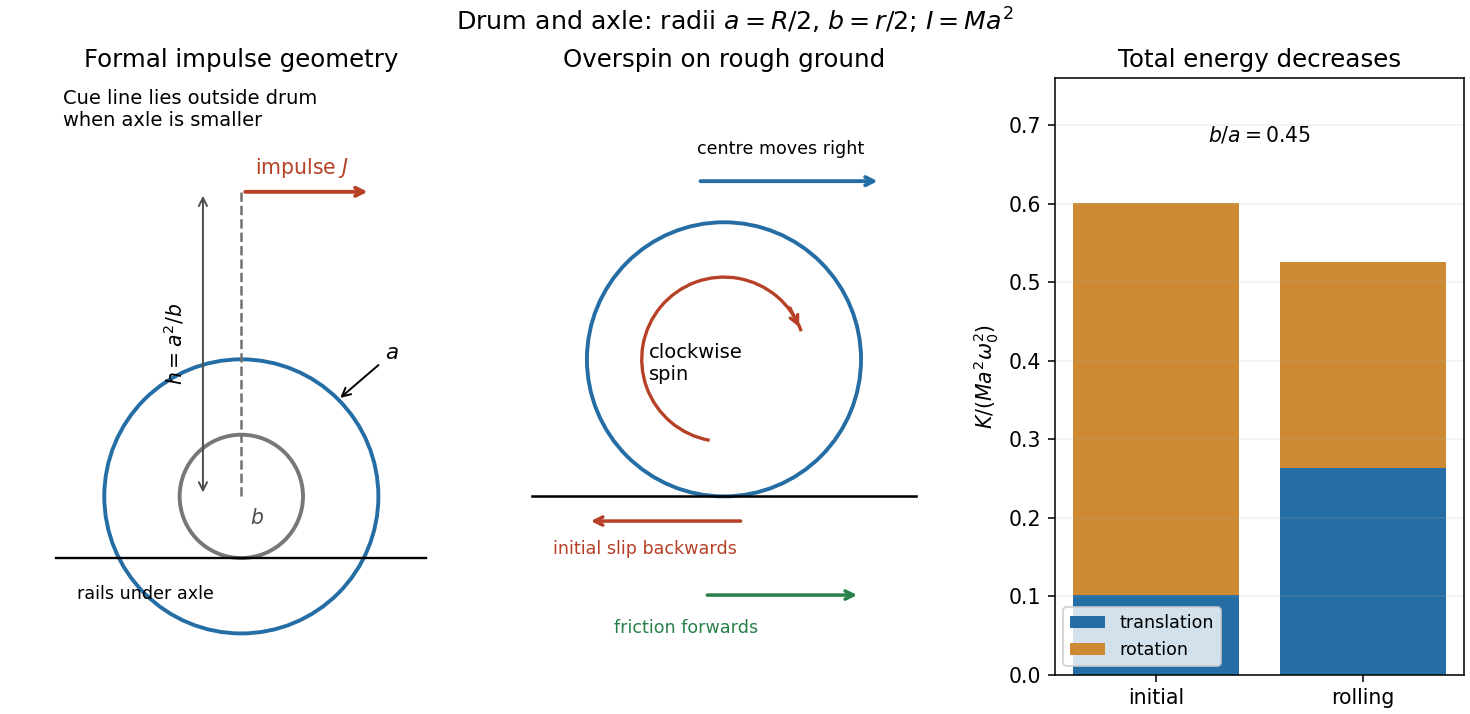
The symbols in the question are diameters: write drum radius , axle radius . For a thin hollow drum, . A rightward horizontal impulse applied at height above the centre gives and clockwise angular velocity . Rolling on the axle requires , soThe frictionless rails do not create the required rotation; the initial impulse must give exactly this ratio of linear to angular motion. For the usual case , the required height is greater than the drum radius. It cannot be reached by striking the bare cylindrical surface horizontally; an extension or equivalent applied couple would be needed. This geometric limitation should accompany the formal result.
With clockwise rotation taken positive and , the total kinetic energy isAngular momentum needs an origin. Its spin about the centre is , in the clockwise direction. About a fixed point in the horizontal rail plane, spin and orbital contributions add toHere the drum centre is height above that plane. The signed clockwise convention fixes the displayed signs; the associated vector points perpendicular to the vertical plane of motion.
For the frictional conversion of spin to rolling, consider the horizontal slipping stage on the rough surface, whose contact radius is now , and neglect extra vertical impact or height-change energies at the transition. A friction impulse changes by and clockwise spin by . Thus is conserved. At the end , givingBecause , the final total kinetic energy is . Subtraction yieldsThe result is independent of the friction coefficient, provided sufficient contact time allows rolling without slipping to be regained. Initially , so the contact point slips backwards. Friction acts forwards and can increase translational kinetic energy, while decreasing rotational kinetic energy by more. A finite vertical drop or inelastic landing would require additional geometric information; the boxed expression describes the horizontal rolling-conversion loss.

Articles by others on the same topic
There are currently no matching articles.