Let be the launch rate and . Treat many small impacts as a continuous momentum flux, justified by . Write for truck displacement from its initial position and , with at the first impact. First neglect vertical motion, so every projectile has horizontal velocity .
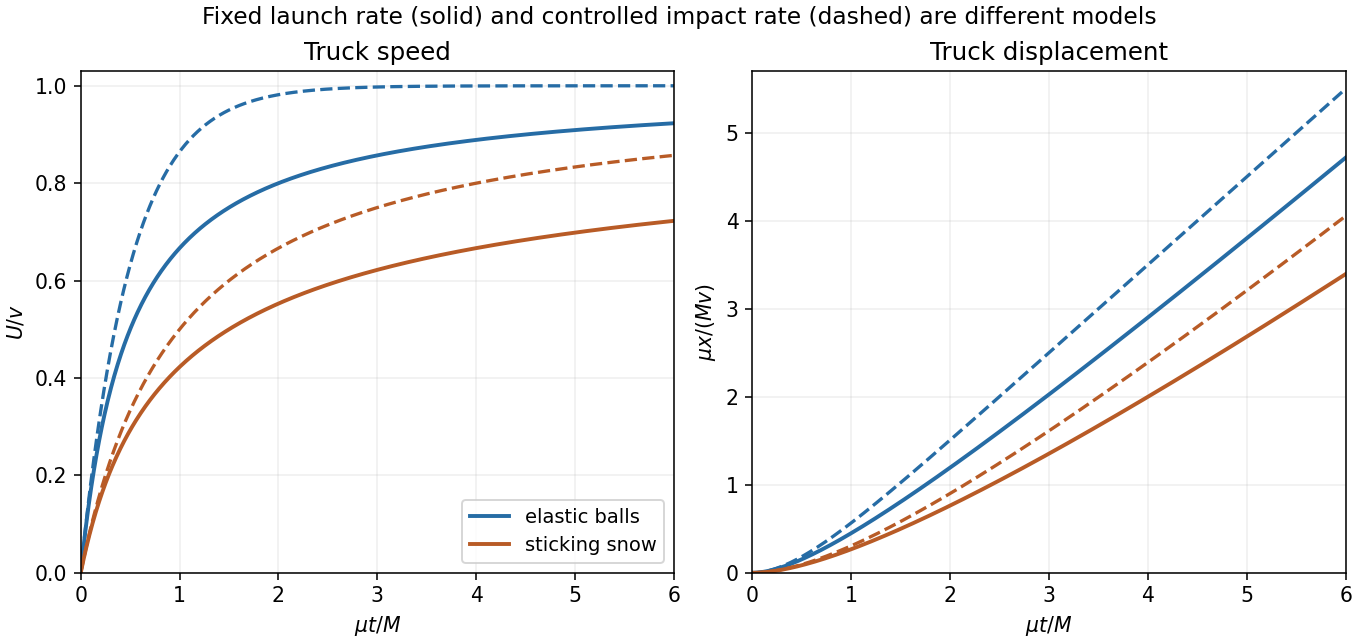
A fixed launch rate is different from a fixed impact rate on a receding truck. Projectiles reaching the truck at time were launched at retarded time , after an irrelevant constant initial-flight offset. The moving-target interception rate is thereforeFor an elastic collision with a much heavier truck, each ball transfers momentum approximately . The elastic-ball truck keeps mass , soSolving from rest and integrating once more givesThe rebound reverses the ball's motion relative to the truck; its laboratory velocity can still be forwards once . The truck approaches asymptotically, while its decreasing impact rate prevents exponential approach in laboratory time. The approximation omits the velocity jumps of individual finite-mass impacts.
For sticking snowballs, let be the instantaneous truck-plus-snow mass, with . The variable-mass system obeysIntegrating the second equation gives . Therefore , and with ,Retaining the accumulated mass is necessary even though each individual snowball is small.
For the range calculation, take the intended idealization of horizontal launch from height , no air resistance, and interception possible until the projectile reaches the ground. Its flight time is and horizontal range is . If the initial truck distance from the boy is , substitute in the last expression. The speed at the range limit isFor an initially nearby truck, in this point-target model and . A different launch angle or finite interception height changes the available range and must be specified separately.

Articles by others on the same topic
There are currently no matching articles.