The parallel axis theorem gives for parallel axes separated by , with the reference axis through the centre of mass. For a plane lamina, the perpendicular axis theorem gives for mutually perpendicular axes meeting at one point, with in the plane.
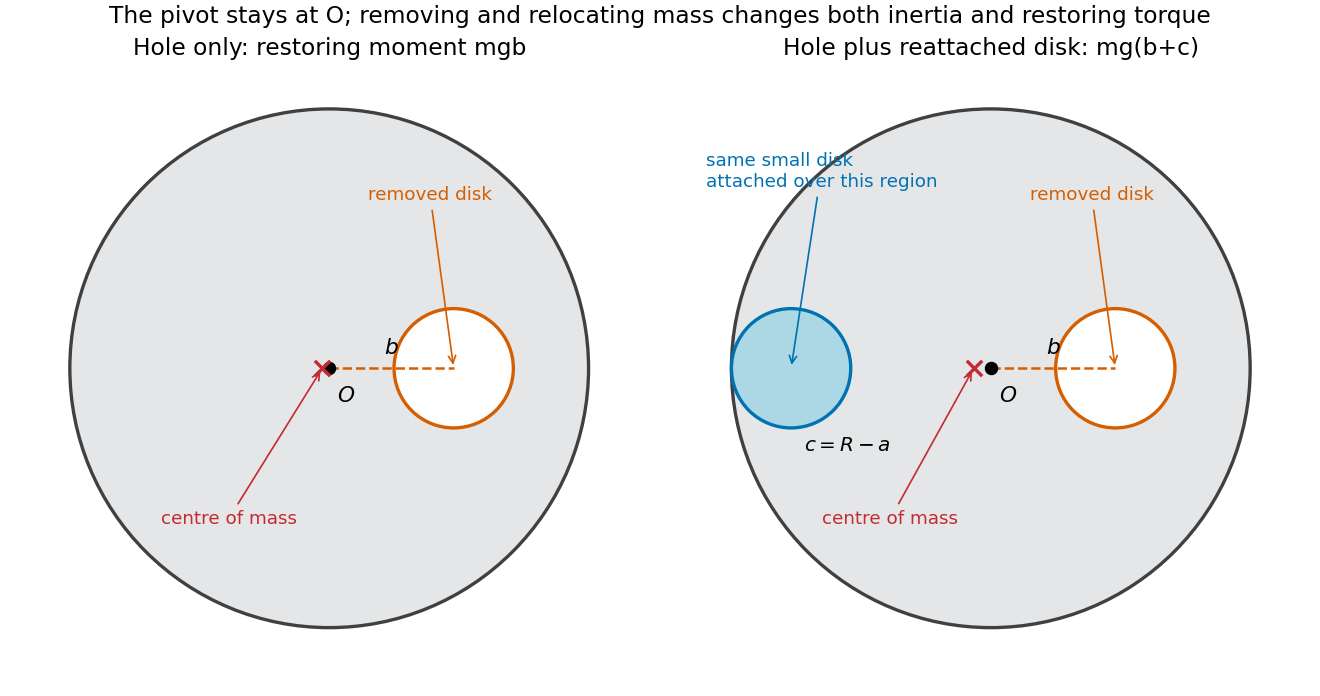
Treat the removed material as negative mass. With the hole's centre at , its moment of inertia about is . The remaining moment of inertia and centre of mass areFor a uniform original disk, . Write and measure from the downward equilibrium direction of its centre of mass. The physical pendulum then has LagrangianThe Euler-Lagrange equation is . For small oscillations, , givingNow add the removed small disk on the opposite side, with its centre a distance from so that it is internally tangent to the large disk. The total mass returns to , while its first moment about is . ThusReplacing both the inertia and gravitational restoring moment givesThe same first-moment method applies to a general perforated-disc pendulum. The added disk is attached to the lamina and shares its rotation; treating it as a massless patch or updating only the inertia would omit its restoring torque.

Articles by others on the same topic
There are currently no matching articles.