Label the capacitor's left terminal and right terminal , with the battery's negative node at zero. The source diagram has from to ground, from to ground, and a source-side resistor feeding from electric potential difference . The capacitor electric current flows from to ; flows through .
With the capacitor removed, and , so the Thévenin equivalent seen by the capacitor has . Suppress the ideal electric potential difference source to find its electrical resistance: the left terminal sees to ground and the right sees , giving between the terminals.
The initially uncharged capacitor electric potential difference therefore obeysSolving gives , with . The capacitor electric current is , henceAt , the short-like uncharged capacitor makes , so directly from the right resistor. At long times the capacitor carries no direct electric current. These endpoint checks agree with the exponential solution.
Kirchhoff's current law at the left capacitor terminal gives . Since ,Thus rises from to , whereas falls from to zero. Their derivatives have opposite signs, and both approach their limiting values on the same time scale . The graph uses electric currents in units of and time in units of .
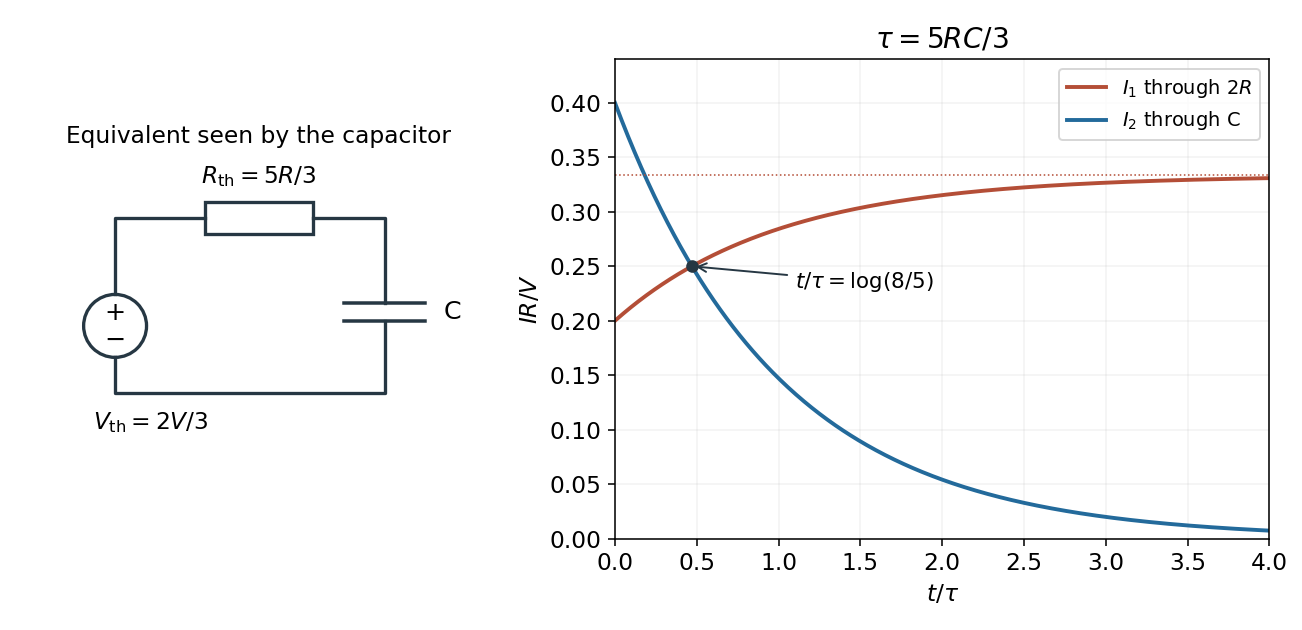

At equality, , so the common electric current is . Substituting the capacitor electric current givesThereforeFor and , and , giving . The battery electric potential difference cancels, as expected because every electric current scales linearly with it in this ideal linear circuit. The result assumes a nonzero source electric potential difference; with both electric currents vanish at all times.
Articles by others on the same topic
There are currently no matching articles.