For a circular coil, use the Biot-Savart lawAt an axial position , every wire element is at distance . The transverse magnetic field contributions cancel by rotational symmetry. The axial part of is , and . Multiplying by the turns givesThe electric current's sense fixes the axial direction by the right-hand rule.
Put the two coil centres at . By superposition, their axial magnetic field isBoth magnetic field contributions point the same way. Evaluation givesThe corresponding coefficients are and . Each individual magnetic field falls as one moves away from its own coil; their sum is much flatter near the midpoint.
For a single coil, differentiating twice produces . At this vanishes. Thus the pair has by reflection symmetry and by its chosen separation; all odd derivatives vanish there. In fact,This Helmholtz coil arrangement produces a nearly uniform central magnetic field, useful for controlled charged particle in a uniform magnetic field and magnetic field calibration. The small orbit used below lies within that central region.
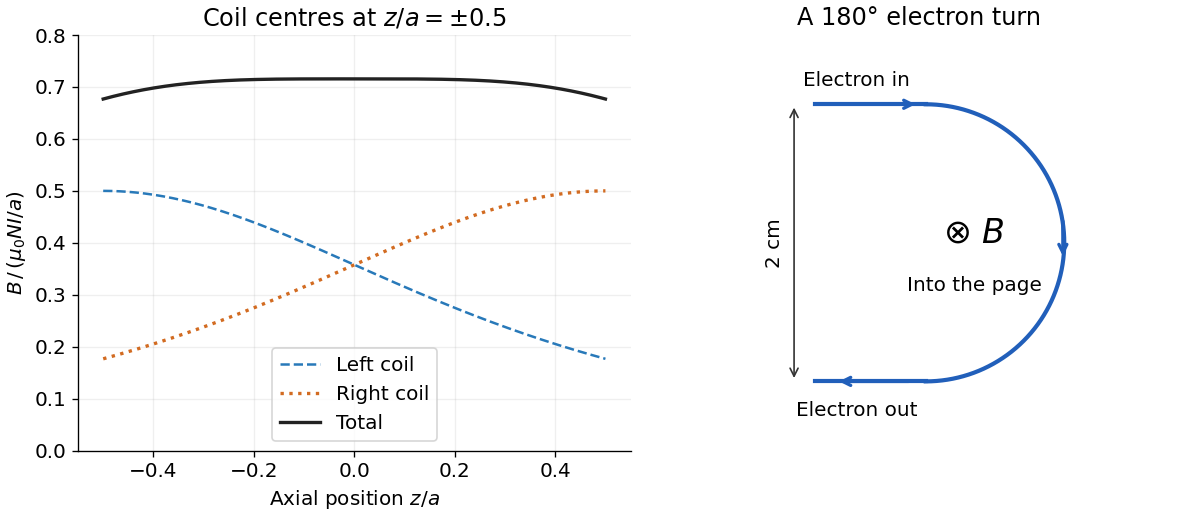

The electron follows a semicircle under the transverse Lorentz force. Parallel, oppositely directed incoming and outgoing paths are separated by a diameter, so the orbit radius is . Acceleration from rest through the electric potential difference gives kinetic energy , where is the elementary electric charge. Equating the Lorentz force magnitude to the required centripetal force givesThe magnetic field must be perpendicular to the plane of the turn, with its sign chosen for the electron's negative electric charge. In the illustration the electron enters rightwards at the upper endpoint, so a magnetic field into the page bends it downwards.
The nonrelativistic estimate has . If the small special relativity correction is retained, use with and . This gives , about larger. The leading answer is adequate at the precision implicit in the classical treatment.
Articles by others on the same topic
There are currently no matching articles.