Set the grounded plane at and the real point charge at . The image charge at makes the electrostatic potential vanish throughout the plane. The uniqueness theorem for the electrostatic potential then identifies the physical solution in :The normal electric field is . Differentiation givesand thereforeFor the electric field points into the electrical conductor, consistently with negative induced surface charge density.
Apply the superposition principle to the result of part (a). If , then the exact normal electric field from the two real point charges and their image charges isFor , Taylor's theorem gives . Sincethe leading electric dipole result isThe electric dipole moment is . The circle is the zero of the leading normal electric field and hence of the induced surface charge density. Inside it, induced surface charge density is negative; outside it, positive. The tangential electric field is zero everywhere on the grounded electrical conductor, so the leading full electric field vanishes on that circle. The corresponding dipole-induced charge on a grounded plane integrates to zero over the whole plane: the negative central region is balanced by the positive exterior.
For finite , is only the leading-order zero. With and , the exact zero satisfies , giving . For example, inserting any in the exact expression at does not give zero. This is a controlled electric dipole approximation, not an exact finite-separation identity.
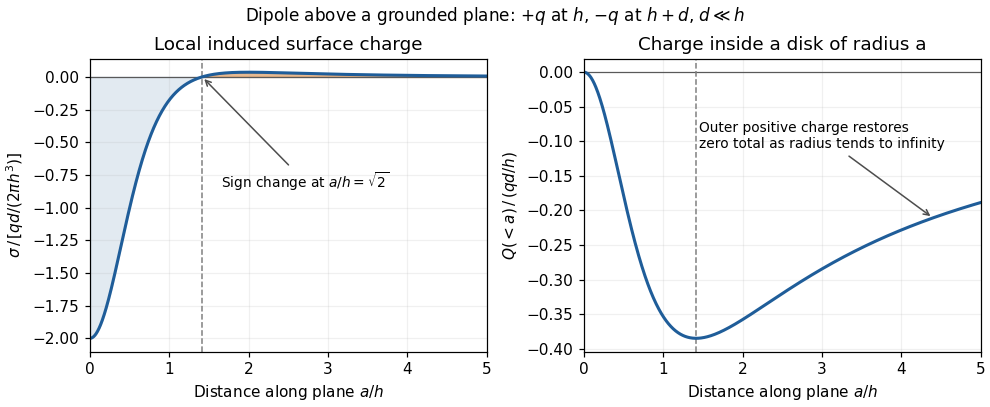
Sign reversal and enclosed induced electric charge for a normal electric dipole above a grounded plane
. Details. 
The electric field within a conductor in electrostatic equilibrium vanishes. The normal electric field boundary condition, with outward normal vector , therefore gives . Directly below the monopole, :For the electric dipole,The exact finite-separation answer iswhose Taylor series agrees with the boxed leading term. Although the real point charges have zero total electric charge, their unequal distances leave negative induced surface charge density immediately beneath them.
Articles by others on the same topic
There are currently no matching articles.