Subtract the two photoelectric effect equations to eliminate the work function:Here converts the energy difference from electronvolts to joules. The precision of the rounded stopping energies justifies about two significant figures, .
Let , and . With , the next two normalized harmonic-oscillator wavefunctions are and . Their energies are , with respectively zero, one and two wavefunction nodes, alternating even and odd parity. The Schrödinger equation givesFor harmonic-oscillator wavefunction inflections, the inflections include both classical turning points and simple wavefunction wavefunction nodes. In dimensionless coordinates the complete sets areThe curvature changes sign at every listed point; none of these states has a wavefunction node coinciding with its turning points.
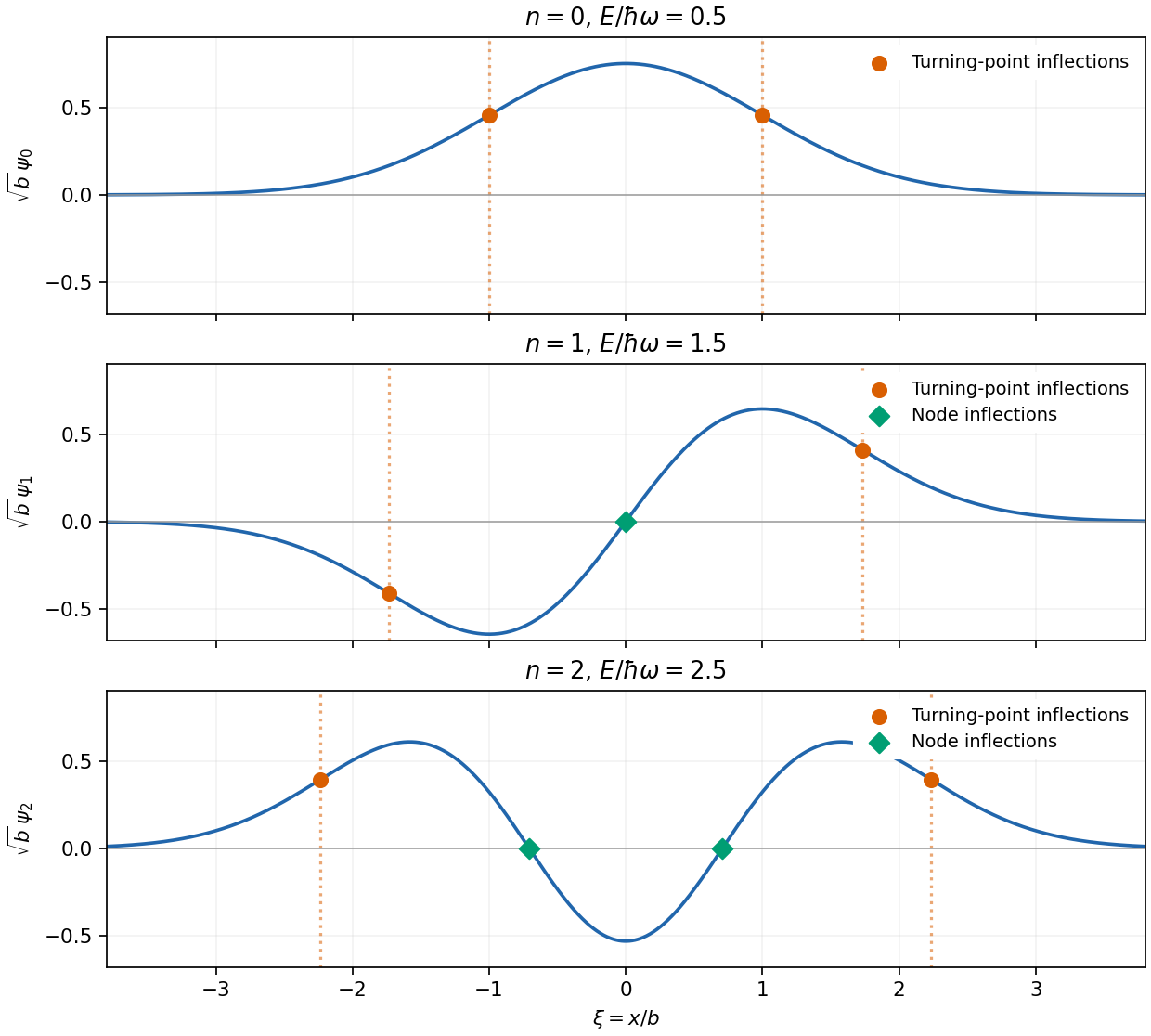
Original lowest harmonic-oscillator wavefunctions with turning-point and node inflections distinguished
. Details. 
Resolving a length requires momentum transfer of order . Taking a hard relativistic scale givesThe full de Broglie wavelength convention gives , differing by ; the intended scale is roughly , far below a proton radius. Two opposing beams have a larger total collision energy, but proton energy is shared among partons: the actual resolution depends on the hard scattering momentum transfer, not simply on beam energy alone.
For radiative temperature uncertainty after background subtraction, write , so and . The two absolute uncertainties are both . If they are independent standard uncertainties,If the percentages instead denote absolute error bounds, linear worst-case propagation gives 0.56%. With correlation coefficient , the standard-uncertainty result is ; subtraction makes positive common errors partly cancel. The independence convention is therefore an assumption, not information supplied by the percentages.
For independent electron arrivals, the shot-noise counting model gives mean transferred charge and count . Poisson statistics implyThis is about 79 electron charges rms. It assumes Poisson shot noise; charge discreteness by itself does not rule out correlations, thermal noise or other apparatus noise.
Articles by others on the same topic
There are currently no matching articles.