The Arago spot is a bright axial point inside the geometrical shadow of a circular opaque object. Under coherent illumination, contributions from points around its circular edge have equal optical path to an axial observation point and interfere constructively. It is a Fresnel diffraction effect, so geometrical rays alone miss it. In the ideal paraxial plane-wave model, Babinet's principle gives on axis for disk radius ; thus the axial intensity equals the unobstructed intensity in that model. The whole shadow is not bright: off-axis phases differ and form a localized central feature. Finite source size, poor coherence or an imperfect edge reduce its visibility.
For elliptical polarization from circular and linear components, use coherent waves of the same frequency, propagation direction and fixed relative phase. Let the circular component be and the linear component , with . Their sum has and , soThe tip of the electric field traces an ellipse with unequal semiaxes and . Coherence is necessary: averaging unrelated phases does not create this fixed polarization ellipse.
Reading the time axis, the rapid oscillation has period about , while successive envelope maxima are about apart. The envelope stays nonzero and has a slowly sinusoidal modulation about a positive mean. The corresponding amplitude-modulation model is , with . Product-to-sum givesThus the intended positive-frequency components are , and . The envelope frequency is not itself a separate additive displacement component. These values use the illustrated sinusoidal-modulation interpretation; a finite qualitative trace alone does not uniquely specify every possible spectral component.
At long wavelength, the acoustic phonon branch moves the two atoms in a cell nearly in phase: . In the limit this is rigid translation and . The optical phonon branch moves them oppositely, with stationary cell centre of mass: . Its frequency is finite because adjacent unlike atoms change their separation. For unequal masses the lighter atom has the larger optical displacement. Three-dimensional crystals have three acoustic branches and, with two atoms per primitive cell, three optical branches; longitudinal and transverse directions describe displacement relative to the wavevector. The name optical does not mean that every optical phonon branch is infrared-active: coupling also depends on effective charges and symmetry.
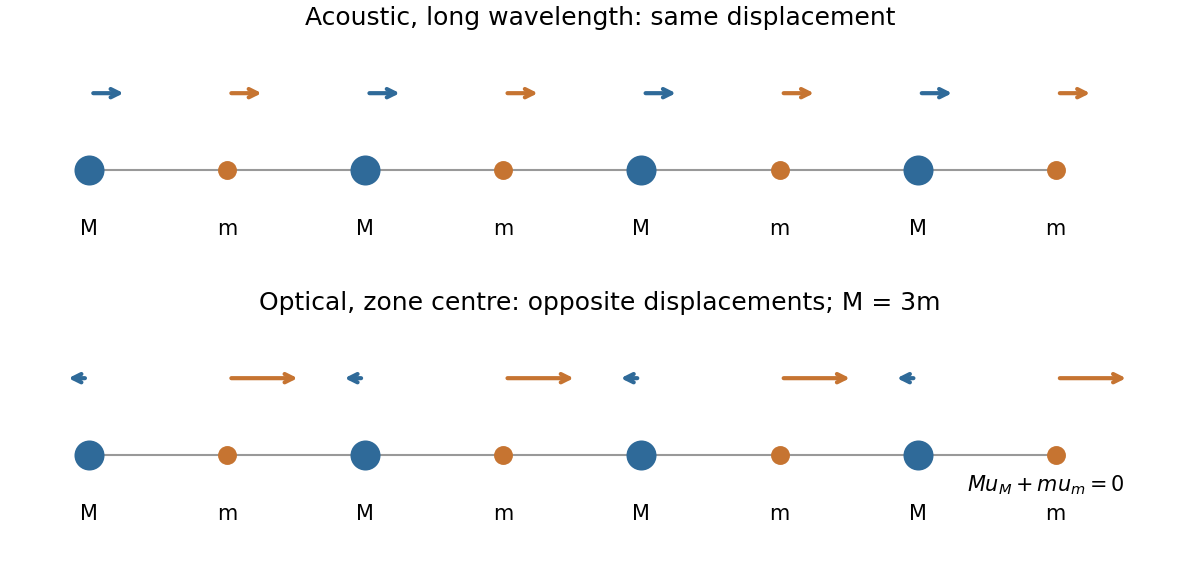
Original long-wavelength acoustic and optical displacement sketches for unequal masses, with optical centre-of-mass cancellation
. Details. 
Let be the number of conduction electrons per atom. Then and the Drude relations give . ConsequentlyUnder an explicit one-electron-per-atom assumption, and . The carrier count is not specified: monatomic does not by itself imply monovalent, so the boxed dependence on is the general result supported by the data. The collision time here is the transport relaxation time inferred within the free-electron model, not a measurement of every microscopic scattering event.
Articles by others on the same topic
There are currently no matching articles.