The Arago spot is a bright axial point inside the geometrical shadow of a circular opaque object. Under coherent illumination, contributions from points around its circular edge have equal optical path to an axial observation point and interfere constructively. It is a Fresnel diffraction effect, so geometrical rays alone miss it. In the ideal paraxial plane-wave model, Babinet's principle gives on axis for disk radius ; thus the axial intensity equals the unobstructed intensity in that model. The whole shadow is not bright: off-axis phases differ and form a localized central feature. Finite source size, poor coherence or an imperfect edge reduce its visibility.
For elliptical polarization from circular and linear components, use coherent waves of the same frequency, propagation direction and fixed relative phase. Let the circular component be and the linear component , with . Their sum has and , soThe tip of the electric field traces an ellipse with unequal semiaxes and . Coherence is necessary: averaging unrelated phases does not create this fixed polarization ellipse.
Reading the time axis, the rapid oscillation has period about , while successive envelope maxima are about apart. The envelope stays nonzero and has a slowly sinusoidal modulation about a positive mean. The corresponding amplitude-modulation model is , with . Product-to-sum givesThus the intended positive-frequency components are , and . The envelope frequency is not itself a separate additive displacement component. These values use the illustrated sinusoidal-modulation interpretation; a finite qualitative trace alone does not uniquely specify every possible spectral component.
At long wavelength, the acoustic phonon branch moves the two atoms in a cell nearly in phase: . In the limit this is rigid translation and . The optical phonon branch moves them oppositely, with stationary cell centre of mass: . Its frequency is finite because adjacent unlike atoms change their separation. For unequal masses the lighter atom has the larger optical displacement. Three-dimensional crystals have three acoustic branches and, with two atoms per primitive cell, three optical branches; longitudinal and transverse directions describe displacement relative to the wavevector. The name optical does not mean that every optical phonon branch is infrared-active: coupling also depends on effective charges and symmetry.
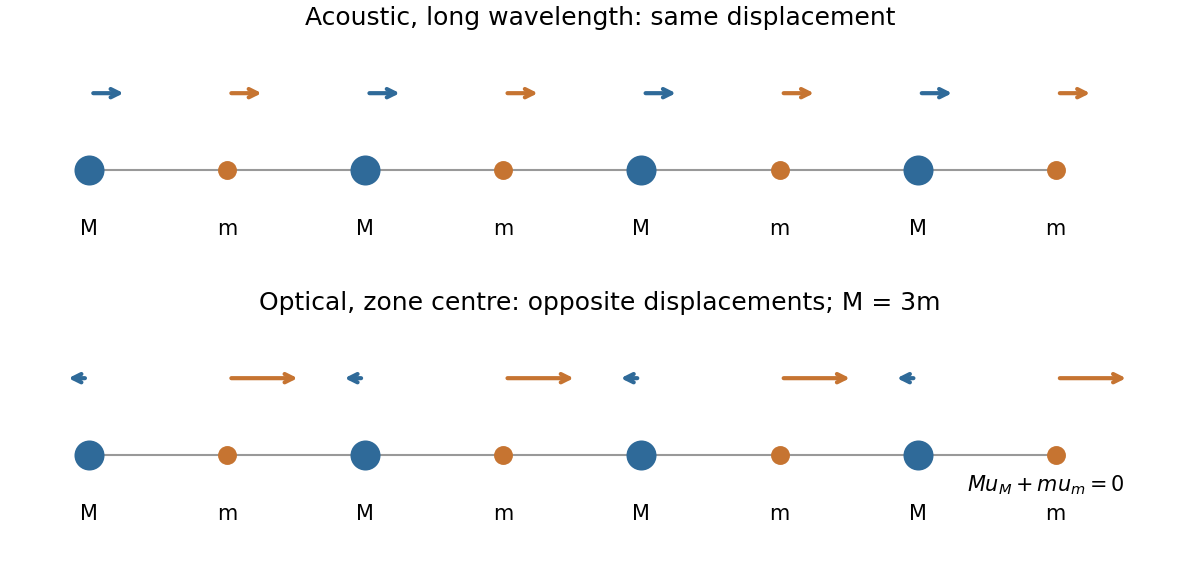
Original long-wavelength acoustic and optical displacement sketches for unequal masses, with optical centre-of-mass cancellation
. Details. 
Let be the number of conduction electrons per atom. Then and the Drude relations give . ConsequentlyUnder an explicit one-electron-per-atom assumption, and . The carrier count is not specified: monatomic does not by itself imply monovalent, so the boxed dependence on is the general result supported by the data. The collision time here is the transport relaxation time inferred within the free-electron model, not a measurement of every microscopic scattering event.
For a narrow packet, phase velocity is and group velocity is . Set . The uncovered surface hasEquality occurs at , also the minimum of . Numerically,The long-wave gravity limit has ; the short-wave capillary limit has .
A compact packet subsequently spreads because different wavenumbers have different group speeds. In the gravity regime , so smaller and longer waves move ahead. Individual crests move twice as fast as the envelope, appearing at its rear and disappearing at its front. In the capillary regime , shorter waves move ahead; the envelope overtakes its slower individual crests, which drift backward relative to it. Thus both the wavelength ordering within the spread packet and the crest motion relative to its envelope reverse.
For the sheet define . The elastic-cover frequency ratio for water waves isAt small , : sheet inertia lowers the frequency, while bending first enters at higher order. At sufficiently large , bending dominates the restoring force and sheet inertia dominates the extra mass, giving . The curve initially dips below one, reaches a minimum, then rises and crosses one. This asymptote describes the supplied ideal dispersion law; arbitrarily large eventually violates a thin-sheet continuum model.
For a pinned-square surface displacement mode, with . The fundamental has . The uncovered frequency is and , soThis uses a square two-dimensional surface mode, not the one-dimensional estimate. A clamped plate or additional hydraulic boundary conditions would require a different mode calculation.
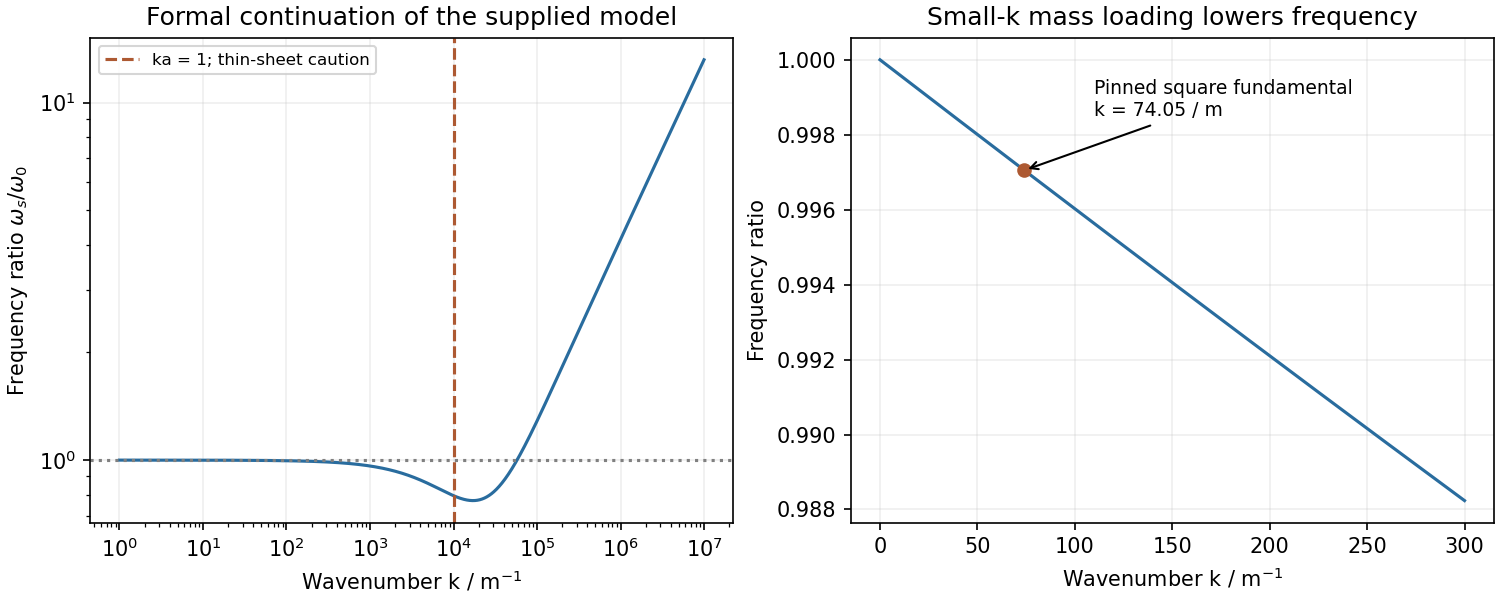
Original sheet-to-uncovered frequency ratio, with the pinned-square fundamental and the ideal large-wavenumber asymptote
. Details. 
The angle in the source ray sketch is inside the gap. Two extra reflections add a full round trip. Comparing adjacent emerging rays on a common outgoing phase plane subtracts the lateral-path contribution, so the optical path difference is , rather than . Thusat transmission maxima. The two internal reflection phases add to an integer full cycle in the stated ideal symmetric-coating model. Snell's law, , converts to the external direction. A fixed internal angle defines a cone and hence an equal-inclination ring in a focal plane.
For identical lossless mirrors the first transmitted amplitude has magnitude times the incident amplitude. Each additional round trip multiplies it by , because is an intensity reflection coefficient for one mirror but the product of the two amplitude reflection magnitudes. Summing the geometric series givesThe maximum is one in this symmetric lossless limit; absorption, unequal mirrors or additional incoherent reflections change it. At fixed angle and negligible material dispersion, and adjacent orders differ by one. For ,
order-safe angular scanning of a Fabry–Pérot spectrum should cover the approximately spectral span within one order while making the instrumental width smaller than . Near normal incidence, requiring the smallest approximate FSR to exceed the span gives , and should exceed roughly . These are design bounds, not a unique optimum. One suitable choice isThe physical spacing is ; an air gap gives . Approximate FSRs near normal incidence are at and at , with widths about and . For a concrete angular scan choose order . The pair lies near internal and the line near ; their widths within this scan remain below . Restricting to this calibrated order window avoids the other-order ring near . Index dispersion and unknown extra source lines would need calibration or order-sorting filters.
The resolving power is approximately : many coherent cavity round trips create a much longer effective optical delay than one traversal. A Michelson instrument with the same available physical delay has less resolving power unless its mirror travel provides a correspondingly long maximum optical path difference. Mirror separation errors spread the round-trip phase; keeping them below a linewidth requires roughlyFor this design the scale is about in an air gap. Both surface flatness and parallelism over the illuminated area, as well as angular collimation and coating uniformity, must support the intended finesse.
The Fraunhofer approximation drops the aperture-dependent quadratic propagation phase. For illuminated extent and observation distance , a sufficient paraxial condition is , with coherent nearly plane incident illumination. Collimation followed by observation in a lens's back focal plane produces the same angular Fourier pattern without an astronomical propagation distance.
Let label the aperture field and let be transverse coordinates of the distant detector, with the axial separation. Expanding the propagation distance retains a common phase and the cross term , while dropping the aperture's quadratic term. Summing the scalar Huygens contributions gives a field proportional to the Fourier transform at . In one dimension, writing , givesRemove the known propagation prefactor and any detector-plane quadratic phase before applying this inverse transform. Recovery needs the complex diffracted field, including phase; its intensity alone is insufficient for this inversion.
The whole-aperture Fraunhofer distance of a coherent array uses the full ten-dish extent, which is about . Thus , and a conventional boundary is about . Far-field propagation must be of order a million kilometres or more, with a stronger inequality for accurate Fraunhofer behaviour. Applying the condition to only one dish or one spacing would miss the array extent.
For equal synchronized dish fields, the array sum is . Its intensity isNear the centre, and the single-dish envelope is nearly constant, giving the requested approximation. A uniformly illuminated circular dish instead supplies the broader envelope , with first zero near . It cannot be ignored over the entire pattern.
Principal array maxima have , height , with spacing approximately arcseconds. There are narrow sidelobes and many grating orders within the dish envelope because . The central maximum's first zeros obey . By reception/transmission reciprocity, the source must therefore move throughfrom zero-order maximum to first minimum. The equatorial geometry fixes the sweep direction; no elapsed time is requested.
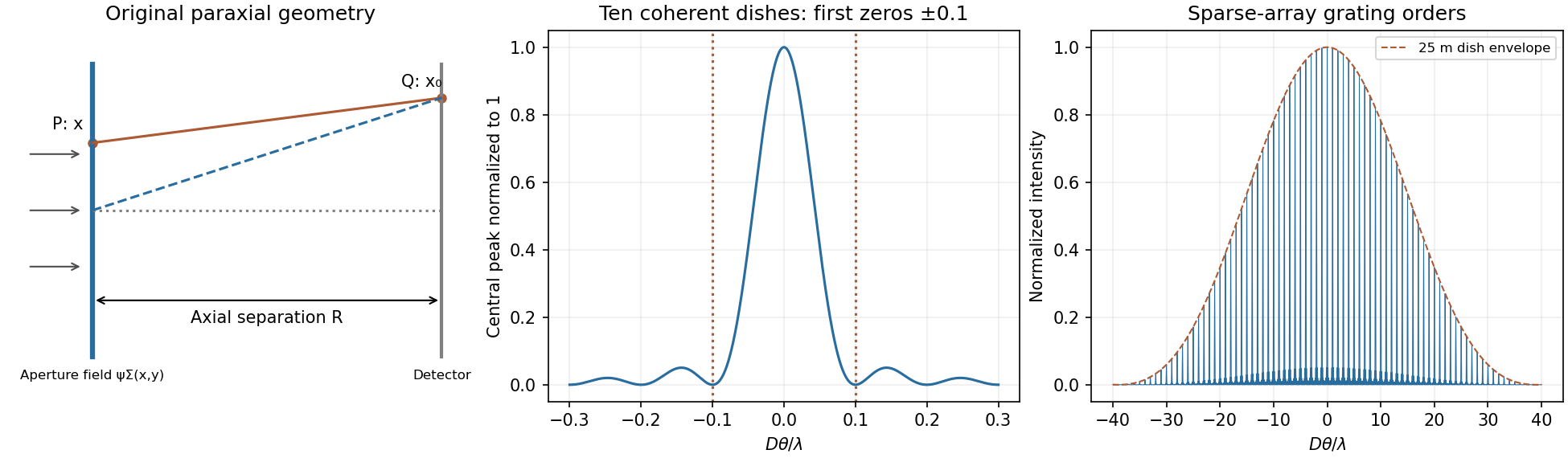
Original labelled Fraunhofer geometry, ten-element central interference lobe and grating orders under a circular-dish envelope
. Details. 
The string speed is . The characteristic impedance is the ratio of the forward-wave transverse force to transverse velocity, . With peak displacement amplitude , the mean power isDisplacement and transverse force are continuous at a massless junction. Since , the displacement amplitudes are and . Taking the incident amplitude real, the light-string motion isIn this standing-and-travelling decomposition of a reflected string wave, the first term travels and the second stands; the decomposition is not a separation into independent incident-power fractions because these fields interfere. The reflected wave has a phase reversal. power coefficients and standing-wave ratio are
For a uniform inserted matching section, unequal exterior impedances require a quarter-wave impedance transformer: and . At equal tension this means middle density and an odd-quarter-wavelength length in that section. Reflections at its two ends then cancel at the design frequency. An arbitrary density or an arbitrary half-wavelength segment cannot perfectly match these unequal exterior strings; the ideal match is frequency-selective.
amplitude scaling along a slowly tapered string instead follows from matching over an adiabatic frequency range. The source fixes frequency, while conserved power and the final characteristic impedance determine amplitude. In the heavy string,Its wave speed halves. The no-reflection approximation needs small fractional characteristic impedance change over each local wavelength, rather than length alone for a taper containing abrupt features.
In a periodic crystal potential, atomic levels broaden into bands of allowed bloch states. Coupling between states of the same symmetry opens avoided crossings, including Bragg-coupled states in the nearly free-electron picture. Bonding and antibonding combinations provide a complementary tight-binding picture. A semiconductor has a filled valence band and an empty conduction band at zero temperature separated by a forbidden energy interval; thermal excitation, light and doping provide mobile electrons and holes. The gap depends on the crystal's periodic potential, bonding and symmetry, not on a classical collision barrier. In a direct gap, the relevant extrema coincide in wavevector.
For the stated parabolic edges, take and . Negligible photon momentum and no phonon make the transition nearly vertical in versus . parabolic-band optical energy sharing divides the excess photon energy in inverse proportion to the effective masses:Thus the initial and final electron energies, relative to the valence-band maximum, areTheir difference is . The selected is about ; either sign gives the same energy in this symmetric approximation.
A shallow donor supplies an electron in a screened impurity potential, so its localized level lies just below the conduction edge. A shallow acceptor binds a hole and has an electron-occupation level just above the valence edge; thermal ionization supplies mobile holes. The level positions are measured relative to the relevant band edge, and deep impurities need not obey this hydrogenic approximation.
For the supplied bound-carrier mass and unit effective ionic charge, dielectric screening and effective mass change the hydrogen binding energy toThis corresponds to and an effective Bohr radius about . The binding is shallow compared with the band gap and typical atomic binding. Trivalent denotes chemical valence, not an unscreened hydrogenic charge of three. An acceptor physically binds a hole; the question's stated is used as its stipulated bound-carrier mass rather than silently replacing it by the separate band-edge .
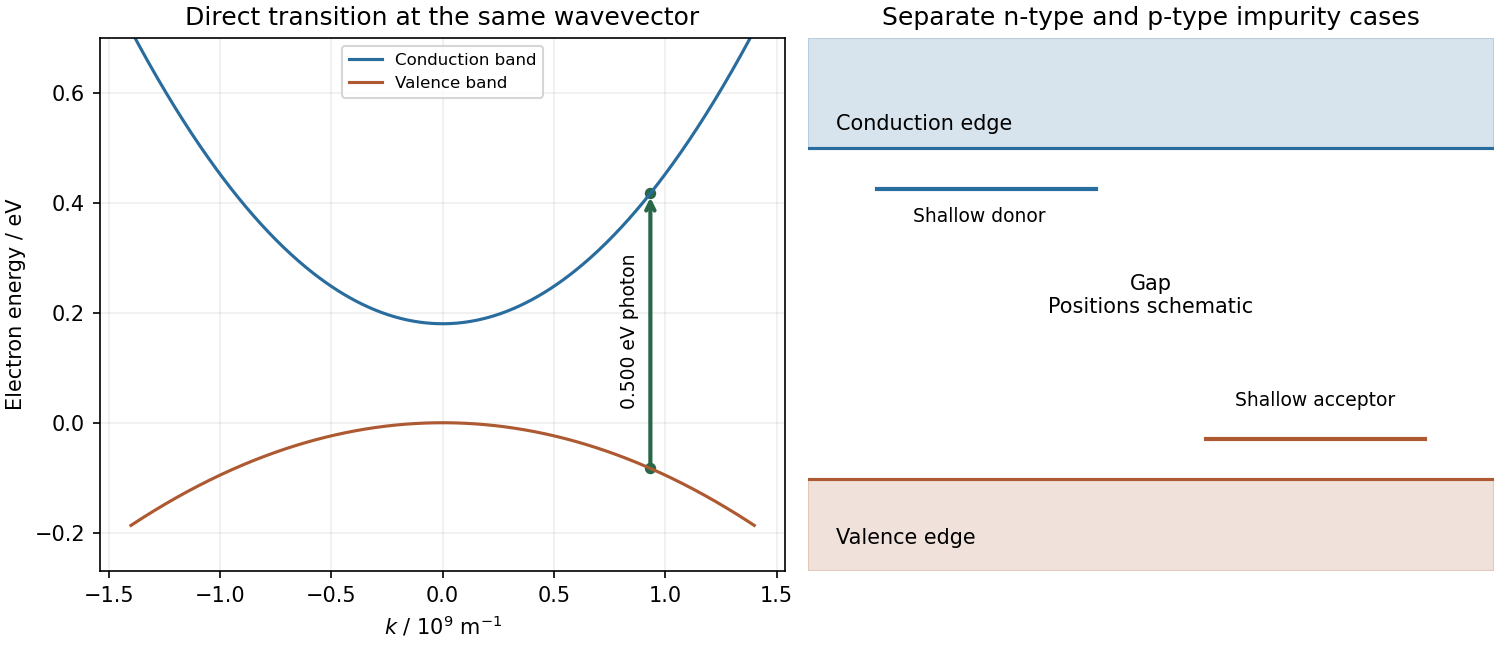
Original direct-gap vertical transition with mass-dependent energy sharing, and separate schematic shallow donor and acceptor levels
. Details. 
With periodic boundary conditions, each state occupies volume and has two spin states. Filling a sphere gives andHere is density of states per volume and per energy; the extensive is . Both spin states are already included.
For divalent magnesium, , givingAt , only electrons within about of the Fermi surface change occupancy. The Sommerfeld heat capacity isEquivalently , with in kelvin, so at room temperature it is about . A temperature was not specified for the estimate; the linear coefficient is the general result.
At sufficiently low temperature, an ordinary nonsuperconducting metal has : electrons dominate at the lowest temperatures, acoustic phonons produce the cubic contribution, and the lattice approaches per mole as temperature exceeds its characteristic Debye scale. Anharmonic expansion can distinguish measured from . In the room-temperature regime, since , so electron excitation is strongly Pauli-limited. The free-electron estimate is only about of the classical lattice scale. Calling it negligible means small relative to the lattice contribution, not identically zero or negligible as . Real band structure and interactions can alter the coefficient.
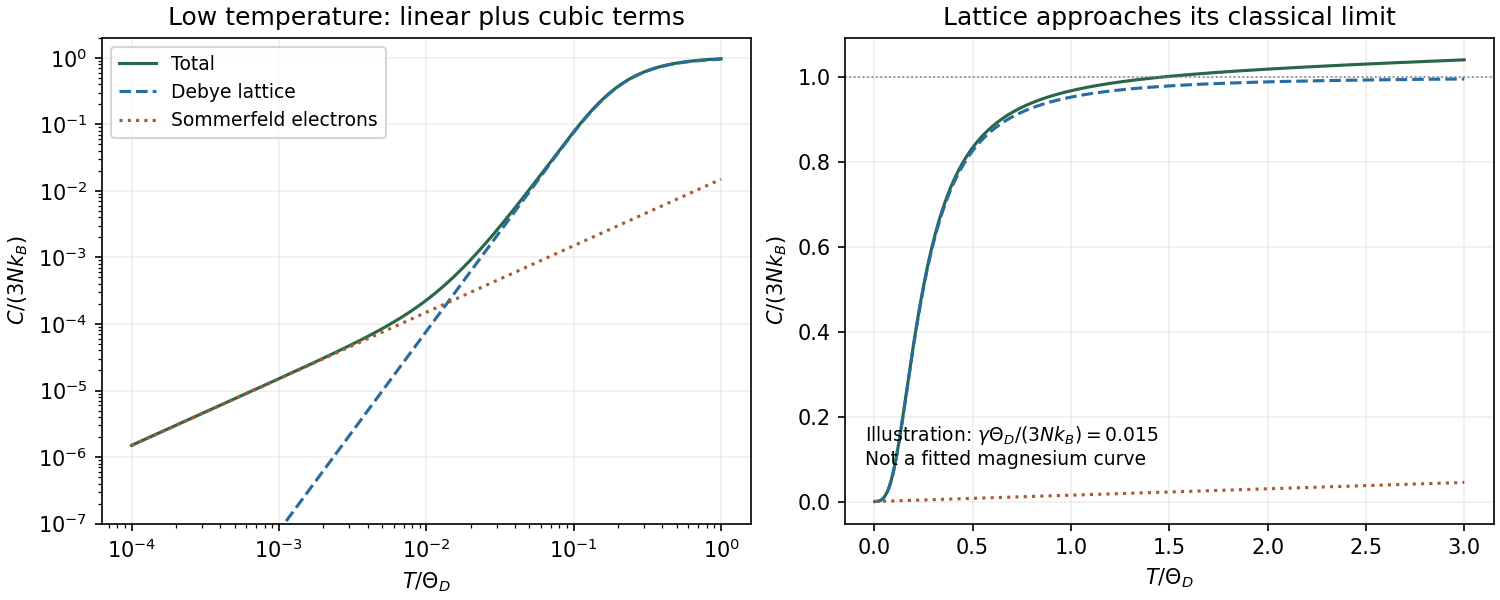
Original illustrative metal heat-capacity regimes: Sommerfeld linear electrons and Debye phonons, with explicit dimensionless model parameters
. Details. 
For , define and . The parameter relating quality factor and viscous damping regimes isAt weak damping it also equals times stored energy divided by energy lost per cycle. The stored-energy convention and frequency matter: this cycle-based interpretation should not be extended to free motions that never complete a cycle.
For the free motion is , where . Thus underdamping means . High gives many oscillations per amplitude-decay time, narrow resonance and strong frequency selectivity; a lightly loaded tuning fork, optical cavity or low-loss electrical resonator provides examples. The amplitude decay time is , while the slowly averaged energy decays with . These times differ by a factor of two.
At critical damping, and , with . There is no ringing; a simple critically damped position indicator can settle without oscillation. For and , there are two real negative decay rates . Increasing very strong drag slows the long-time return, whose rate approaches . A strongly viscously damped mechanical indicator illustrates this regime. These classifications concern the linear homogeneous equation, not every possible nonlinear damping law.
The driven displacement amplitude isThe displacement-resonance threshold of a viscous oscillator requires , or ; it lies at . Some underdamped systems therefore have no such maximum. Average absorbed power instead peaks at for this viscous model. Its half-power frequencies are , so their separation is and . For broad response this ratio remains a useful parameter but not a claim of many free oscillations. The familiar displacement-linewidth version is a high- approximation.
A series RLC circuit has and for the charge oscillation. Resistance dissipates energy, inductance provides the inertial analogue and capacitance the restoring analogue. Ringdown and a calibrated half-power scan independently estimate loss; parasitic resistance, loading and radiation change the measured value. A large increases frequency selectivity but also lengthens settling time, so it is not universally the best instrumental choice.
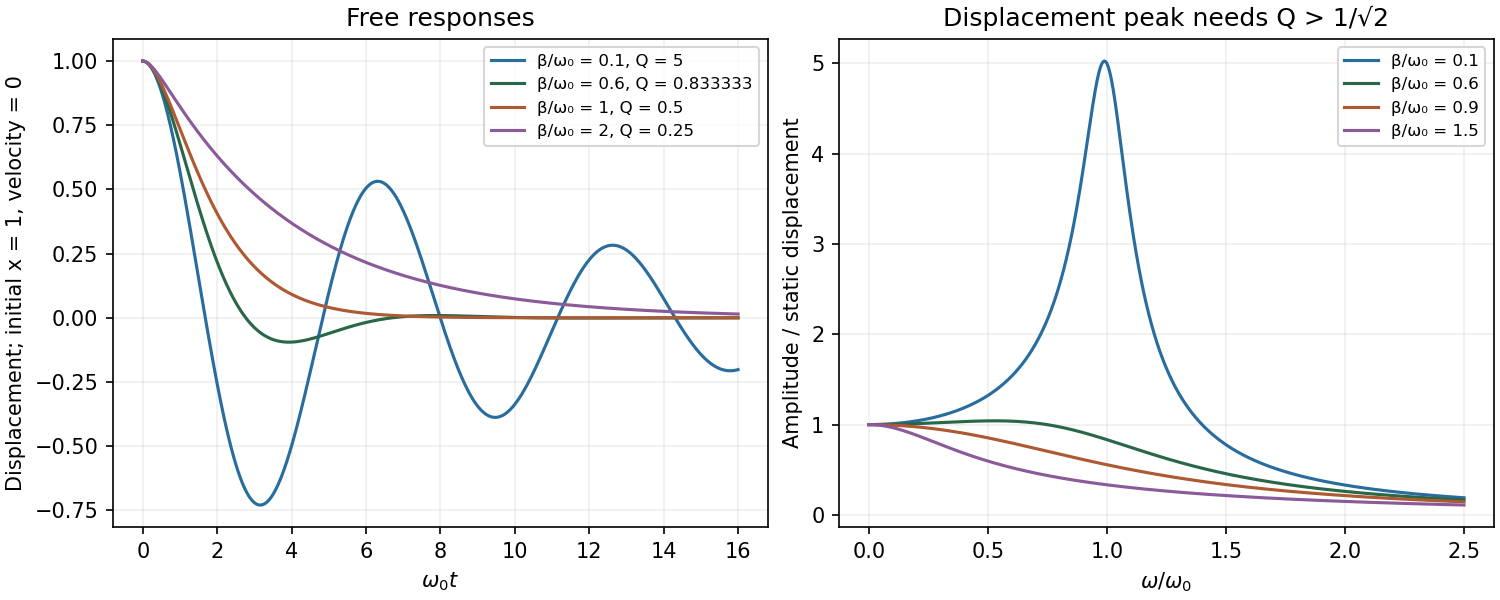
Original free decay and forced-displacement curves distinguishing underdamping, critical damping, overdamping and the resonance threshold
. Details. 
A three-phonon normal process conserves crystal wavevector without a reciprocal-lattice shift, . An Umklapp process instead hasThe crystal can absorb the reciprocal-lattice momentum; after reduction to the first Brillouin zone the phonon drift transporting heat is relaxed. A normal process redistributes phonons while preserving their total crystal momentum, so it is not by itself the same resistive mechanism. energy must also be conserved in either process.
At low temperature, large-wavevector phonons are rare, suppressing Umklapp scattering. Boundary and defect scattering then limit the mean free path; with a nearly constant boundary-limited path, grows as . As temperature increases, heat capacity rises but Umklapp scattering shortens , often producing a electrical conductivity maximum. At sufficiently high temperature a simple anharmonic model has nearly constant and , giving . These are regime estimates, not a universal law for every material or size.
For degenerate carriers with approximately elastic scattering and a common transport relaxation time, and . Using and givesThis is the Wiedemann–Franz law. The same mobile electrons carry charge and heat, but Pauli statistics set the electronic heat capacity and hence the Lorenz number. The relation applies to electronic thermal conductivity, not automatically to total electrical conductivity including phonons. Inelastic electron-phonon scattering can relax energy and charge currents differently; nondegeneracy and strong energy dependence of scattering also limit the simple form.
A meaningful test combines a four-terminal electrical measurement with a steady thermal-gradient measurement on the same sample and temperature range. Contact heat resistance, parasitic heat leaks, phonon conduction and sample geometry must be controlled before interpreting a measured Lorenz ratio as an electronic departure from the law.
A carrier in a locally parabolic isotropic band obeys , soIlluminate a high-mobility crystal with a transverse alternating electric field, sweep a calibrated static magnetic field at known microwave or far-infrared frequency, and detect resonant absorbed power. Cooling lengthens the relaxation time; resolving the resonance generally needs . Varying field direction measures band anisotropy, while circular polarization distinguishes the two senses of rotation for opposite carrier charges. This is orbital motion rather than electron spin resonance.
The classic silicon/germanium measurements used single crystals near , light modulation and circularly polarized microwaves, with directional scans to infer anisotropic carrier-energy surfaces.[ref]
Cyclotron Resonance of Electrons and Holes in Silicon and Germanium Crystals by Gene Dresselhaus and others. Abstract: low-temperature single crystals, light modulation, circular polarization and anisotropy
Carrier generation, calibration, scattering linewidth and inhomogeneity must be separated from a genuine mass shift.In a general band the cyclotron mass is an orbit property, for the appropriate field-normal orbit. It need not equal every component of the band-curvature mass tensor. For an ellipsoidal parabolic band with field along a principal direction it is . Thus a single resonance does not determine a whole effective-mass tensor without angular information.
Articles by others on the same topic
There are currently no matching articles.