The Fraunhofer approximation drops the aperture-dependent quadratic propagation phase. For illuminated extent and observation distance , a sufficient paraxial condition is , with coherent nearly plane incident illumination. Collimation followed by observation in a lens's back focal plane produces the same angular Fourier pattern without an astronomical propagation distance.
Let label the aperture field and let be transverse coordinates of the distant detector, with the axial separation. Expanding the propagation distance retains a common phase and the cross term , while dropping the aperture's quadratic term. Summing the scalar Huygens contributions gives a field proportional to the Fourier transform at . In one dimension, writing , givesRemove the known propagation prefactor and any detector-plane quadratic phase before applying this inverse transform. Recovery needs the complex diffracted field, including phase; its intensity alone is insufficient for this inversion.
The whole-aperture Fraunhofer distance of a coherent array uses the full ten-dish extent, which is about . Thus , and a conventional boundary is about . Far-field propagation must be of order a million kilometres or more, with a stronger inequality for accurate Fraunhofer behaviour. Applying the condition to only one dish or one spacing would miss the array extent.
For equal synchronized dish fields, the array sum is . Its intensity isNear the centre, and the single-dish envelope is nearly constant, giving the requested approximation. A uniformly illuminated circular dish instead supplies the broader envelope , with first zero near . It cannot be ignored over the entire pattern.
Principal array maxima have , height , with spacing approximately arcseconds. There are narrow sidelobes and many grating orders within the dish envelope because . The central maximum's first zeros obey . By reception/transmission reciprocity, the source must therefore move throughfrom zero-order maximum to first minimum. The equatorial geometry fixes the sweep direction; no elapsed time is requested.
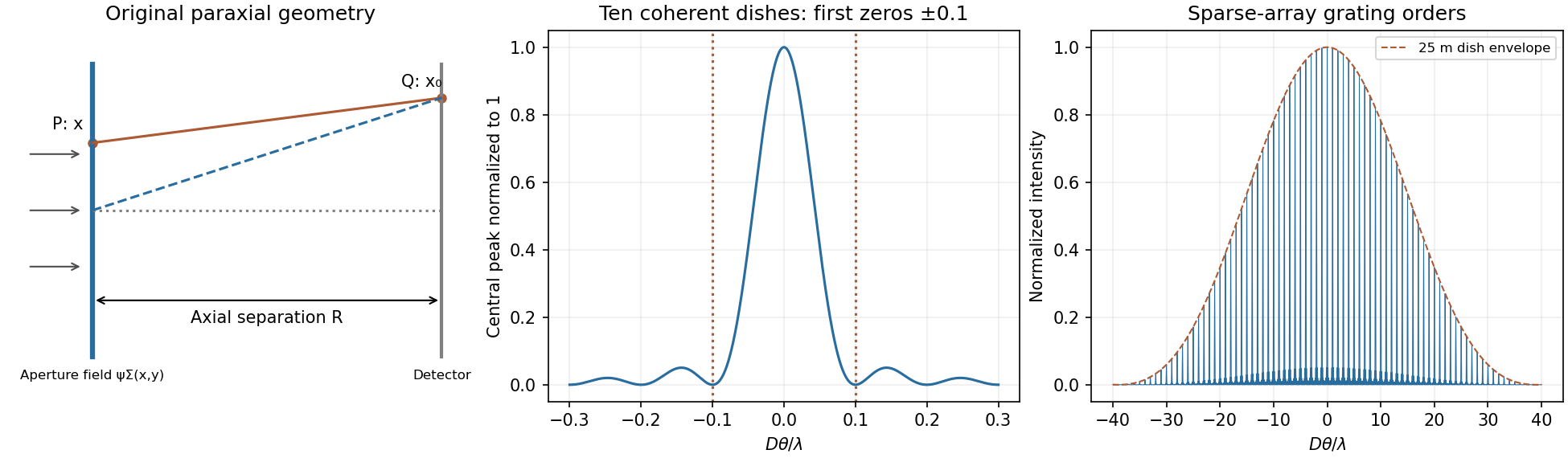
Original labelled Fraunhofer geometry, ten-element central interference lobe and grating orders under a circular-dish envelope
. Details. 
Articles by others on the same topic
There are currently no matching articles.