For a narrow packet, phase velocity is and group velocity is . Set . The uncovered surface hasEquality occurs at , also the minimum of . Numerically,The long-wave gravity limit has ; the short-wave capillary limit has .
A compact packet subsequently spreads because different wavenumbers have different group speeds. In the gravity regime , so smaller and longer waves move ahead. Individual crests move twice as fast as the envelope, appearing at its rear and disappearing at its front. In the capillary regime , shorter waves move ahead; the envelope overtakes its slower individual crests, which drift backward relative to it. Thus both the wavelength ordering within the spread packet and the crest motion relative to its envelope reverse.
For the sheet define . The elastic-cover frequency ratio for water waves isAt small , : sheet inertia lowers the frequency, while bending first enters at higher order. At sufficiently large , bending dominates the restoring force and sheet inertia dominates the extra mass, giving . The curve initially dips below one, reaches a minimum, then rises and crosses one. This asymptote describes the supplied ideal dispersion law; arbitrarily large eventually violates a thin-sheet continuum model.
For a pinned-square surface displacement mode, with . The fundamental has . The uncovered frequency is and , soThis uses a square two-dimensional surface mode, not the one-dimensional estimate. A clamped plate or additional hydraulic boundary conditions would require a different mode calculation.
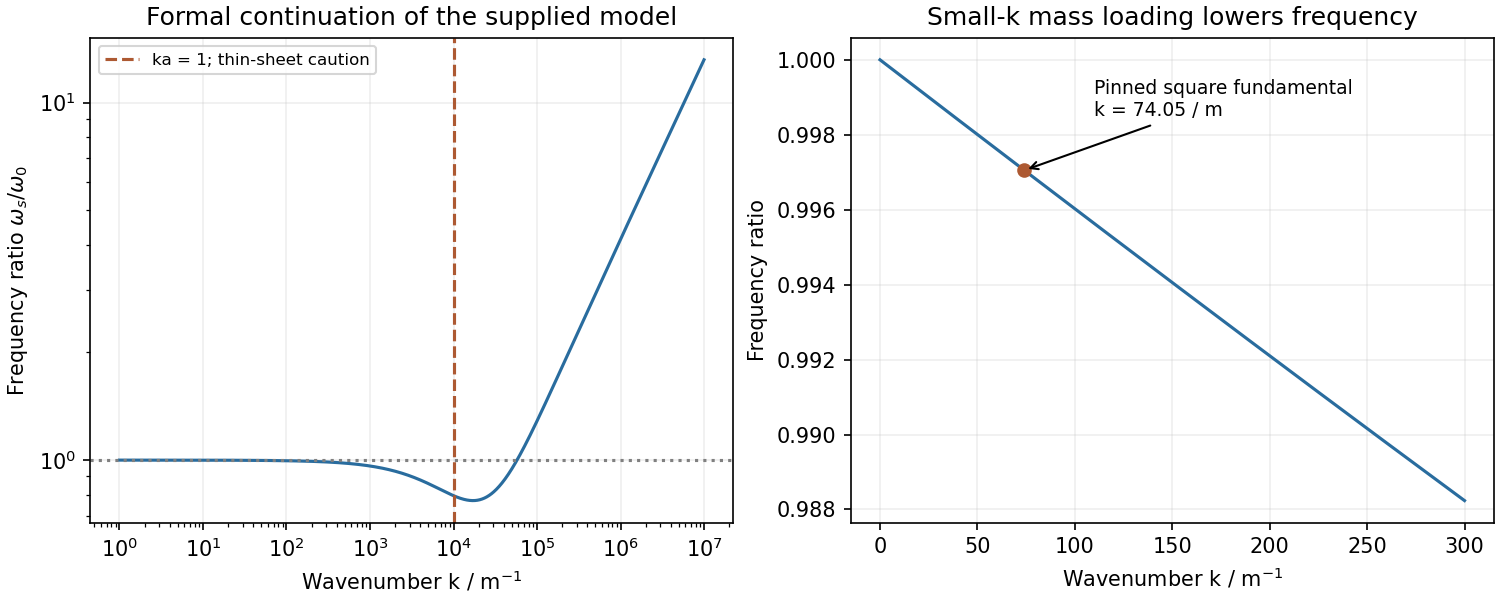
Original sheet-to-uncovered frequency ratio, with the pinned-square fundamental and the ideal large-wavenumber asymptote
. Details. 
The angle in the source ray sketch is inside the gap. Two extra reflections add a full round trip. Comparing adjacent emerging rays on a common outgoing phase plane subtracts the lateral-path contribution, so the optical path difference is , rather than . Thusat transmission maxima. The two internal reflection phases add to an integer full cycle in the stated ideal symmetric-coating model. Snell's law, , converts to the external direction. A fixed internal angle defines a cone and hence an equal-inclination ring in a focal plane.
For identical lossless mirrors the first transmitted amplitude has magnitude times the incident amplitude. Each additional round trip multiplies it by , because is an intensity reflection coefficient for one mirror but the product of the two amplitude reflection magnitudes. Summing the geometric series givesThe maximum is one in this symmetric lossless limit; absorption, unequal mirrors or additional incoherent reflections change it. At fixed angle and negligible material dispersion, and adjacent orders differ by one. For ,
order-safe angular scanning of a Fabry–Pérot spectrum should cover the approximately spectral span within one order while making the instrumental width smaller than . Near normal incidence, requiring the smallest approximate FSR to exceed the span gives , and should exceed roughly . These are design bounds, not a unique optimum. One suitable choice isThe physical spacing is ; an air gap gives . Approximate FSRs near normal incidence are at and at , with widths about and . For a concrete angular scan choose order . The pair lies near internal and the line near ; their widths within this scan remain below . Restricting to this calibrated order window avoids the other-order ring near . Index dispersion and unknown extra source lines would need calibration or order-sorting filters.
The resolving power is approximately : many coherent cavity round trips create a much longer effective optical delay than one traversal. A Michelson instrument with the same available physical delay has less resolving power unless its mirror travel provides a correspondingly long maximum optical path difference. Mirror separation errors spread the round-trip phase; keeping them below a linewidth requires roughlyFor this design the scale is about in an air gap. Both surface flatness and parallelism over the illuminated area, as well as angular collimation and coating uniformity, must support the intended finesse.
The Fraunhofer approximation drops the aperture-dependent quadratic propagation phase. For illuminated extent and observation distance , a sufficient paraxial condition is , with coherent nearly plane incident illumination. Collimation followed by observation in a lens's back focal plane produces the same angular Fourier pattern without an astronomical propagation distance.
Let label the aperture field and let be transverse coordinates of the distant detector, with the axial separation. Expanding the propagation distance retains a common phase and the cross term , while dropping the aperture's quadratic term. Summing the scalar Huygens contributions gives a field proportional to the Fourier transform at . In one dimension, writing , givesRemove the known propagation prefactor and any detector-plane quadratic phase before applying this inverse transform. Recovery needs the complex diffracted field, including phase; its intensity alone is insufficient for this inversion.
The whole-aperture Fraunhofer distance of a coherent array uses the full ten-dish extent, which is about . Thus , and a conventional boundary is about . Far-field propagation must be of order a million kilometres or more, with a stronger inequality for accurate Fraunhofer behaviour. Applying the condition to only one dish or one spacing would miss the array extent.
For equal synchronized dish fields, the array sum is . Its intensity isNear the centre, and the single-dish envelope is nearly constant, giving the requested approximation. A uniformly illuminated circular dish instead supplies the broader envelope , with first zero near . It cannot be ignored over the entire pattern.
Principal array maxima have , height , with spacing approximately arcseconds. There are narrow sidelobes and many grating orders within the dish envelope because . The central maximum's first zeros obey . By reception/transmission reciprocity, the source must therefore move throughfrom zero-order maximum to first minimum. The equatorial geometry fixes the sweep direction; no elapsed time is requested.
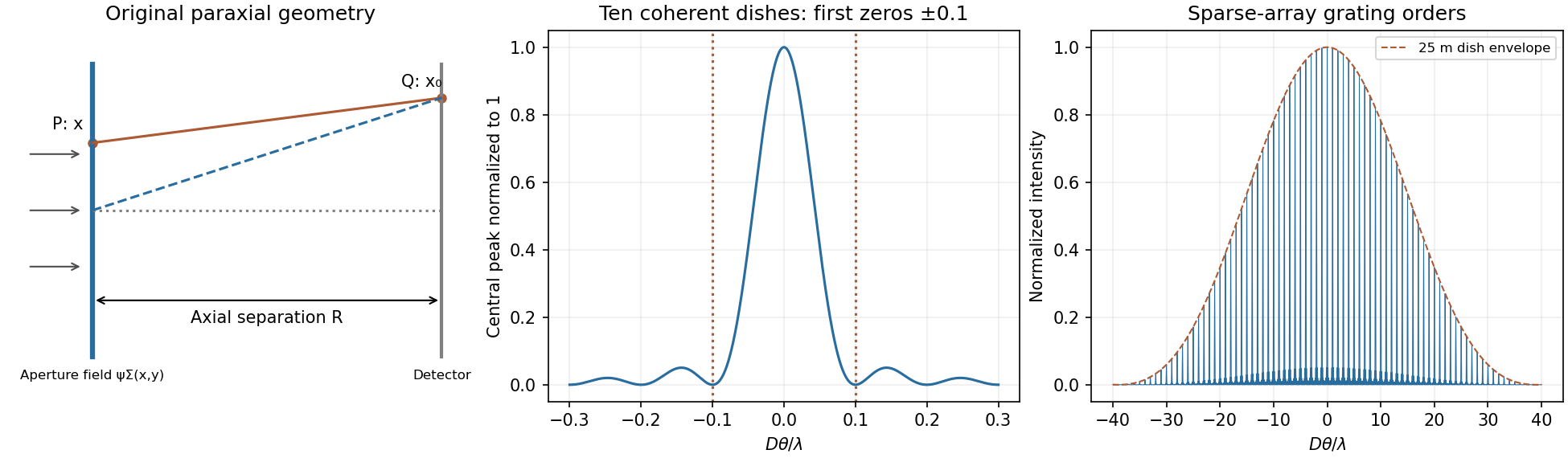
Original labelled Fraunhofer geometry, ten-element central interference lobe and grating orders under a circular-dish envelope
. Details. 
The string speed is . The characteristic impedance is the ratio of the forward-wave transverse force to transverse velocity, . With peak displacement amplitude , the mean power isDisplacement and transverse force are continuous at a massless junction. Since , the displacement amplitudes are and . Taking the incident amplitude real, the light-string motion isIn this standing-and-travelling decomposition of a reflected string wave, the first term travels and the second stands; the decomposition is not a separation into independent incident-power fractions because these fields interfere. The reflected wave has a phase reversal. power coefficients and standing-wave ratio are
For a uniform inserted matching section, unequal exterior impedances require a quarter-wave impedance transformer: and . At equal tension this means middle density and an odd-quarter-wavelength length in that section. Reflections at its two ends then cancel at the design frequency. An arbitrary density or an arbitrary half-wavelength segment cannot perfectly match these unequal exterior strings; the ideal match is frequency-selective.
amplitude scaling along a slowly tapered string instead follows from matching over an adiabatic frequency range. The source fixes frequency, while conserved power and the final characteristic impedance determine amplitude. In the heavy string,Its wave speed halves. The no-reflection approximation needs small fractional characteristic impedance change over each local wavelength, rather than length alone for a taper containing abrupt features.
Articles by others on the same topic
There are currently no matching articles.