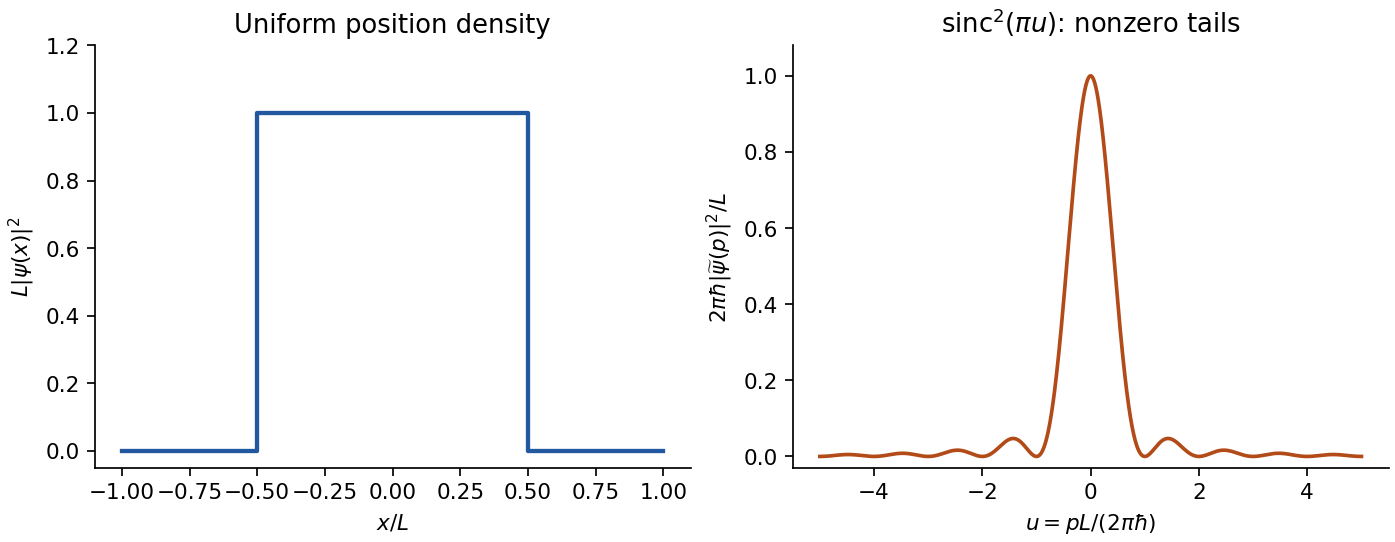
For a normalized top-hat wavefunction of width centred at zero, inside the interval and zero outside. Its position distribution has and . With Fourier convention , the momentum amplitude isThe momentum density has long oscillatory tails. Consequently diverges: the ideal discontinuous top hat has infinite r.m.s. momentum spread. Its symmetric momentum density has formal principal-value mean zero, but no finite absolute first moment either. The finite-variance form is therefore not saturated and cannot be evaluated using the width of the central diffraction lobe as .
The first momentum zeros occur at , showing the inverse-width scale. Smoothing the edges sufficiently gives a finite momentum variance and restores the ordinary finite-variance uncertainty comparison; sharper edges require larger high-momentum components. It is the ideal jump, not a violation of the uncertainty principle, that causes the divergence.

Articles by others on the same topic
There are currently no matching articles.