For a normalized top-hat wavefunction of width centred at zero, inside the interval and zero outside. Its position distribution has and . With Fourier convention , the momentum amplitude isThe momentum density has long oscillatory tails. Consequently diverges: the ideal discontinuous top hat has infinite r.m.s. momentum spread. Its symmetric momentum density has formal principal-value mean zero, but no finite absolute first moment either. The finite-variance form is therefore not saturated and cannot be evaluated using the width of the central diffraction lobe as .
The first momentum zeros occur at , showing the inverse-width scale. Smoothing the edges sufficiently gives a finite momentum variance and restores the ordinary finite-variance uncertainty comparison; sharper edges require larger high-momentum components. It is the ideal jump, not a violation of the uncertainty principle, that causes the divergence.
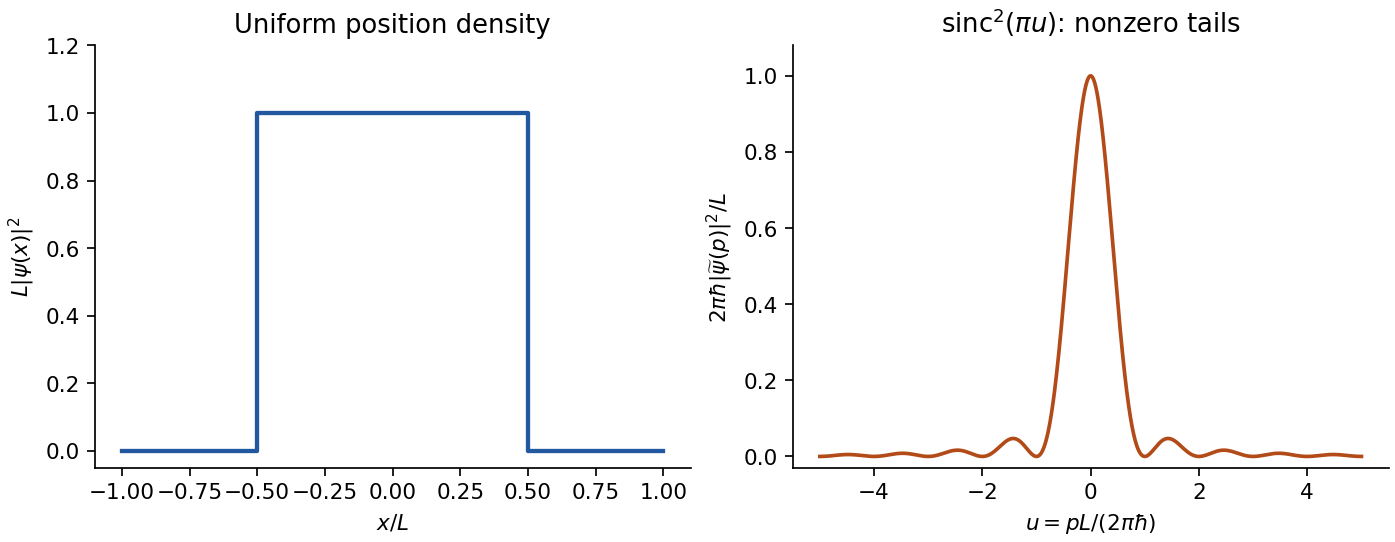
Original top-hat position density and sinc-squared momentum density; the latter has tails giving divergent momentum variance
. Details. 
In a classically forbidden region the local wavevector becomes imaginary. For a slowly varying barrier, the WKB transmission probability has leading exponentialwhere are turning points and is the reduced mass. This is a probability exponent; the wave amplitude has only half that exponent. Near a turning point one uses matching formulas rather than the unmodified local WKB expression.
For alpha decay, an attractive nuclear interior supports a quasibound state behind the repulsive Coulomb barrier of the daughter nucleus. For zero orbital angular momentum, write the exterior potential as , , with nuclear matching radius and outer turning point . The exterior action can be integrated:The decay rate is approximately and the half-life is . Here is the interior assault-frequency scale and is the alpha preformation probability. They are model-dependent; barrier penetration alone does not determine them. Nonzero orbital angular momentum adds a centrifugal barrier.
For , the leading dependence is . Thus a modest increase in decay energy can cause an enormous increase in decay rate, giving the Geiger-Nuttall law relating logarithmic half-life to inverse square-root energy along a suitable isotope sequence. Tunnelling conserves the total energy: the escaping alpha particle does not acquire energy from the barrier.
electron spin is intrinsic angular momentum, independent of an orbital wavefunction's . It has , soA spatial orbital therefore carries a two-component spinor degree of freedom. Noncommuting components do not describe an ordinary vector with simultaneously definite projections; measurements along one axis give only the two allowed values. Even a spherically symmetric orbital retains electron spin.
The associated magnetic moment is with and . A spinor changes sign under a rotation and returns under ; that sign is observable only relative to another coherent amplitude, not as an isolated global phase. A literal classically rotating charged sphere does not account for this fixed half-integer representation, component algebra and spinor rotation law. Classical angular momentum provides useful analogies for torque and precession, but no ordinary classical orientation reproduces the full intrinsic quantum spin structure.
Articles by others on the same topic
There are currently no matching articles.