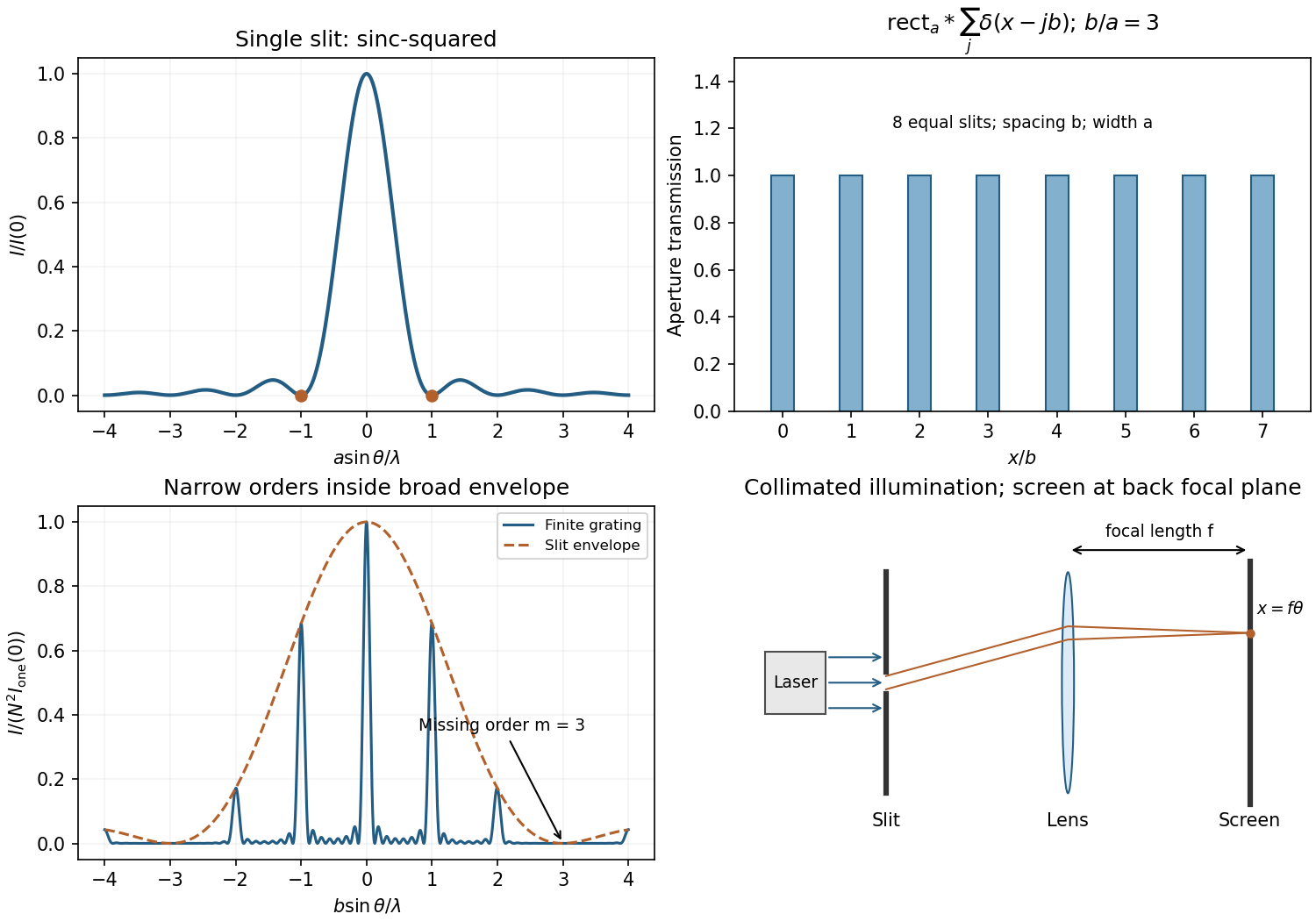
For uniform illumination, the aperture is for and zero otherwise. With ,Zeros occur at , ; the central maximum extends between . A monochromatic laser expanded into a collimated beam can illuminate the slit. A lens with the screen in its back focal plane produces the Fraunhofer pattern; alternatively use a sufficiently distant screen, . Align the slit and beam and avoid detector saturation.
For equally spaced slits, write the aperture as a convolutionThe convolution theorem converts this into a single-slit transform times the finite-array transform. ThereforePrincipal maxima are at for normal incidence, inside the single-slit envelope. Their height scales as times the envelope, and their first zeros are separated from a peak by .
The envelope-to-order-spacing ratio is : increasing it admits more orders within the central envelope and changes the relative order strengths. In particular, an order is missing when is a nonzero integer. Statements about absolute angular spacing need a fixed dimension: at fixed , increasing reduces order spacing; at fixed , decreasing broadens the envelope.
For fixed incident angle, differentiating the grating equation gives an order displacement . Equating this to the peak-to-first-zero width givesHere is the illuminated grating width; this is the ideal Rayleigh limit, before slit width or aberrations broaden the spectral image.
With , the required count is . Thus 932 illuminated slits, or , suffice ideally. Checking diffraction-order feasibility, normal incidence cannot produce this second order because ; an oblique spectrograph geometry is required. A feasible reflection-Littrow example has , or .

Articles by others on the same topic
There are currently no matching articles.