For pendulum length , small angular displacement gives and horizontal restoring force . Thus andFor , the complementary solution and a sinusoidal particular solution giveInitial rest at the origin fixes and , givingAt exact resonance the corresponding limit is ; unrestricted initial conditions add the complementary solution.
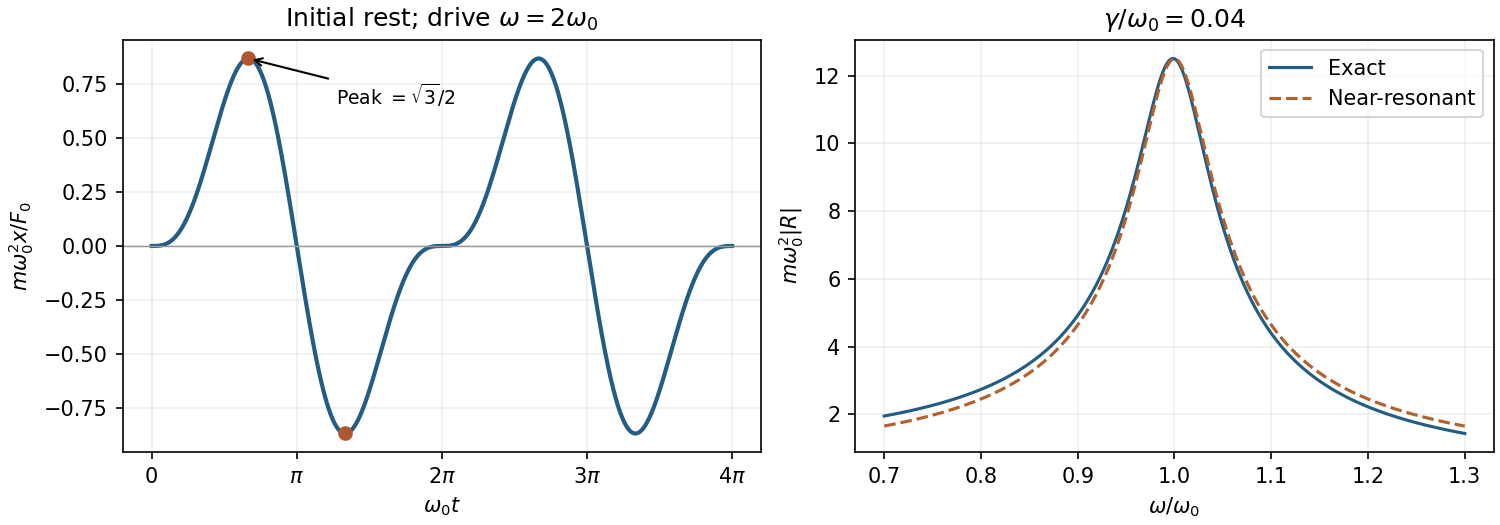
For , set . Then : the period is in , zeros are at integer multiples of , and the first extrema are and . Both initial displacement and slope vanish.
Substitution of the damped complex ansatz gives . HenceFor the near-resonant mechanical susceptibility, put and , and neglect and near resonance:Thus , with angular-frequency full width . The displacement lags the force by at .
Reflection at the fixed edges combines waves with opposite into a transverse standing wave while retaining their common longitudinal propagation factor. The membrane waveguide scalar transverse displacement satisfies the wave equation and vanishes at both edges:The sine gives no displacement. separation of variables givesFor a propagating branch with ,Their product is . The phase velocity can exceed the material wave speed; energy transport follows the group velocity.
At every transverse mode is below cutoff. There is no propagating guided mode in an infinite uniform guide; excitation produces only evanescent penetration. For the slowest-decaying mode write , so under the preceding convention, with , giving a penetration length about .
At modes can propagate. Their positive values are approximately . Mode is a nonpropagating mode at waveguide cutoff: and , so it does not carry longitudinal power as a traveling mode. Higher modes are evanescent. The injected transverse profile determines which permitted modes are actually excited.
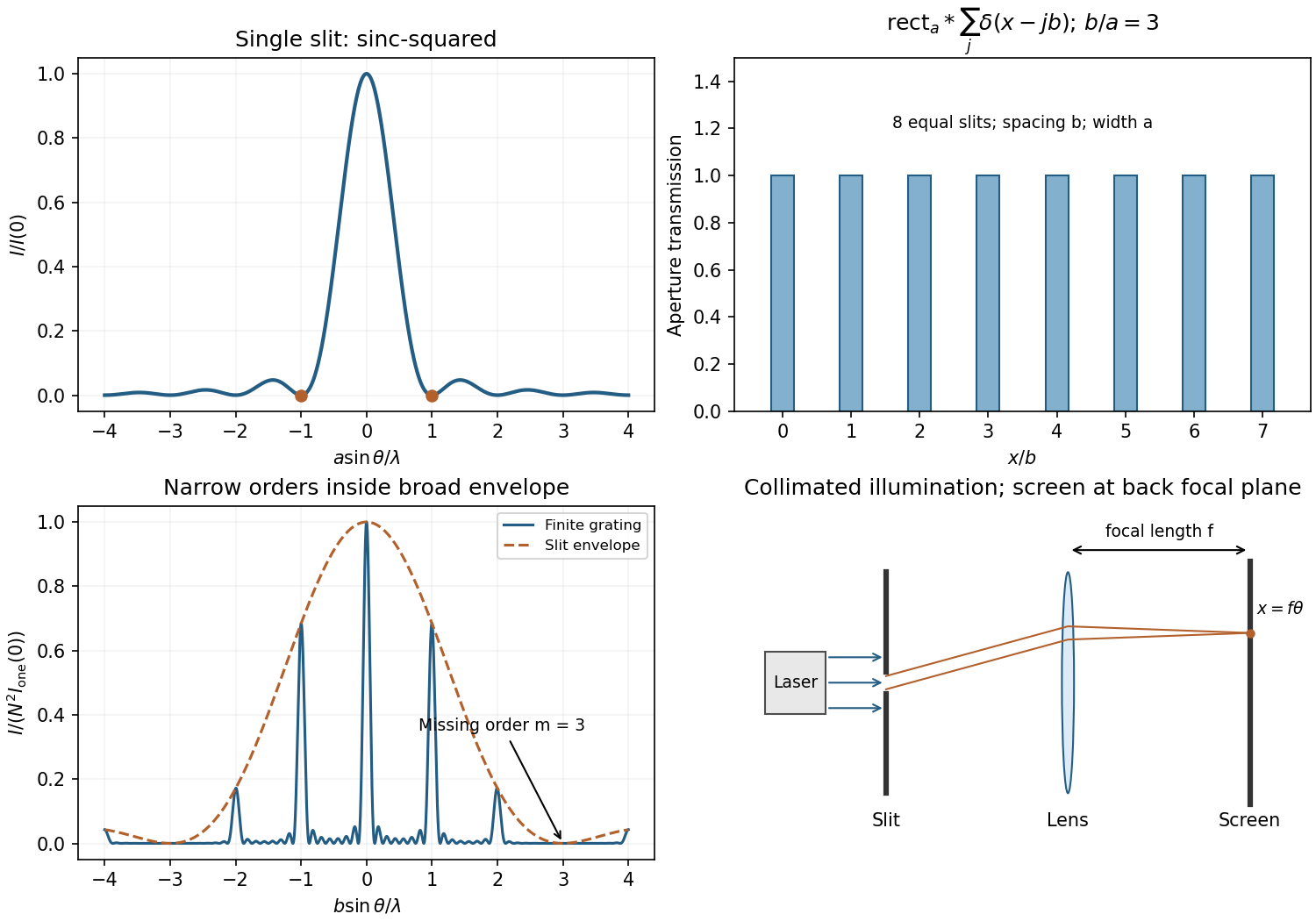
For uniform illumination, the aperture is for and zero otherwise. With ,Zeros occur at , ; the central maximum extends between . A monochromatic laser expanded into a collimated beam can illuminate the slit. A lens with the screen in its back focal plane produces the Fraunhofer pattern; alternatively use a sufficiently distant screen, . Align the slit and beam and avoid detector saturation.
For equally spaced slits, write the aperture as a convolutionThe convolution theorem converts this into a single-slit transform times the finite-array transform. ThereforePrincipal maxima are at for normal incidence, inside the single-slit envelope. Their height scales as times the envelope, and their first zeros are separated from a peak by .
The envelope-to-order-spacing ratio is : increasing it admits more orders within the central envelope and changes the relative order strengths. In particular, an order is missing when is a nonzero integer. Statements about absolute angular spacing need a fixed dimension: at fixed , increasing reduces order spacing; at fixed , decreasing broadens the envelope.
For fixed incident angle, differentiating the grating equation gives an order displacement . Equating this to the peak-to-first-zero width givesHere is the illuminated grating width; this is the ideal Rayleigh limit, before slit width or aberrations broaden the spectral image.
With , the required count is . Thus 932 illuminated slits, or , suffice ideally. Checking diffraction-order feasibility, normal incidence cannot produce this second order because ; an oblique spectrograph geometry is required. A feasible reflection-Littrow example has , or .


For time dependence , a scalar Fresnel-Kirchhoff aperture formula for a point-source amplitude isHere , , and is the obliquity factor, approximately the mean of the incident and outgoing direction cosines measured with the forward aperture normal. The factors describe incident spherical spreading, outgoing spreading and accumulated phase. This is the scalar Kirchhoff aperture approximation; it does not supply an exact electromagnetic edge boundary solution.
In the Fresnel regime, expand path lengths to quadratic order in aperture coordinates while replacing slowly varying amplitude and obliquity factors by their axial values. In the Fraunhofer regime the quadratic aperture phase is negligible, leaving the aperture Fourier transform. For characteristic aperture size , the latter requires in the relevant finite-source geometry; a lens can supply the Fourier-plane configuration.
For the one-dimensional Cornu construction, put on the unobstructed straight ray, with the aperture plane perpendicular at . An element is displaced transversely by , with , where and . A long straight edge or slit makes the other transverse direction separable. Then
For knife-edge diffraction at the fence, the edge is above the direct ray, with , , , and . The unblocked aperture extends upward from , so its Cornu chord runs from to infinity. Using and normalizing by the full unobstructed chord givesThe approximate chord coordinates are , . This is the standard single-knife-edge Fresnel normalization.[ref]
Propagation by diffraction (ITU-R P.526-13) by International Telecommunication Union. Annex 1, Sections 2.7 and 4.1, Fresnel integrals and single knife edge
For geometric spreading in a moving-receiver diffraction measurement, set while retaining and :Normalized transmission decreases toward the fence. Absolute received intensity initially increases, because the free-space spherical-wave intensity rises as source–receiver distance decreases. In this model it reaches a maximum near , then falls. The formal paraxial small- behavior is ; extrapolation to is outside the small-angle approximation. The sketch distinguishes the absolute signal from its ratio to the unobstructed signal at each position.
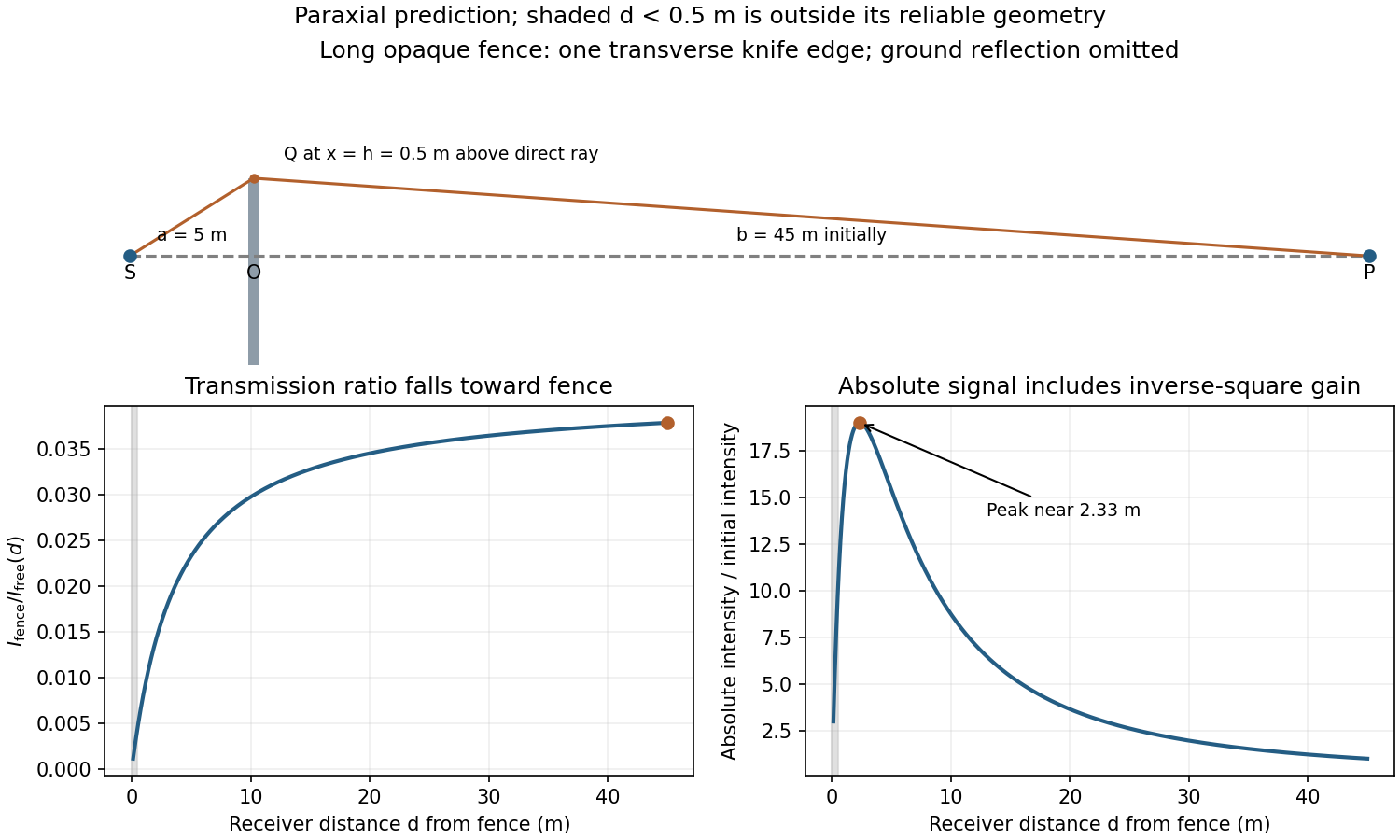
Original knife-edge geometry and distinct absolute-intensity and normalized-transmission predictions
. Details. 
Articles by others on the same topic
There are currently no matching articles.