For a diffraction-limited circular aperture, the Rayleigh criterion gives . The photon wavelength is , hence . This assumes adequate optical quality and sampling; being in space removes atmospheric seeing, not diffraction.
For a lossless single interface at normal incidence, and the Fresnel equations give , taking air's refractive index as one. Selecting the glass branch givesThe reciprocal root is the mathematical lower-index branch, not ordinary glass.
The power linewidth is . Fourier frequency resolution is of order , so , and preferably longer to distinguish the intrinsic linewidth from the observation-window width. zero padding does not improve this physical resolution. A freely decaying signal also needs sufficient microphone dynamic range.
The mean energy of a two-dimensional Fermi gas follows from its constant density of states for nonrelativistic quadratic dispersion. At zero temperature, states below are filled, so
Translating a scattering centre by any lattice translation changes the scattered amplitude by , up to the immaterial overall sign convention. constructive interference requires times an integer. Applying this to yieldsThus lies in the reciprocal lattice. elastic scattering additionally requires ; not every reciprocal vector is accessible for a fixed incident beam.
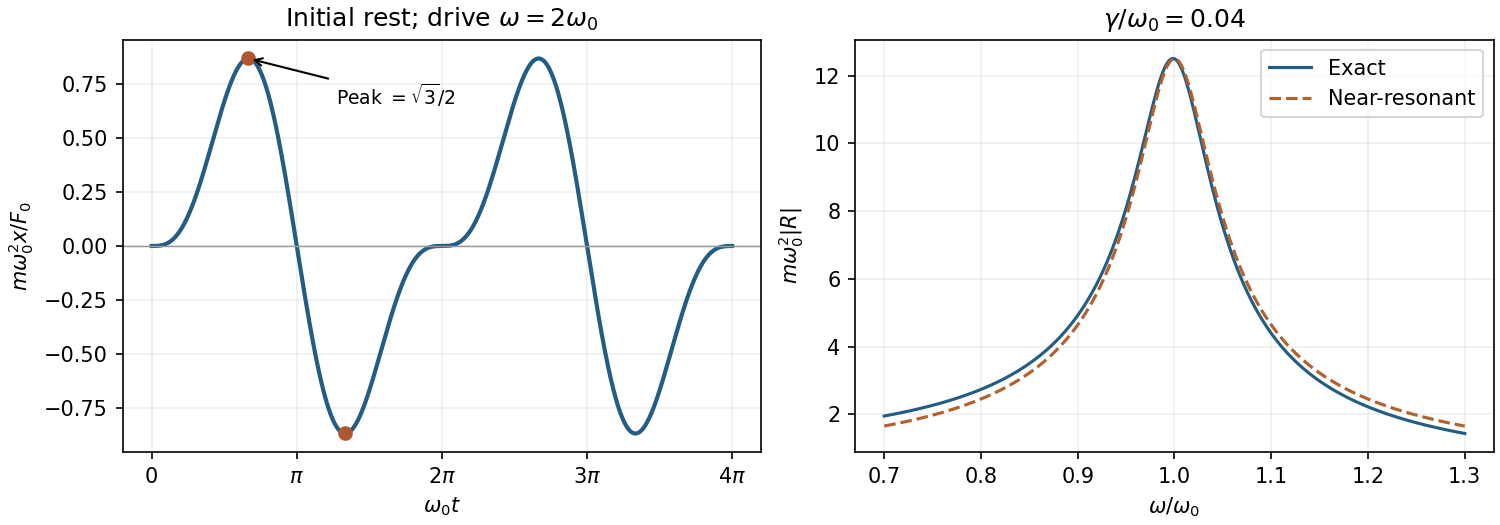
For pendulum length , small angular displacement gives and horizontal restoring force . Thus andFor , the complementary solution and a sinusoidal particular solution giveInitial rest at the origin fixes and , givingAt exact resonance the corresponding limit is ; unrestricted initial conditions add the complementary solution.
For , set . Then : the period is in , zeros are at integer multiples of , and the first extrema are and . Both initial displacement and slope vanish.
Substitution of the damped complex ansatz gives . HenceFor the near-resonant mechanical susceptibility, put and , and neglect and near resonance:Thus , with angular-frequency full width . The displacement lags the force by at .
Reflection at the fixed edges combines waves with opposite into a transverse standing wave while retaining their common longitudinal propagation factor. The membrane waveguide scalar transverse displacement satisfies the wave equation and vanishes at both edges:The sine gives no displacement. separation of variables givesFor a propagating branch with ,Their product is . The phase velocity can exceed the material wave speed; energy transport follows the group velocity.
At every transverse mode is below cutoff. There is no propagating guided mode in an infinite uniform guide; excitation produces only evanescent penetration. For the slowest-decaying mode write , so under the preceding convention, with , giving a penetration length about .
At modes can propagate. Their positive values are approximately . Mode is a nonpropagating mode at waveguide cutoff: and , so it does not carry longitudinal power as a traveling mode. Higher modes are evanescent. The injected transverse profile determines which permitted modes are actually excited.
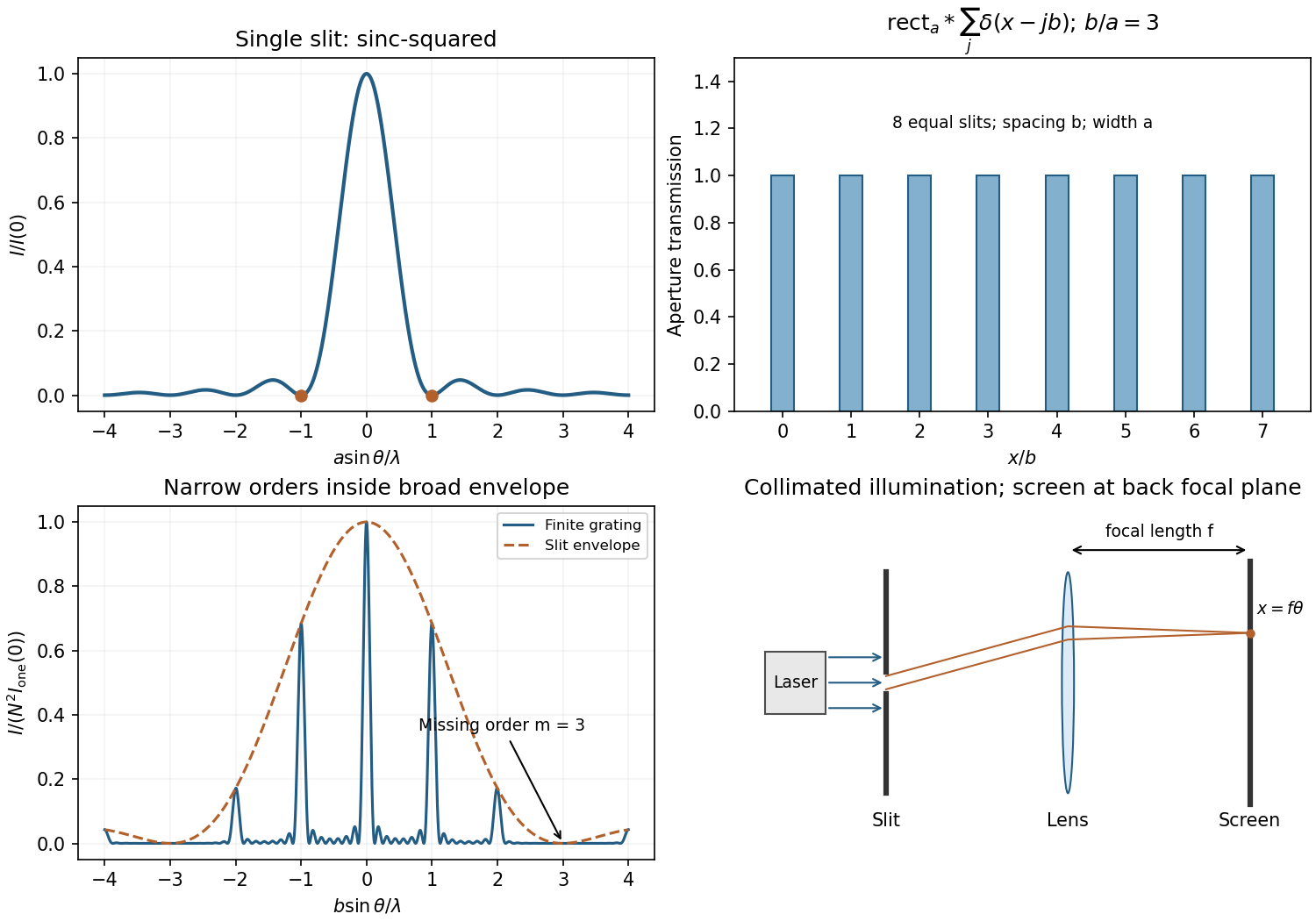
For uniform illumination, the aperture is for and zero otherwise. With ,Zeros occur at , ; the central maximum extends between . A monochromatic laser expanded into a collimated beam can illuminate the slit. A lens with the screen in its back focal plane produces the Fraunhofer pattern; alternatively use a sufficiently distant screen, . Align the slit and beam and avoid detector saturation.
For equally spaced slits, write the aperture as a convolutionThe convolution theorem converts this into a single-slit transform times the finite-array transform. ThereforePrincipal maxima are at for normal incidence, inside the single-slit envelope. Their height scales as times the envelope, and their first zeros are separated from a peak by .
The envelope-to-order-spacing ratio is : increasing it admits more orders within the central envelope and changes the relative order strengths. In particular, an order is missing when is a nonzero integer. Statements about absolute angular spacing need a fixed dimension: at fixed , increasing reduces order spacing; at fixed , decreasing broadens the envelope.
For fixed incident angle, differentiating the grating equation gives an order displacement . Equating this to the peak-to-first-zero width givesHere is the illuminated grating width; this is the ideal Rayleigh limit, before slit width or aberrations broaden the spectral image.
With , the required count is . Thus 932 illuminated slits, or , suffice ideally. Checking diffraction-order feasibility, normal incidence cannot produce this second order because ; an oblique spectrograph geometry is required. A feasible reflection-Littrow example has , or .


For time dependence , a scalar Fresnel-Kirchhoff aperture formula for a point-source amplitude isHere , , and is the obliquity factor, approximately the mean of the incident and outgoing direction cosines measured with the forward aperture normal. The factors describe incident spherical spreading, outgoing spreading and accumulated phase. This is the scalar Kirchhoff aperture approximation; it does not supply an exact electromagnetic edge boundary solution.
In the Fresnel regime, expand path lengths to quadratic order in aperture coordinates while replacing slowly varying amplitude and obliquity factors by their axial values. In the Fraunhofer regime the quadratic aperture phase is negligible, leaving the aperture Fourier transform. For characteristic aperture size , the latter requires in the relevant finite-source geometry; a lens can supply the Fourier-plane configuration.
For the one-dimensional Cornu construction, put on the unobstructed straight ray, with the aperture plane perpendicular at . An element is displaced transversely by , with , where and . A long straight edge or slit makes the other transverse direction separable. Then
For knife-edge diffraction at the fence, the edge is above the direct ray, with , , , and . The unblocked aperture extends upward from , so its Cornu chord runs from to infinity. Using and normalizing by the full unobstructed chord givesThe approximate chord coordinates are , . This is the standard single-knife-edge Fresnel normalization.[ref]
Propagation by diffraction (ITU-R P.526-13) by International Telecommunication Union. Annex 1, Sections 2.7 and 4.1, Fresnel integrals and single knife edge
For geometric spreading in a moving-receiver diffraction measurement, set while retaining and :Normalized transmission decreases toward the fence. Absolute received intensity initially increases, because the free-space spherical-wave intensity rises as source–receiver distance decreases. In this model it reaches a maximum near , then falls. The formal paraxial small- behavior is ; extrapolation to is outside the small-angle approximation. The sketch distinguishes the absolute signal from its ratio to the unobstructed signal at each position.
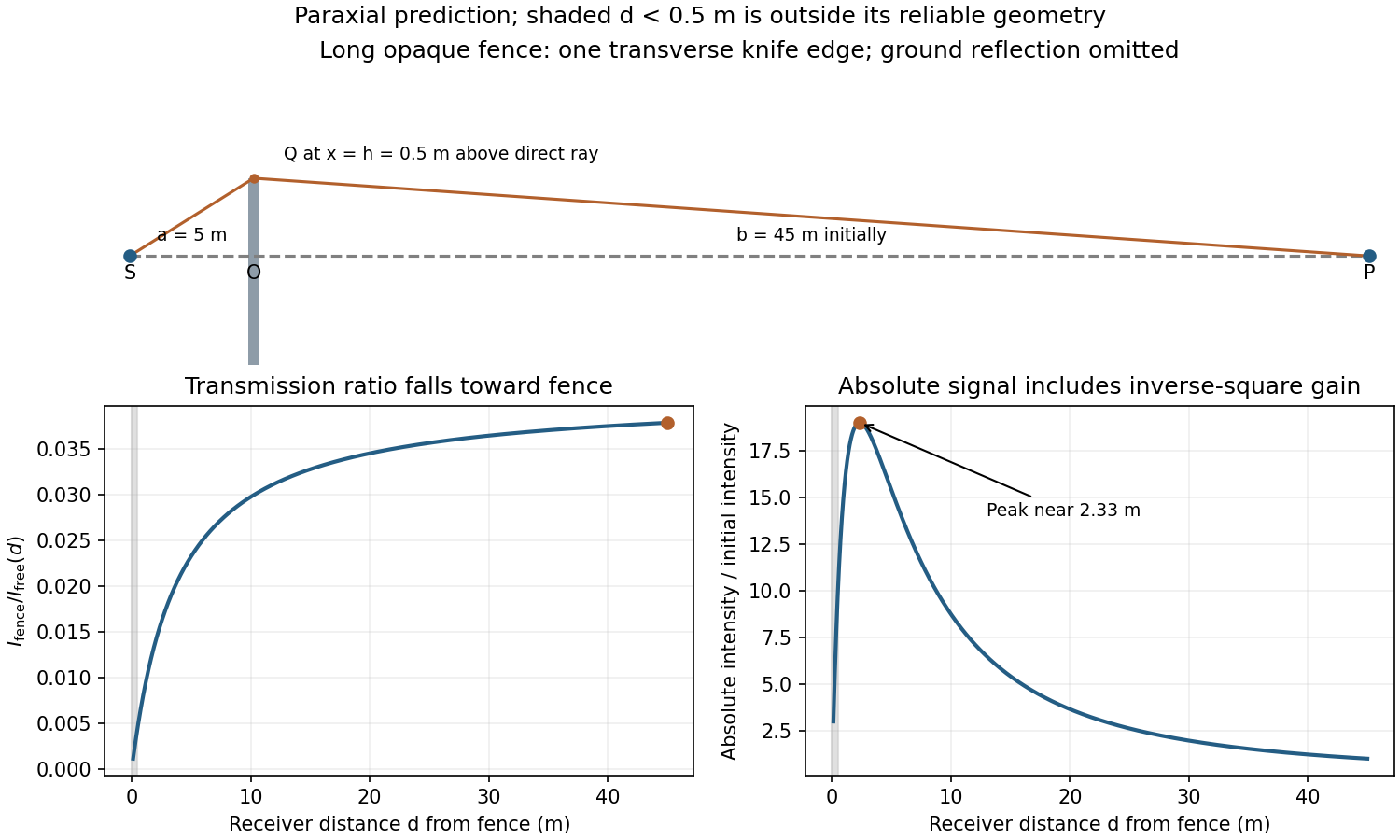
Original knife-edge geometry and distinct absolute-intensity and normalized-transmission predictions
. Details. 
The Pauli exclusion principle confines thermally excited conduction electrons to an energy interval of order around the Fermi surface. Their excess energy is therefore proportional to , giving an electronic heat capacity . More precisely, . In a three-dimensional Debye model, acoustic phonons have density of states proportional to ; their thermal energy scales as , givingper mole of atoms. This assumes a normal metal without a lower-temperature superconducting or magnetic anomaly.
For , the lattice approaches the Dulong-Petit value, so , usually dominated by . Each classical vibrational mode contributes through kinetic and potential equipartition. This is a high-temperature solid-state regime, not a claim that the solid persists to arbitrarily high temperature; anharmonicity and can matter.
The body-centred cubic cell has two atoms, so . Counting three acoustic branches gives . By the Debye-temperature definition,This is an effective Debye sound speed; separate longitudinal and transverse speeds are not determined. For isotropic branches, .
The first Brillouin zone is . For one atom per primitive cell and two spin states, a monovalent free-electron gas hasIts circular Fermi surface lies inside the zone and encloses half its area: a partially filled band is conducting. Here odd filling obstructs a spin-degenerate band insulator: a monovalent band insulator is impossible in this spin-degenerate one-atom independent-electron model. It would require changed premises, such as unit-cell enlargement or physics beyond the free-electron picture; no insulating free-electron contour should be invented.
For divalent atoms, . The circle has the same area as the first Brillouin zone but crosses its faces and leaves its corners unfilled. Thus the free-electron case remains conducting: filling capacity alone does not remove band overlap. A nearly free-electron conductor has reconstructed electron and hole pockets; a divalent band insulator instead has one completely filled band separated from all higher bands, with no Fermi surface in the gap.
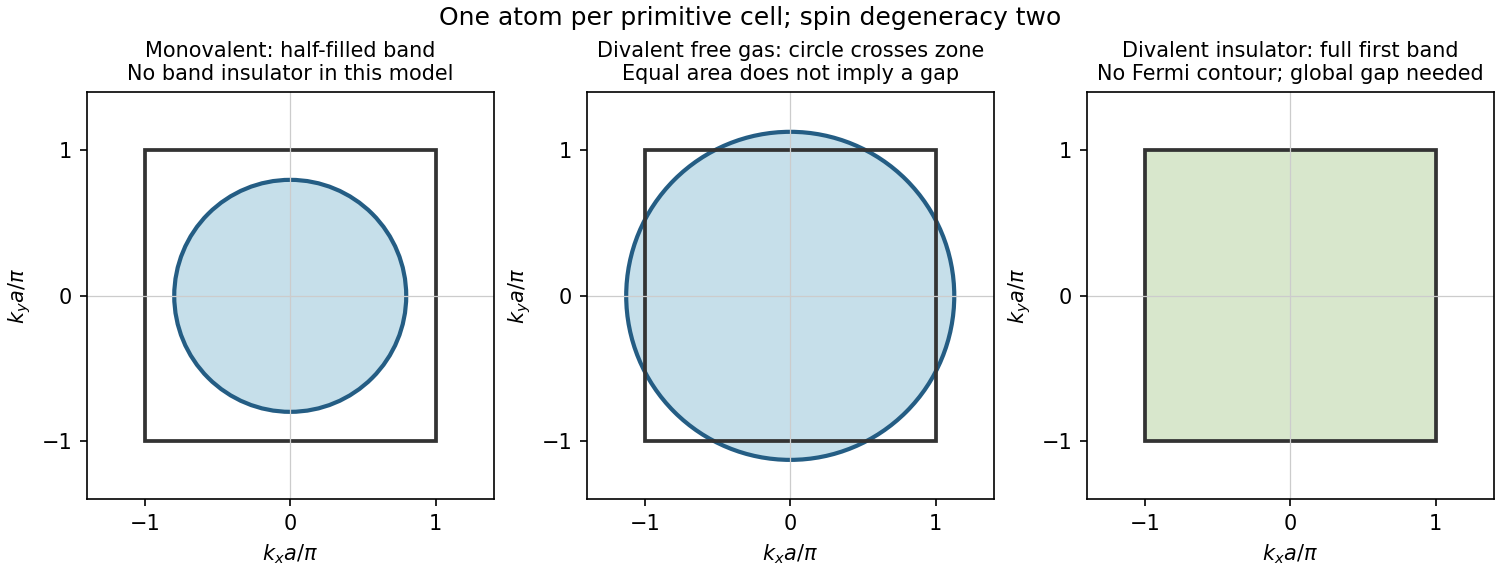
Original square-zone state counting, monovalent and divalent free contours, and insulating band filling
. Details. 
For two electrons per primitive cell,Set . In the indirect gap in a uniformly split zone-boundary model approximation stipulated here, the free boundary energies are along at and along at . Opening a symmetric gap givesThe branches bend away from the free-electron crossings and flatten at their boundary extrema. Importantly, the upper band near lies below the lower band's corner energy:Therefore the crystal is metallic despite its positive boundary gaps; electron and hole occupations redistribute across overlapping bands. positive direct gaps can coexist with band overlap.
A microscopic square-lattice corner has additional plane-wave degeneracy. The quoted symmetric boundary numbers use the question's directional gap model, not an unspecified four-state corner Hamiltonian. For the indirect gap of a separable square cosine potential, a separable weak potential with the same face gap gives the lowest corner energy , still above the upper-band face energy. This refinement preserves the metallic conclusion.
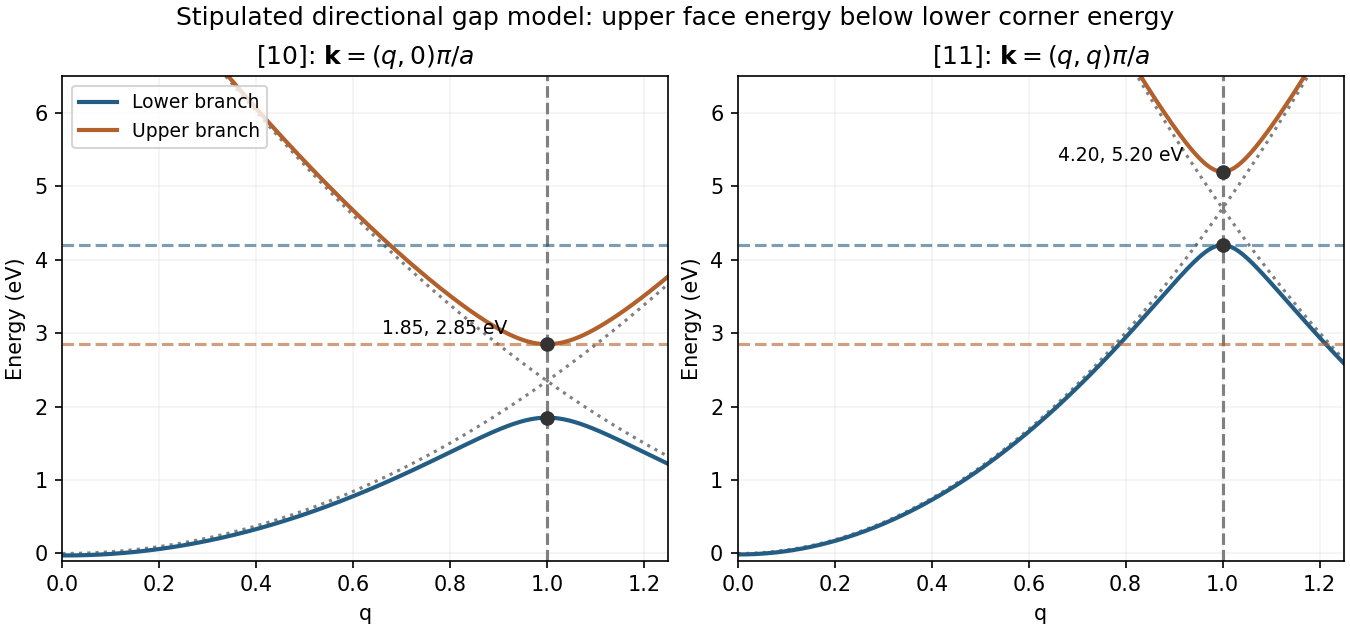
Original directional avoided crossings and the overlap of lower- and upper-band boundary energies
. Details. 
For a plane sound wave, acoustic impedance is , with pressure amplitude and particle-velocity amplitude . Continuity of pressure and normal velocity at normal incidence on a lossless interface givesMatching eliminates reflection. A quarter-wave intermediate layer with transforms the load to the source impedance at its design frequency; its bandwidth is limited. For strings, the analogous mechanical impedance is transverse force divided by velocity, ; continuity of displacement and transverse force gives the corresponding matching condition. These amplitudes use different force/velocity conventions from acoustic pressure, so reflection signs must be stated consistently.
Reflections from the two film surfaces interfere with propagation phase plus the relative reflection phase. Reflection from a lower to a higher refractive index contributes a phase reversal. For a higher-index film surrounded by air there is one relative reversal, henceThickness or angle variation therefore produces fringes or colours under broadband illumination. An antireflection coating between indices instead uses, at normal incidence, and : the two reflected amplitudes then cancel at the design wavelength. Absorption, polarization, unequal amplitudes and multiple reflections determine the full contrast.
A Michelson interferometer divides light at a beam splitter, sends it to two mirrors, and recombines the returned beams. A compensating plate can equalize glass traversal. For approximately axial rays the optical path difference is , plus fixed instrument phase, andfor coherent, mode-matched fields. Moving one mirror by in air changes the round-trip path by , so one fringe corresponds to mirror motion. It measures displacement, wavelength and refractive-index changes; scanning the delay enables Fourier-transform spectroscopy. Mirror alignment, polarization overlap, vibration and source coherence control visibility. A finite coherence length limits useful arm mismatch.
Donor doping supplies conduction electrons to n-type semiconductor; acceptor doping supplies holes to p-type semiconductor. In the nondegenerate, fully ionized limit, majority densities are approximately and , while minority densities follow . On contact, majority carriers diffuse across the junction, exposing positive donor ions on the n side and negative acceptor ions on the p side. The depletion-region electric field points from n to p and opposes further diffusion. At thermal equilibrium the Fermi level is uniform and drift balances diffusion, with no net current.
For an abrupt junction with uniform doping and permittivity , charge neutrality gives . Poisson's equation then givesPositive applied means forward bias: it lowers the barrier and narrows the depletion region. Most depletion width lies in the more lightly doped side. The formula assumes the depletion approximation and fails once its operating assumptions break down.
forward bias increases minority densities at the depletion edges by the factor . In the neutral material, the steady diffusion–recombination equation gives exponentially decaying excess minorities, with lengths and . Taking the carrier gradients at the junction yieldsThis ideal diode law assumes low injection, nondegenerate statistics, negligible depletion-region recombination and series resistance, and sufficiently long neutral regions. Its exponential comes from the bias-dependent injection barrier; there is no universal abrupt “turn-on” voltage. reverse bias suppresses injection, giving an approximate current until additional leakage or breakdown matters.[ref]
The Theory of p-n Junctions in Semiconductors and p-n Junction Transistors by William Shockley. Bell System Technical Journal 28, pp. 435–489, minority-carrier injection and rectifying-junction theory
Rectification uses the asymmetric current-voltage characteristic; controlled reverse breakdown enables voltage references, with current limiting. Bias-dependent depletion capacitance enables varactors. photodiodes and solar cells collect optically generated carriers through the junction field and diffusion toward it; efficient light-emitting diodes use radiative electron–hole recombination, preferably in a direct-gap material. Series resistance, high injection, trap-assisted recombination, heating and finite carrier storage explain departures from the ideal steady-state law.
Articles by others on the same topic
There are currently no matching articles.