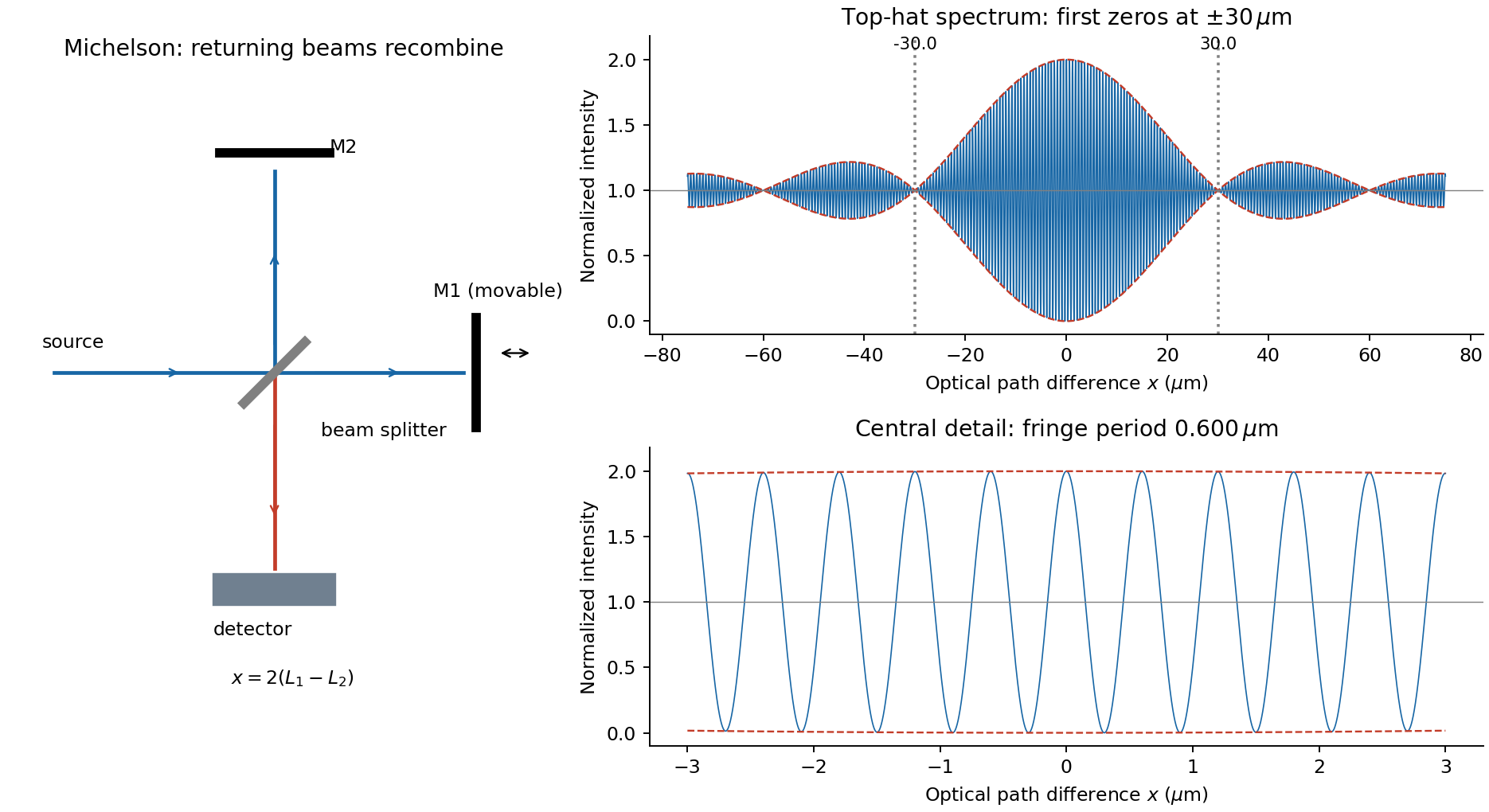
A Michelson interferometer divides a source beam at a partially reflecting beam splitter. The two perpendicular arms terminate in mirrors whose reflected beams return to the splitter and overlap at the detector. The recombined fields must have overlapping wavefronts and compatible polarization of waves. Moving one mirror by changes the round-trip optical path difference by , so passing fringes determine . Conversely a known mirror displacement measures wavelength. Scanning the delay can determine temporal optical coherence and, by Fourier transform spectroscopy, spectral structure. A compensating plate may equalize glass traversal, particularly for broadband illumination.

For equal real peak field amplitudes, the superposition isTime averaging the square over many optical cycles gives . With after absorbing a constant port-dependent phase into the zero of ,Here is the sum of the two separate-arm intensities; maximum intensity is and the ideal minimum is zero. Equal amplitudes give unit interference visibility.
For a stationary source with a flat intensity spectrum, different spectral components add in time-averaged intensity. Keeping their individual two-arm interference terms and defining givesOne must not coherently add unrelated source frequencies as if they had a fixed common phase. The sinc envelope is the Fourier transform of the rectangular spectral intensity.
Numerically, and . The annotated interferogram usesIt is even in , has central value 2 and background 1, and its carrier-fringe period in optical path difference is . The first envelope zeros are at , corresponding to mirror shifts of from equal paths. Side lobes persist beyond the zeros; a negative sinc reverses fringe phase. The intensity remains between and , not between the signed sinc curves with an assumed fixed ordering.
Articles by others on the same topic
There are currently no matching articles.