Take , and define and . Substitution of into the unforced equation gives . The roots determine whether the return is oscillatory.
For return after a displacement in this ideal model, critical damping, case (b), is the usual comfort choice: it removes repeated bouncing while avoiding the slow relaxation mode of strong overdamping. For release from rest it gives a monotone return with the fastest asymptotic decay available without oscillation. This criterion does not prove optimal comfort for every road profile or initial velocity; actual comfort also depends on acceleration, road forcing and suspension travel.
For the forced response, set and use . ThenThe general forced solution adds the appropriate homogeneous transient from (a), (b) or (c). Initial data were not specified, so its constants cannot be fixed. Positive damping removes this transient at long times. This solution uses the particular driving force in the supplied equation; it does not silently replace it by a different moving-support model.
Maximising is minimising its squared denominator . Differentiation givesA nonzero displacement resonance exists only if . Here , and thereforeThe low-frequency limit is , whereas at large . The parameters give damping ratio , consistent with an underdamped system and the existence of this amplitude maximum.
For , define . The two characteristic roots are real and negative:This is overdamping: there is no repeated oscillation, and the slow root controls late-time return. A generic initial velocity can still cause a single crossing of equilibrium, so “nonoscillatory” need not mean monotone for all initial data. For large , the slow root approaches .
For , the repeated characteristic root requires a second linearly independent solution :This is critical damping. If and , then , demonstrating the monotone return used in the suspension discussion.
For , put . Complex-conjugate roots give the real solutionThis is underdamping: oscillation at persists within a decaying exponential envelope. damping reduces the oscillation frequency below . Constants in all three cases are determined by two initial conditions.
For a monochromatic wave, a constant phase moves at phase velocity . For a narrow wave packet around , expansion shows that its envelope moves at group velocity . The envelope interpretation requires a sufficiently narrow spectrum and weak distortion; it is not a general identification with a causal signal front. Since and ,For the gravity-capillary wave, put and take . Direct differentiation givesThus when , orAt this wavelength the gravity and surface-tension restoring terms contribute equally. Also with positive second derivative: this is the minimum phase speed of a gravity-capillary wave, . Locally the carrier crests and narrow envelope travel together. The medium has not become nondispersive: there, so a finite wave packet can still spread. In the gravity-dominated limit ; in the capillary-dominated limit it tends to .
Take the aperture in and the observation point , with . Under scalar diffraction theory, the Huygens-Fresnel principle sums complex amplitudes from area elements, rather than summing their intensities. Apart from a common normalization,Here is the complex aperture transmission, is the axial distance, and is the angle of the secondary ray to the aperture normal. The obliquity factor describes the direction dependence of the secondary contribution; one Kirchhoff convention is for normal illumination. Other scalar boundary approximations have slightly different angular weights, all tending to unity near the axis.
Put . The paraxial approximation gives in the phase and in the amplitude. Removing common yieldsAssumptions are uniform normally incident plane-wave illumination, coherent monochromatic propagation, aperture dimensions large enough for the scalar description, , and phase accuracy over the relevant aperture. The last condition justifies dropping the quartic distance term; geometric smallness alone does not guarantee phase accuracy.
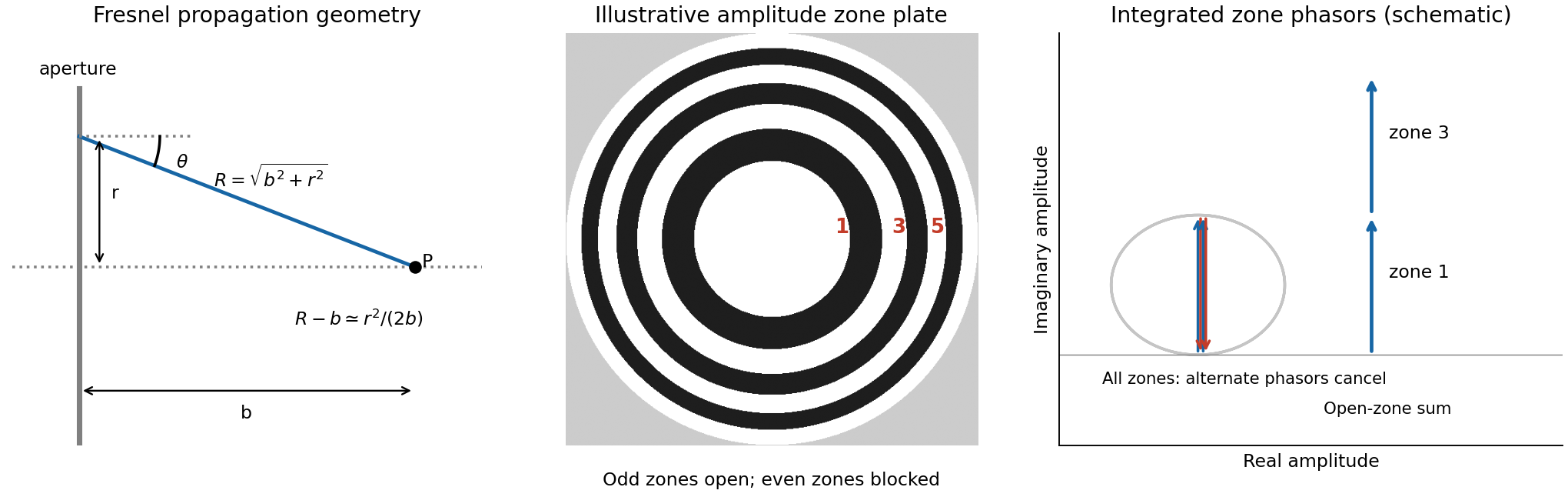
For a circular aperture, for and zero elsewhere. Rotational symmetry and give , , andThe constant can be absorbed into the proportionality factor, producing the required one-dimensional integral.
At a focus a distance away, half-period-zone boundaries obeyWith slowly varying obliquity and illumination, each zone has almost the same area and its integrated phasor has the opposite sign to its neighbour. A zone plate blocks alternate zones, so the remaining phasors add instead of nearly cancelling. Choosing an open central zone, the first three open regions have outer boundaries :These are outer radii, not zone widths; the second open region is the annulus between and .
For the specified outer radius, : there are approximately 49 half-period zones, of which 25 odd zones are open. Normalize to the field of the unobstructed plane wave. The normalized Fresnel aperture integral isFor any odd open annulus this gives , so the whole plate gives andThe axial intensity gain of an amplitude zone plate grows as the square of the number of open zones. Treating the number of zones continuously gives , the same accuracy as an estimate. This large local intensity gain is consistent with conservation of energy because light is concentrated into a small focal spot. It is not a power efficiency; the ideal first-order power efficiency of a binary amplitude zone plate is only .[ref]
Zone Plates by Janos Kirz and David Attwood. X-Ray Data Booklet, §4.4, first-order efficiency paragraph
“Without the zone plate” has here meant removing the finite plate and its outer stop, giving the unobstructed incident wave. If instead a clear circular aperture of radius is retained, its axial field is , so the ratio to that finite-aperture reference is . The two reference experiments differ; neither ratio should be confused with total transmitted power.
A Michelson interferometer divides a source beam at a partially reflecting beam splitter. The two perpendicular arms terminate in mirrors whose reflected beams return to the splitter and overlap at the detector. The recombined fields must have overlapping wavefronts and compatible polarization of waves. Moving one mirror by changes the round-trip optical path difference by , so passing fringes determine . Conversely a known mirror displacement measures wavelength. Scanning the delay can determine temporal optical coherence and, by Fourier transform spectroscopy, spectral structure. A compensating plate may equalize glass traversal, particularly for broadband illumination.
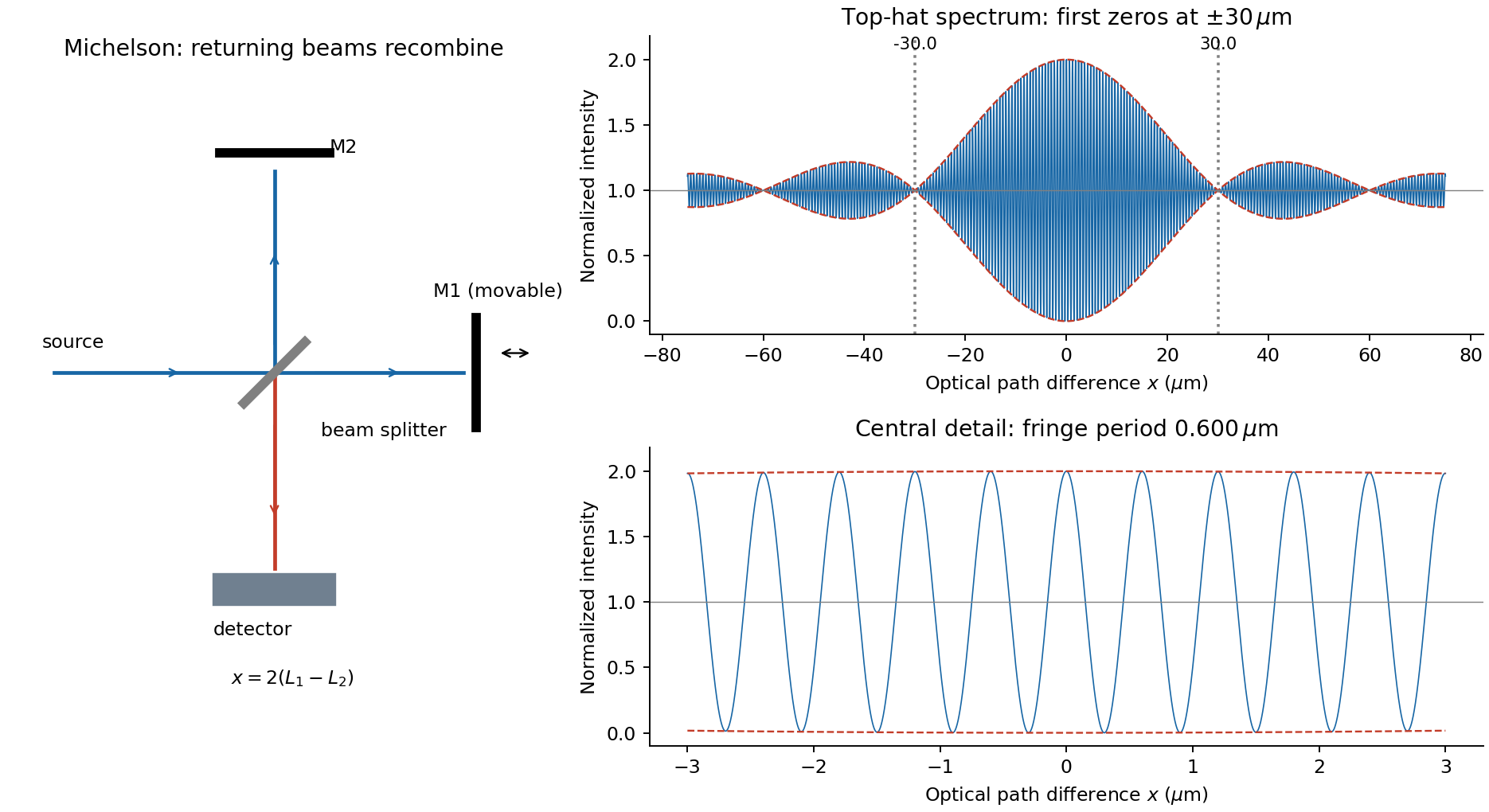


For equal real peak field amplitudes, the superposition isTime averaging the square over many optical cycles gives . With after absorbing a constant port-dependent phase into the zero of ,Here is the sum of the two separate-arm intensities; maximum intensity is and the ideal minimum is zero. Equal amplitudes give unit interference visibility.
For a stationary source with a flat intensity spectrum, different spectral components add in time-averaged intensity. Keeping their individual two-arm interference terms and defining givesOne must not coherently add unrelated source frequencies as if they had a fixed common phase. The sinc envelope is the Fourier transform of the rectangular spectral intensity.
Numerically, and . The annotated interferogram usesIt is even in , has central value 2 and background 1, and its carrier-fringe period in optical path difference is . The first envelope zeros are at , corresponding to mirror shifts of from equal paths. Side lobes persist beyond the zeros; a negative sinc reverses fringe phase. The intensity remains between and , not between the signed sinc curves with an assumed fixed ordering.
Articles by others on the same topic
There are currently no matching articles.