A non-ideal amplifier is not specified by infinite input impedance alone: its open-loop gain and output impedance must also be modeled. Take its internal controlled output to be , where is the inverting-input potential, and place a resistance between and the actual output . The non-inverting input remains grounded; assume no external load. This gives an explicit finite-gain operational-amplifier integrator model.
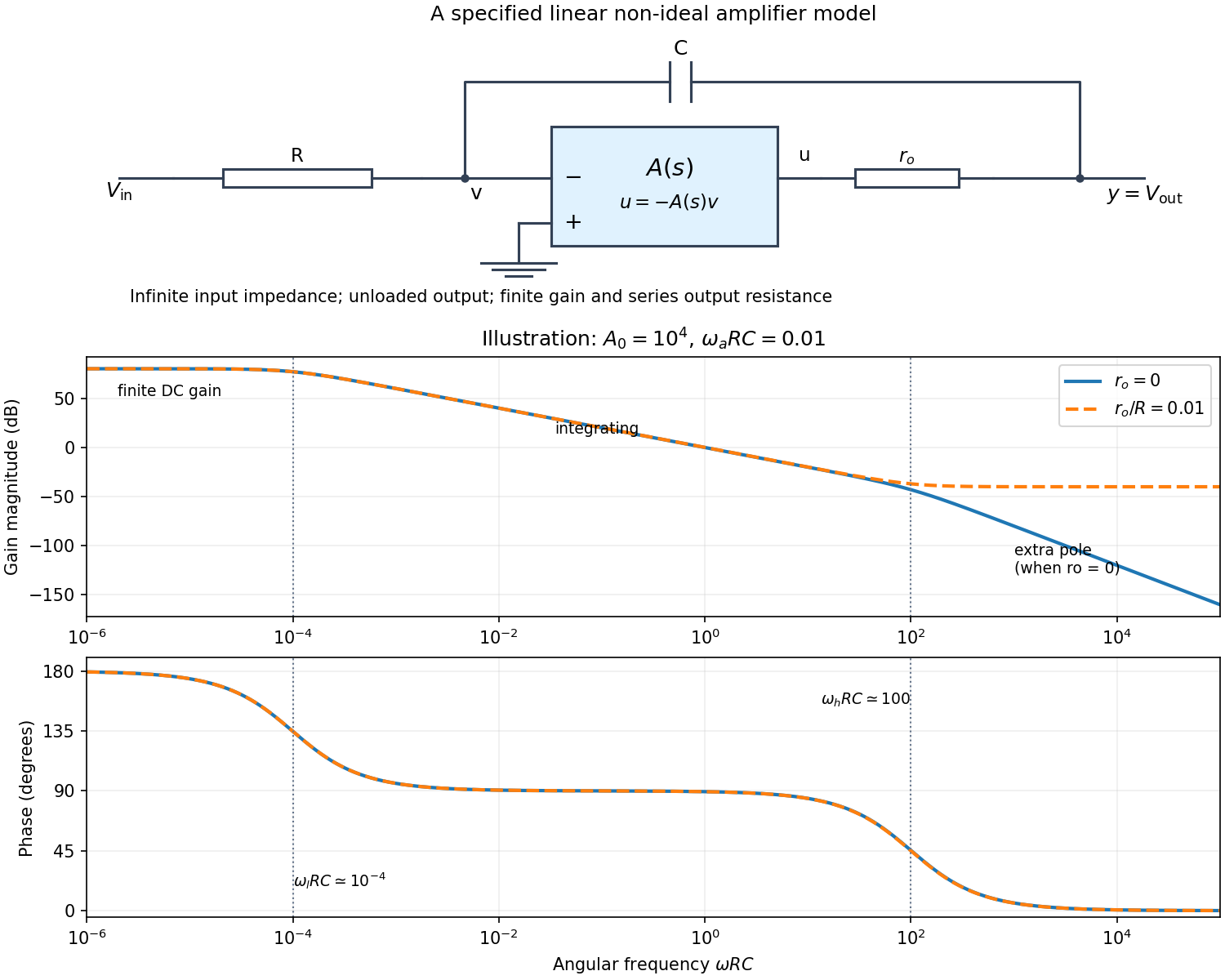

Writing Kirchhoff's current law at the input and output nodes givesThe second equation gives . Substitution in the first gives the general transfer functionFor sinusoidal phasors, set . The numerator and denominator are complex, so the magnitude gives the amplitude ratio and their arguments give the relative phase.
The simplest model takes and a constant finite gain . It givesThus below the amplifier has gain magnitude and inversion. Above that frequency it approaches an integrator with magnitude and phase . Constant finite gain by itself predicts no further high-frequency turnover.
For a more realistic sketch, use the standard dominant-pole open-loop gain , still with . ThenThe exact frequency response isAssuming and , the turnover frequencies are well separated: and , the approximate unity-gain angular frequency of the amplifier. The regimes arewith magnitude slopes per decade and smooth phase transitions. This is the solid curve in the figure; and denote the same phase.
If finite is retained and , the general expression instead approaches at very high frequency: the capacitor couples the input to the output through a passive voltage divider. The dashed curve illustrates that eventual feedthrough. Other amplifier poles or an external load would alter the response again. No particular values of are given in the paper, so the numerical sketch is illustrative and the general expression states the model dependence explicitly.
Articles by others on the same topic
There are currently no matching articles.