A bubble is a thin water layer surrounded by air. At a locally flat patch, let its thickness be , its refractive index be , and the internal angle of refraction be . The two principal reflected light contributions are the reflection at the first surface and the contribution that enters the layer, reflects at its second surface and leaves again. The first reflection, from lower to higher refractive index, introduces a phase shift; the second does not. Their optical path difference is , so their phase difference is, modulo ,where is the vacuum wavelength. Constructive interference in reflected light therefore occurs approximately whenDestructive interference occurs at . In the weak-reflection approximation, the reflected light intensity at each wavelength is proportional to . This is a smooth spectral filter, with broad maxima and minima: it does not select three pure wavelengths corresponding to display primaries. Ordinary illumination contains many visible wavelengths, and the eye combines their remaining contributions through color vision. The result is a mixture of colours, often pastel or desaturated.
The layer thickness varies over the bubble because of drainage and flow; the bubble's curvature also changes the local angle of refraction and the viewed optical path difference. The spectral filter therefore changes continuously across the surface and in time. Very thin regions become dark because the two reflected contributions nearly cancel across the visible optical spectrum. Thin-film interference explains both the changing colours and this dark limit.
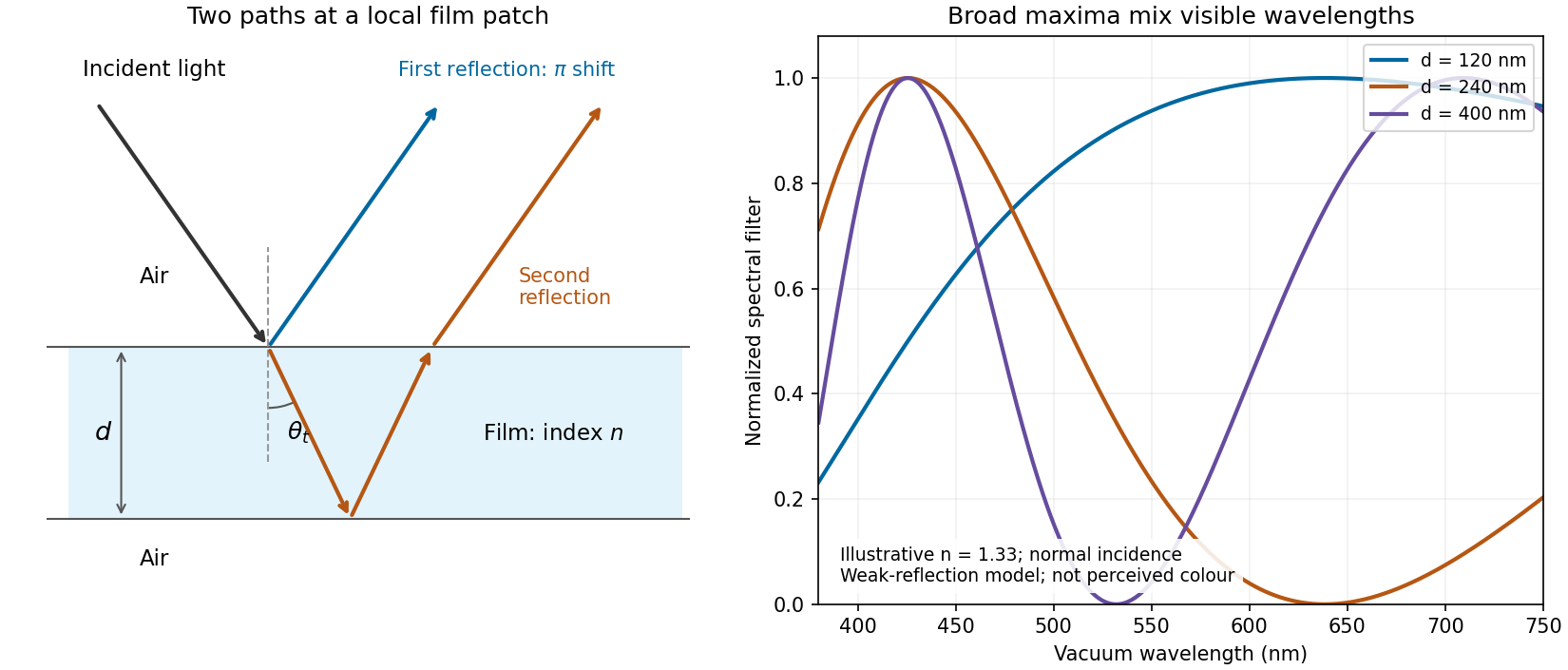
Two reflected paths through a thin film and the broad spectral filtering that produces mixed colours
. Details. 
The ray sketch shows a local patch and is not to scale. The plotted curves use a chosen constant at normal incidence and illustrative thicknesses; they show the spectral filter rather than calibrated perceived colours.
Articles by others on the same topic
There are currently no matching articles.