For the deep-water gravity wave, the phase velocity and group velocity follow from its dispersion relation:The wave packet travels at , while the individual crests travel at . Let its effective length be , where is the carrier wavelength. A fixed observer is inside the wave packet for , and crests arrive with wave period . ThusCrests enter the rear of the moving wave packet and disappear at its front, so the five visible at one instant are not five permanently identifiable crests. The count uses the intended narrow-band, approximately unchanged wave packet and neglects the precise visibility of its end crests.
A bubble is a thin water layer surrounded by air. At a locally flat patch, let its thickness be , its refractive index be , and the internal angle of refraction be . The two principal reflected light contributions are the reflection at the first surface and the contribution that enters the layer, reflects at its second surface and leaves again. The first reflection, from lower to higher refractive index, introduces a phase shift; the second does not. Their optical path difference is , so their phase difference is, modulo ,where is the vacuum wavelength. Constructive interference in reflected light therefore occurs approximately whenDestructive interference occurs at . In the weak-reflection approximation, the reflected light intensity at each wavelength is proportional to . This is a smooth spectral filter, with broad maxima and minima: it does not select three pure wavelengths corresponding to display primaries. Ordinary illumination contains many visible wavelengths, and the eye combines their remaining contributions through color vision. The result is a mixture of colours, often pastel or desaturated.
The layer thickness varies over the bubble because of drainage and flow; the bubble's curvature also changes the local angle of refraction and the viewed optical path difference. The spectral filter therefore changes continuously across the surface and in time. Very thin regions become dark because the two reflected contributions nearly cancel across the visible optical spectrum. Thin-film interference explains both the changing colours and this dark limit.
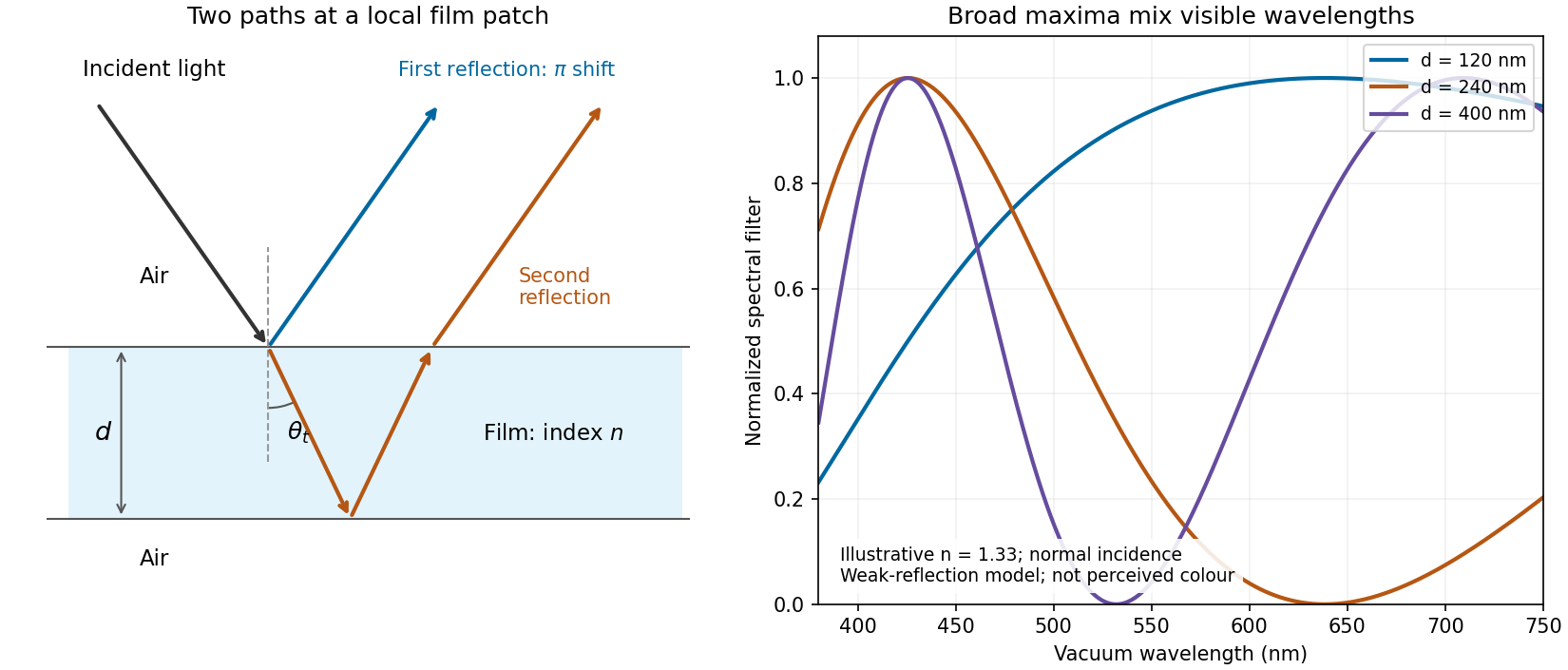
Two reflected paths through a thin film and the broad spectral filtering that produces mixed colours
. Details. 
The ray sketch shows a local patch and is not to scale. The plotted curves use a chosen constant at normal incidence and illustrative thicknesses; they show the spectral filter rather than calibrated perceived colours.
Model the room's decaying acoustic waves as a weakly damped resonator. The quality factor from ringdown is related to stored energy bywhere is the pressure wave amplitude and . The measured frequency gives . If the stated is interpreted as an approximate wave amplitude exponential relaxation time,an estimate of order . Taking as an energy exponential relaxation time instead gives .
There is a real convention ambiguity: “heard to die away” gives neither an initial sound level nor an audibility threshold, so it does not determine either exponential relaxation time. More generally, if the energy falls by a factor in ,In room acoustics, a reverberation time usually denotes a decibel drop of , or an energy factor . If means , the corresponding estimate is instead . The simple decay-time estimate and the conventional reverberation time estimate should not be silently equated.
The three primitive lattice translation vectors join a cube corner to the three adjacent face centres. Thus the Bravais lattice is a face-centered cubic lattice, with conventional cubic side .
Write the given primitive lattice translation vectors as . Their primitive unit cell volume isThe reciprocal lattice convention then givesEach reciprocal lattice vector has units when is in metres. Integer combinations generate a body-centered cubic lattice of conventional cubic side ; the point is its body centre. Directly taking the nine dot products checks the signs and the normalization.
Let be the integer number of primitive unit cells. A Bloch state can be written as , with . The periodic boundary condition therefore requiresThe spacing of allowed wavevectors is . The first Brillouin zone has width , soFor an exact endpoint convention take a half-open Brillouin zone, such as . Its two endpoints differ by a reciprocal lattice vector and must not both be counted as distinct values of crystal momentum. There are exactly inequivalent integers modulo , irrespective of whether is even or odd. This is state counting in a Bloch band: one allowed wavevector per primitive unit cell per energy band. A separate twofold spin multiplicity gives electronic states per energy band, without doubling the number of wavevectors.
Articles by others on the same topic
There are currently no matching articles.