The expression is a scalar diffraction theory integral for a monochromatic wave. The complex quantity represents a field complex amplitude, with physical field obtained by taking the real part after multiplication by . The light intensity is proportional to . The coordinates label transverse positions in the aperture plane, is its transmitting region, and is the incident field multiplied by the aperture's complex transmission. The wavenumber is in the propagation medium, and is the axial propagation distance if already includes the incident field.
To derive the Fresnel diffraction, start from Huygens-Fresnel principle contributions with propagation factor . With the coordinate origin at the projection of into the aperture plane,The paraxial approximation requires , where . Replace the slowly varying and the obliquity factor by their axial values, but retain the quadratic variation of wave phase. Neglect of the next wave phase term requires over the relevant aperture. Thus, apart from a common constant,The quadratic wave phase may be of order one or much larger; setting it to zero would require the stronger conditions for Fraunhofer diffraction. The scalar treatment also neglects the detailed vector field at aperture edges and assumes dimensions large enough compared with wavelength for this approximation to be useful.
For a finite-distance axial point source at distance and an observer at distance , the incident field contributes its own quadratic wave phase. If instead denotes only the aperture transmission, the combined curvature is described by an effective distanceThese are two equivalent conventions for distributing the incident wave phase between and the exponential. Both distances must be included in the later calculation.
Write and for the axial source and observation distances, and put . The aperture is . Under the Fresnel diffraction, the spherical incident wave amplitude is effectively constant over this small aperture, while its quadratic wave phase must be retained. Therefore the two transverse integrals separate:where contains the source strength, the propagation distances and a common phase factor.
Use the dimensionless variable and define the optical normalization of Fresnel integralsThe oddness of makes the bracket , soThis square-aperture Fresnel diffraction normalization is especially useful for comparing with no aperture. In the same Fresnel diffraction, the unrestricted one-dimensional Fresnel integral is ; its square is . Thus, writing for the unobscured field at the same point,The normalization has the correct no-aperture limit because in this convention.
Use SI units throughout: , , and . The effective propagation distance is , givingIn the supplied Cornu spiral, the endpoint at is approximately . HenceMore accurate Fresnel integrals, and , give . The central light intensity is increased to about times the unobscured value, an increase of roughly .
There is no violation of conservation of energy: the aperture reduces the total transmitted power, while removing contributions that partly cancel the central field redistributes the transmitted power across the observation plane. In particular, the square aperture does not give the same central field as a circular aperture of a superficially similar size.
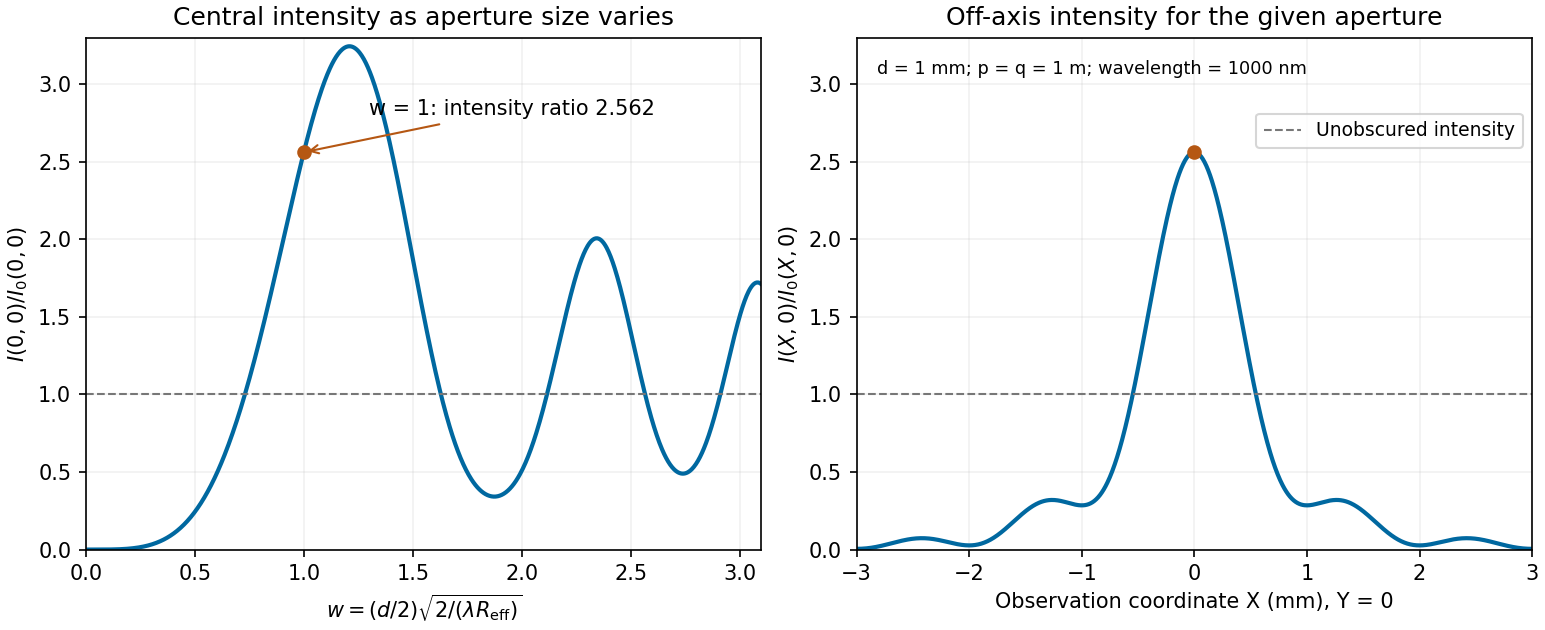
Calculated central intensity and an off-axis section for the square aperture in the Fresnel approximation
. Details. 
Let the source remain at and let the observation point be . The paraxial approximation to the source-to-aperture-to-observer optical path length isCompleting the squares givesThe point is where the straight source-observer line intersects the aperture. Define the four dimensionless edge positionsOn the Cornu spiral , draw the directed chord from to , and a second directed chord from to . Denote their complex differences by and . The complex amplitude is proportional to their product: multiply their lengths and add their arguments, including the common propagation phase factor.
More explicitly, normalize by the unobscured field at this same observation point. The constant wave phase from completing the square is then already included in , andEach directed chord is a one-dimensional Fresnel diffraction factor. One must multiply the two factors, rather than add the chords or use just one chord length for the square aperture. Setting recovers and the on-axis answer.
Articles by others on the same topic
There are currently no matching articles.