The image charge construction replaces conductor-induced charge by fictitious sources outside the physical domain. Match the conductor potentials and the far-field condition; uniqueness then fixes the potential in the physical region. For a grounded plane, reflect a charge and reverse its sign, giving attraction . For a grounded sphere of radius , a charge at distance has image at radial distance . These are examples with prescribed zero potential, not arbitrary isolated conductors.[ref]
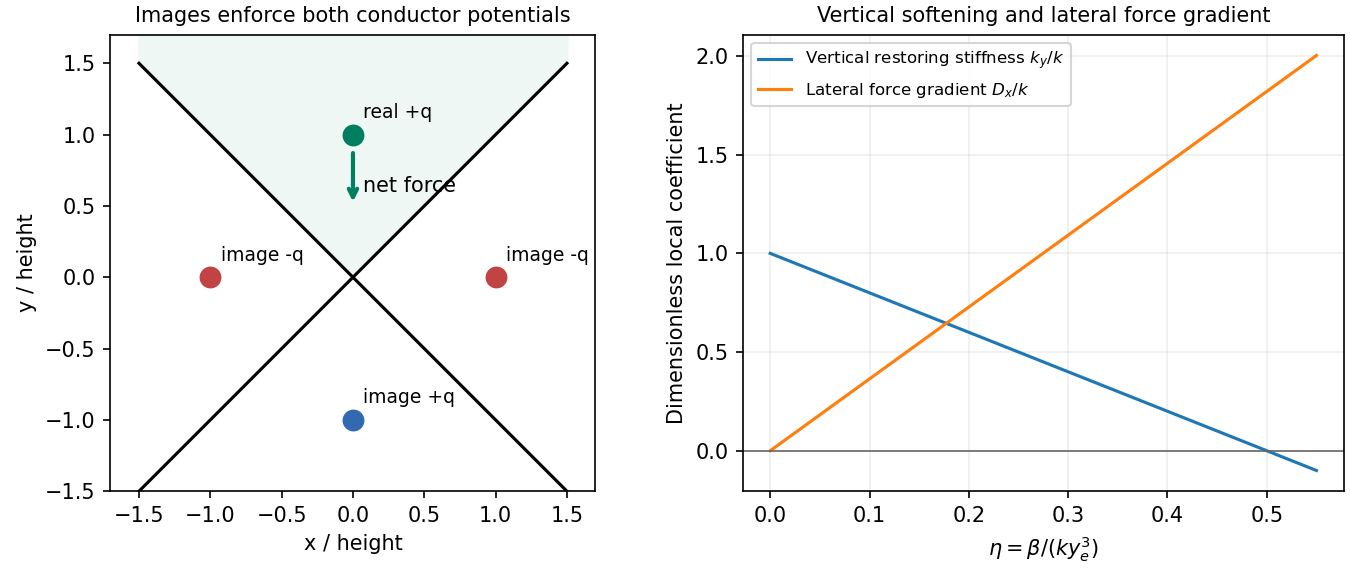
Use horizontal and upward in the upper right-angle wedge. The sheets meet electrically, so take their common potential as zero and assume no externally imposed field. For a real charge at , the image charges in a right-angle conducting wedge are at and , and at . The first two contributions have cancelling horizontal components. With ,Thus the force magnitude at the original height is , directed down toward the intersection. The sphere is treated as a point charge, with size much smaller than its distances from the sheets.
Since gravity is already balanced in the uncharged equilibrium, the charged vertical equilibrium satisfies . For , . Differentiating the force givesThe electrostatic softening above a conducting wedge reduces the restoring force; the small-charge vertical equilibrium remains stable.
For the lateral stability of a spring-supported charge in a wedge, the off-axis images of are at and and at . Expansion near the bisector givesSo the electrostatic force is laterally destabilizing: moving toward either sheet strengthens its attraction. In the simplified model where the spring supplies only a vertical force, the overall equilibrium is a saddle and is unstable.
A three-dimensional spring suspension also has geometrical transverse stiffness. If its charged-equilibrium tension is and length is , a small sideways displacement gives spring force , with . The full stability conditions in this suspension model areMotion parallel to the intersection line has no electrostatic stiffness in the ideal infinite-wedge geometry and is stabilized by the positive spring tension. Thus lateral electrostatic destabilization alone does not prove instability of a real hanging spring. At fixed finite support geometry, a sufficiently small charge preserves stability because while . The given vertical-displacement approximation does not specify the attachment length or by itself establish the transverse inequality for an arbitrary charge. The general criterion above states what can be concluded; the saddle verdict applies to the distinct idealization with zero lateral support stiffness.

Articles by others on the same topic
There are currently no matching articles.