Original paper: Public original, physical PDF pages 142–149.
For hydrostatic volume strain from Young's modulus and Poisson's ratio in isotropic linear elasticity, the bulk modulus is . Hydrostatic compression therefore givesHere is the pressure increase, and the negative sign denotes contraction. Equivalently each normal strain is and the three strains add. This is the small-strain isotropic model; concrete's microstructure is represented only through the supplied elastic constants.
Put line charges and on the two axes. For , the surface potentials differ byThus the capacitance per unit length in vacuum isThe two logarithms belong to one potential difference, not two independent capacitances in parallel. A homogeneous dielectric replaces by its absolute permittivity; finite radii and proximity corrections are neglected.
With the standard liquid-water approximation , each portion has mass . The equal heat capacities give final temperature by energy conservation. For an insulated mixing process with no other changes,The reversible integrals evaluate entropy differences between equilibrium states; the actual heat transfer is irreversible. These are two portions of the same substance, so there is no additional ideal-mixture compositional entropy.
Let absorbed solar flux per unit surface area be . The single-layer greenhouse model emits infrared upward and downward. Top-of-atmosphere balance gives , hence . Surface balance is , soThe layer simultaneously satisfies . This ideal radiative model excludes convection, spectral windows and atmospheric temperature structure; it is not a quantitative prediction for the real atmosphere.
For the tangent-axis inertia of a spherical shell, subtract the missing solid core from a solid sphere:The parallel axis theorem shifts the axis a distance :It tends to for a solid sphere and for a thin spherical shell.
The image charge construction replaces conductor-induced charge by fictitious sources outside the physical domain. Match the conductor potentials and the far-field condition; uniqueness then fixes the potential in the physical region. For a grounded plane, reflect a charge and reverse its sign, giving attraction . For a grounded sphere of radius , a charge at distance has image at radial distance . These are examples with prescribed zero potential, not arbitrary isolated conductors.[ref]
Use horizontal and upward in the upper right-angle wedge. The sheets meet electrically, so take their common potential as zero and assume no externally imposed field. For a real charge at , the image charges in a right-angle conducting wedge are at and , and at . The first two contributions have cancelling horizontal components. With ,Thus the force magnitude at the original height is , directed down toward the intersection. The sphere is treated as a point charge, with size much smaller than its distances from the sheets.
Since gravity is already balanced in the uncharged equilibrium, the charged vertical equilibrium satisfies . For , . Differentiating the force givesThe electrostatic softening above a conducting wedge reduces the restoring force; the small-charge vertical equilibrium remains stable.
For the lateral stability of a spring-supported charge in a wedge, the off-axis images of are at and and at . Expansion near the bisector givesSo the electrostatic force is laterally destabilizing: moving toward either sheet strengthens its attraction. In the simplified model where the spring supplies only a vertical force, the overall equilibrium is a saddle and is unstable.
A three-dimensional spring suspension also has geometrical transverse stiffness. If its charged-equilibrium tension is and length is , a small sideways displacement gives spring force , with . The full stability conditions in this suspension model areMotion parallel to the intersection line has no electrostatic stiffness in the ideal infinite-wedge geometry and is stabilized by the positive spring tension. Thus lateral electrostatic destabilization alone does not prove instability of a real hanging spring. At fixed finite support geometry, a sufficiently small charge preserves stability because while . The given vertical-displacement approximation does not specify the attachment length or by itself establish the transverse inequality for an arbitrary charge. The general criterion above states what can be concluded; the saddle verdict applies to the distinct idealization with zero lateral support stiffness.
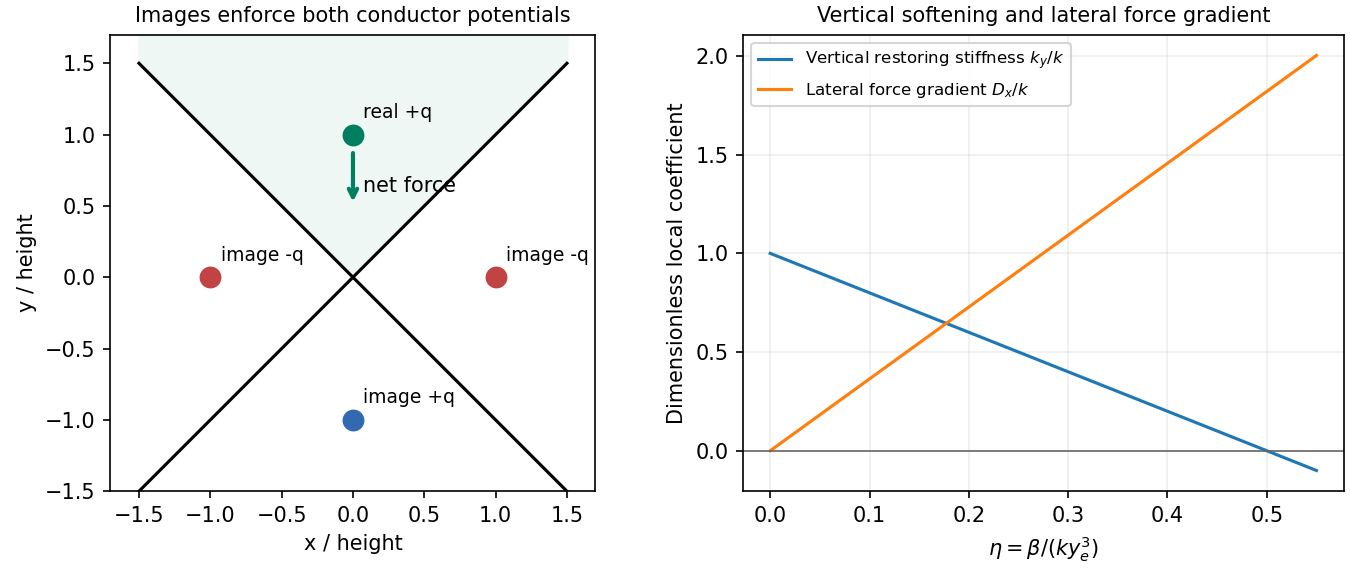
Original image-charge field construction and the opposite signs of vertical softening and lateral electrostatic stiffness
. Details. For distributed inductance and capacitance , a small segment obeys and . Differentiation gives and . For a forward wave,A backward voltage wave has current . This sign matters at an impedance discontinuity.
The source figure is the stacked-strip parallel-plate transmission line geometry, despite its use of the word coplanar. Gauss's law gives . Opposite surface currents give magnetic field between the strips by Ampère's law; the magnetic flux per unit length is , hence . ThereforeNo numerical is given; the impedance is appropriately left in terms of that ratio. The line is taken to be nonmagnetic and lossless.
Increasing the gap by changes to and to , so while is unchanged. voltage and current continuity at the step giveConsequently the voltage and energy-flux transmission coefficients areHere amplitudes are peak voltage amplitudes, with mean power . The reciprocal gaps have : equal reflected energy but opposite voltage phase. A voltage transmission coefficient above one does not imply energy gain.
For a finite impedance section of a transmission line, put and . Multiple reflections inside the altered section interfere. Summing their geometric series, relative to the first boundary,Transmission is unity at and minimal at , with minima . Resonances are separated by ; the long-wavelength limit also transmits fully. Matching the far termination removes end echoes, not the two internal reflections.
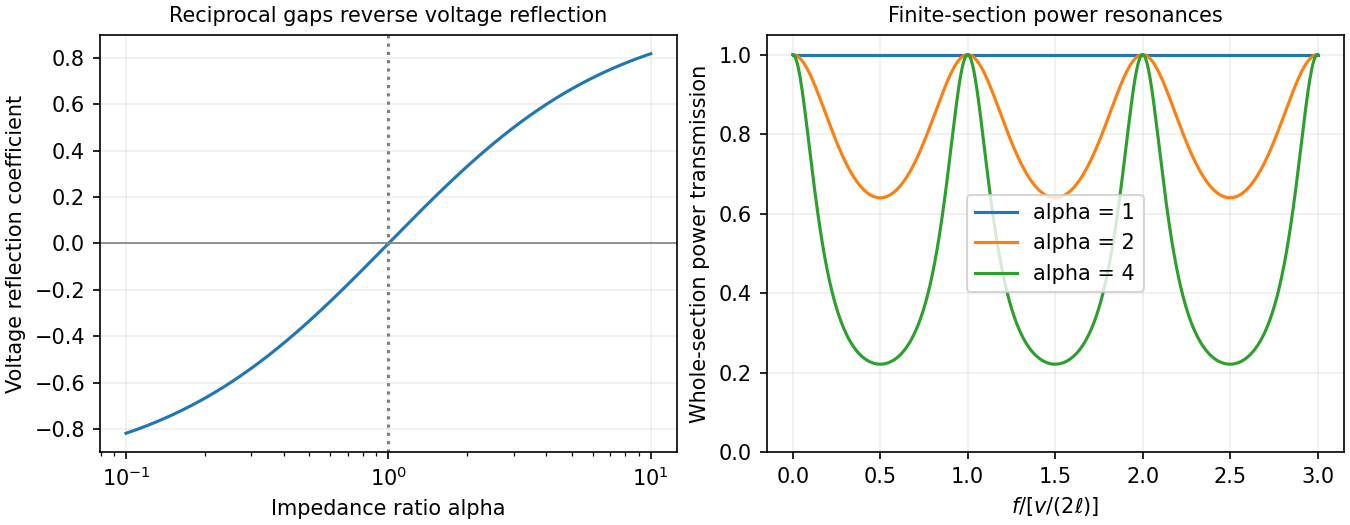
Original calculated power transmission through a finite changed-impedance section between matched lines
. Details. For a moving loop, Faraday's law of induction is , where is the local wire velocity, , and the oriented boundary and surface follow the right-hand rule. For a fixed loop the motional term vanishes. Lenz's law is the minus sign: the induced response opposes the change of linked flux, not necessarily the applied field itself.
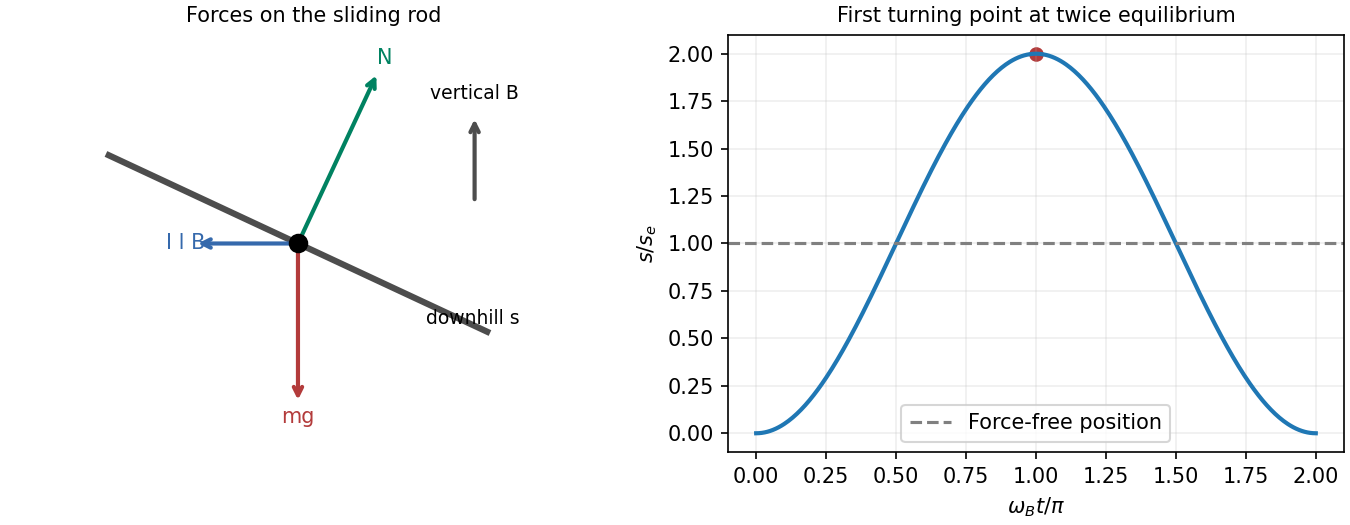
Let increase downhill and choose positive current to produce an uphill magnetic force. The normal component of the imposed field is , so the changing external flux is . With initially zero current and no resistance, conservation of flux linkage gives . The rod feels gravity vertically downward, a rail reaction normal to the slope, and magnetic force of magnitude horizontally uphill. Its downhill component is ; its normal component presses the rod into the rails, giving .
The inductive oscillation of a sliding rod on inclined rails follows fromThe magnetic force is not itself parallel to the rails. Defining and , release from rest givesThe first stop occurs at ; the rod then returns and oscillates between and . At the force is zero but the speed is maximal. Mechanical potential energy is reversibly exchanged with kinetic energy and ; a perfectly conducting circuit provides no damping.
For the resistive long-time drift of an inductive sliding rod, with loop resistance , useJoule heating damps the transient oscillation. On sufficiently long rails the asymptotic motion is steady sliding, not permanent rest:The zero-resistance model has persistent oscillations; its late-time limit cannot be interchanged with taking . These results assume , smooth contacts, negligible rod self-inductance and constant geometry.
For cold, collisionless, unmagnetized electrons with stationary heavy ions, . Therefore andThis is the cold collisionless plasma dielectric response. For a propagating transverse wave, , so in vacuum and in plasma, where . Equivalently and for .
Converting the density gives , so and . At ,At an interface without independently imposed surface charge or sheet current, tangential and normal are continuous, with the electron response included in the effective permittivity. Normal need not be continuous; the induced electron charge is represented by that response. In a convention treating it explicitly as a surface charge, the normal vacuum-displacement jump equals that charge instead.
For the downward transmitted wave, transversality gives . The measured field therefore has , so and . Tangential phase matching givesFor inferring incident power from a transmitted plasma field, choose and . Their magnetic fields have opposite directions. The two tangential conditions areHence and . Since these are peak phasor amplitudes,This is incident power per area perpendicular to its propagation. Per area of the interface the incoming normal flux is . The reflected sign is a phase reversal, not negative reflected energy.
At , the relative permittivity is negative and there is no propagating transverse bulk wave. The field decays evanescently into the plasma and the ideal collisionless half-space reflects all incoming normal power. Collisions would allow absorption; a complex refractive index here does not by itself imply dissipative heating.
A fictitious force is a term required when writing Newton's second law in an accelerating frame; it comes from the coordinate choice rather than a new interaction. For axes rotating at constant about a fixed inertial origin,Apply this identity twice to position to get . Moving the last two terms to the right of gives the stated Coriolis and centrifugal forces. An accelerating origin or changing rotation rate would add further terms.
A slowly rotating fluid planet follows an equipotential of gravitational plus centrifugal potential. The centrifugal potential is , most negative at the equator. An outward equatorial shift raises gravitational potential and restores the balance, producing an oblate figure. Self-gravity also changes with the shape; no flattening coefficient follows from rotation alone without a density model.
Using local north and radial-up unit vectors, the centrifugal acceleration on a stationary mass isIt points away from the rotation axis: upward and equatorward, at angle to radial up in the northern hemisphere. Its vertical fraction of gravitational force isusing a day for this approximate number. The resultant effective weight tilts equatorward relative to radial down. A plumb-defined local vertical already follows effective gravity; the component calculation uses the spherical radial vertical. A supported stationary mass of course has zero net acceleration.
For the Coriolis deflection of vertical launch and drop, retain only first order in , use effective constant , and neglect horizontal velocities in the Coriolis term as instructed. With east positive, vertical velocity gives and no northward acceleration. For launch, and the flight time is . Integrating with zero initial horizontal velocity givesThe landing is westward. The westward velocity accumulated on ascent is only recovered on descent, so the two displacement contributions do not cancel.
For release from rest at , , , and . ThusThe drop lands eastward with one quarter the launch-return displacement magnitude. North–south corrections from horizontal Coriolis coupling are beyond the retained approximation.
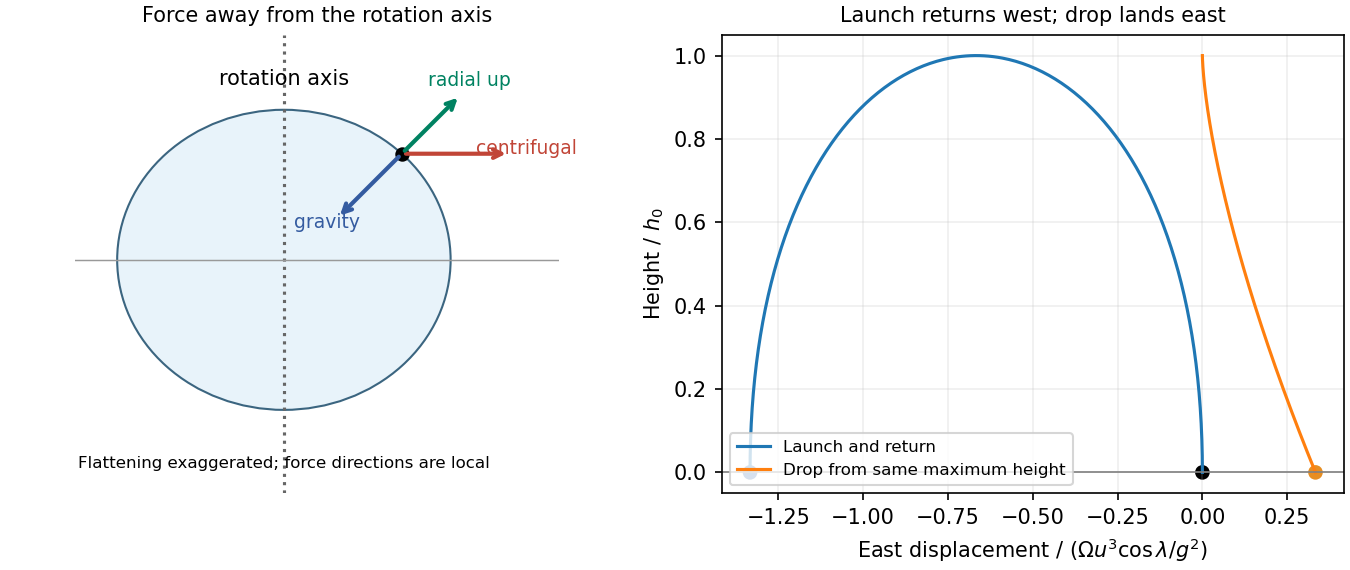
Original centrifugal geometry and opposite east–west deflections for launch-return and drop trajectories
. Details. The shell theorem gives enclosed halo mass . Define . Then . Interior to the uniform halo its potential energy may be writtenOuter shells alter the additive constant, not this interior force. An actually infinite uniform mass distribution has no finite potential referenced to infinity; only local potential differences are needed here.
The central force has zero torque, so is conserved and the motion is planar. With , the effective radial potential and equation areFor circular radius , givesSet at fixed . The derivative of the right-hand side at equilibrium is , soBoth frequencies are positive, but radial and azimuthal motion no longer close with the Kepler ratio. At first order in eccentricity , one may write and . For a weak halo this is a nearly Keplerian ellipse whose apsis rotates at angular rate .
Put and . Expansion yieldsThe precession is retrograde. In cycles per unit time the precession frequency is ; per radial period the apsidal shift is . This weak-halo interpretation avoids confusing a focus-centred Kepler ellipse with the centred ellipse of a purely harmonic potential.
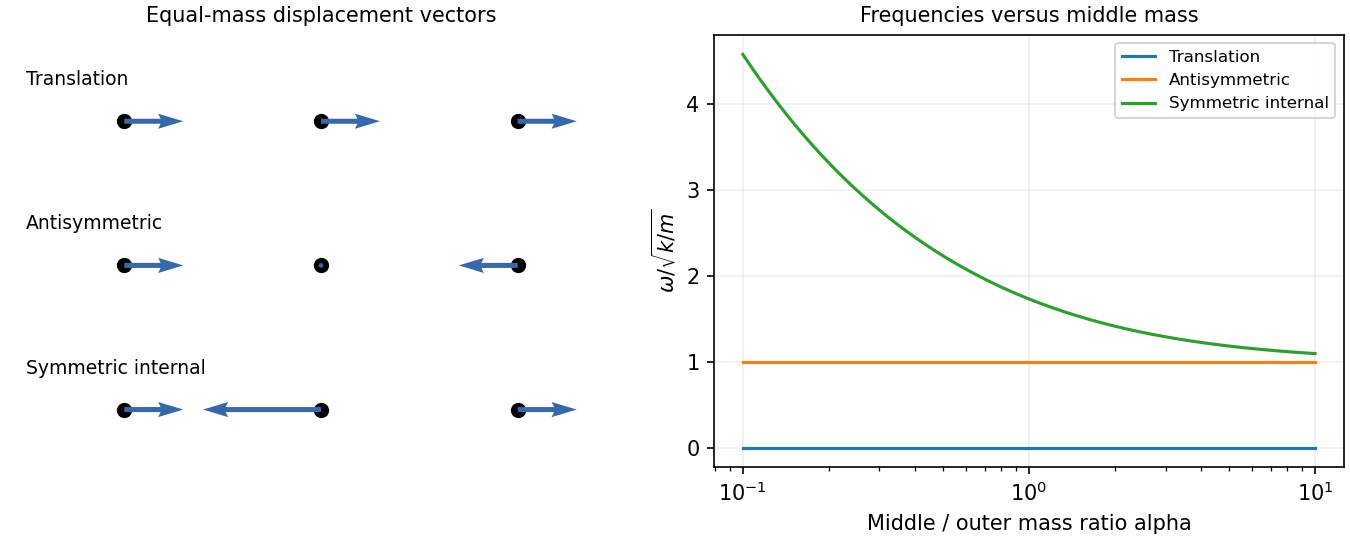
A normal mode is a pattern in which all coordinates share one frequency and fixed relative amplitudes. For a conservative linear system, it solves a generalized eigenvalue equation with stiffness matrix and mass matrix . For this free three-mass spring chain,Solving , for , givesTheir overall normalization is arbitrary; distinct modes are orthogonal in the mass inner product. The zero mode is rigid translation because neither end is fixed. In the antisymmetric mode the middle mass stays still, so changing its mass cannot alter the frequency. The symmetric internal mode keeps the centre of mass fixed through its middle displacement . Its frequency rises without bound as and approaches as , becoming degenerate with the antisymmetric frequency in that limit.
For equal masses put and . Positions are equilibrium positions plus displacementsThe translational mode needs the linear-in-time term; a cosine at zero frequency alone would miss arbitrary centre-of-mass velocity.
Taking the springs initially at equilibrium, the impulse gives . Their squared Euclidean norms are , so their initial kinetic energies are . Relative to total ,Subsequent motion conserves each mode's total energy, exchanging its kinetic and spring contributions. The zero-mode share remains centre-of-mass kinetic energy.
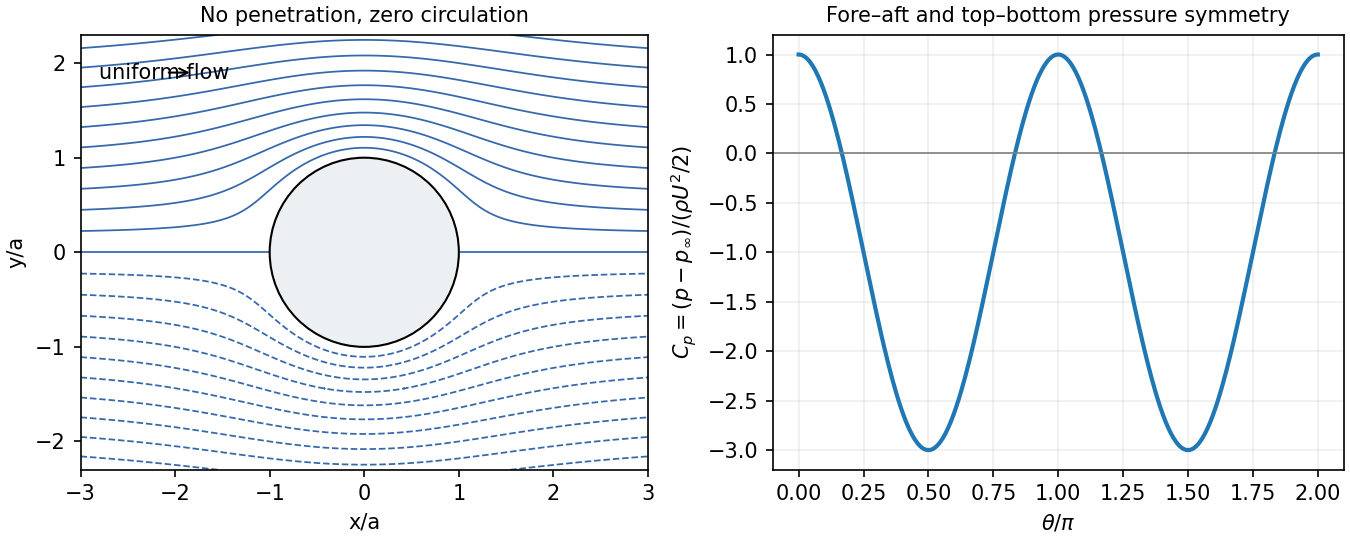
Locally, zero curl permits ; for a global single-valued potential the circulation around every noncontractible loop must also vanish. incompressibility gives . The exterior of a cylinder is multiply connected, so local irrotationality alone does not exclude a circulating solution.
For inviscid constant-density flow under conservative gravity, Euler's equation is . The identity gives, for irrotational flow,For steady flow, absorb the potential's time-only gauge term and obtain throughout the connected fluid region. Without irrotationality the steady constant need only be common along each streamline.
Use for the uniform upstream speed and take the flow along . The boundary conditions are and at infinity. A perfect inviscid model imposes no penetration, not no slip. For the intended no-circulation solution, require a globally single-valued potential, so the coefficient of is zero. The logarithmic term would be a net source and violates no penetration, so its coefficient is also zero. Growing terms with violate the uniform far field. For each remaining , the surface normal condition then forces its decaying coefficient to vanish. The terms satisfy and :An irrelevant additive potential constant is understood. At the same elevation, Bernoulli balance with the upstream stream givesThe force per unit height ispressure symmetry gives zero drag and zero lift in this zero-circulation idealization. D'Alembert's paradox is the failure of this inviscid model to represent real separated viscous wakes and their drag, not a claim that a real pole feels no force.
The zero-circulation assumption matters: leaves the stated velocity boundary conditions intact but adds to the surface tangential speed. It produces for positive counterclockwise circulation. Thus the boundary conditions alone do not justify excluding the angular term; an initially noncirculating inviscid start, or an explicitly single-valued potential, supplies the missing condition.[ref]
Flow Past a Cylindrical Obstacle by Richard Fitzpatrick. equations 5.73–5.81 and discussion after 5.83: circulation, force and the zero-circulation initial condition


Articles by others on the same topic
There are currently no matching articles.