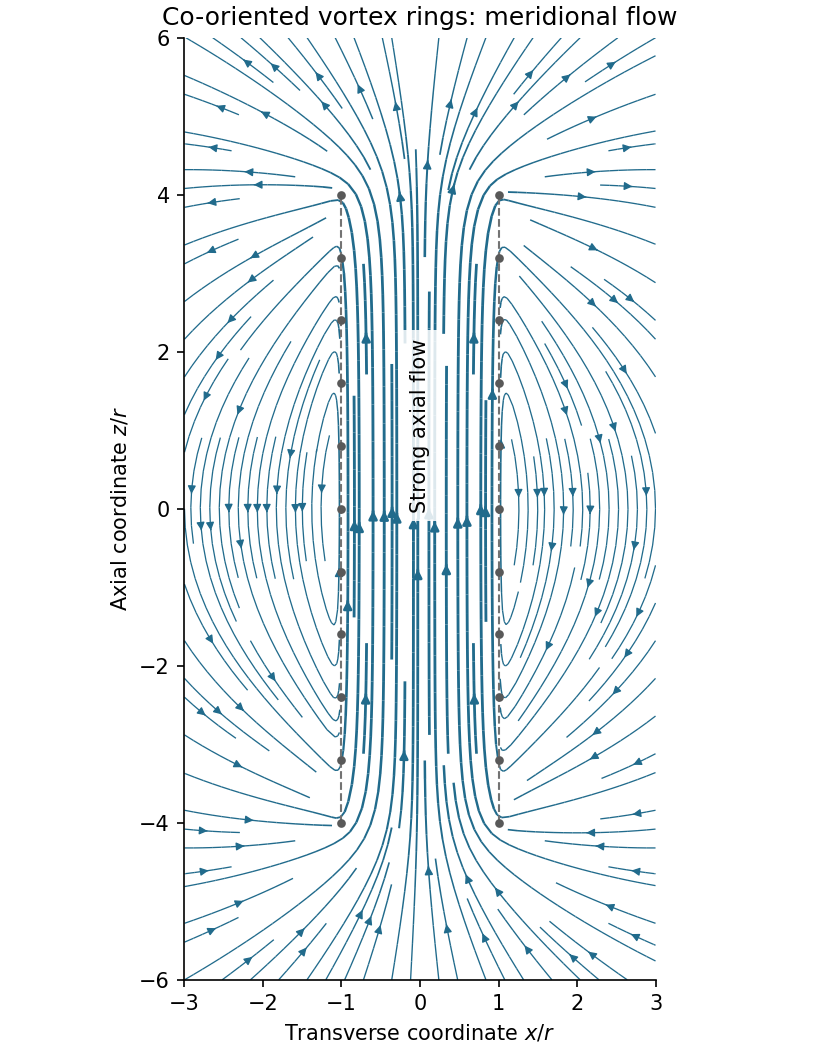
Assume all rings have the same circulation and orientation, and that there is no imposed background flow. Vortex lines describe the direction of vorticity, not the direction of velocity. For an incompressible fluid, the velocity induced by a thin vortex filament has the same Biot-Savart integral form as the magnetic field of a current filament:A closely spaced coaxial array of vortex rings is therefore analogous to a solenoid. The velocity field passes along the common axis through the rings and returns outside a finite array. Its orientation reverses if every circulation is reversed. In a long array, far from its ends and vortex cores, the velocity field of a dense coaxial vortex-ring array is approximatelyThe exterior field is exactly zero only in the ideal continuous infinitely long limit, with the background velocity set to zero. In a finite array the streamlines spread out at one end, run back outside, and converge into the other. A large number of closely spaced rings alone does not guarantee that the total array length greatly exceeds ; if it does not, the end and return flows remain substantial. Different unspecified ring circulations would require superposing their actual signed contributions.

Articles by others on the same topic
There are currently no matching articles.