Assume a hollow square electromagnetic waveguide with perfectly conducting walls, filled with vacuum or air. For side , the waveguide cutoff frequency isA transverse electric mode can have one zero index, but not both. A transverse magnetic mode requires both indices positive. Thus the lowest cutoff belongs to the two degenerate transverse electric modes and , withThe corresponding cutoff vacuum wavelength is . Strictly, a travelling mode carrying power along the guide needs : at the cutoff itself, the axial wavenumber and group velocity are zero. The number above is therefore the lower frequency threshold, not a propagating mode with nonzero longitudinal energy flux exactly at that frequency. A dielectric filling would replace by the wave speed in that medium.
Treat the lake as a large thermal reservoir at , and take the copper's heat capacity constant over the cooling interval from . Although the actual cooling is irreversible, entropy is a state function, so its change can be calculated along a hypothetical reversible path:The lake receives at constant temperature, givingTherefore, neglecting other changes,The positive total is the entropy generated by transferring heat across a finite temperature difference. The copper's entropy decreases, but the colder lake gains a greater amount.
Let be the length of the free straight segment from the current contact point to the mass, and let measure the contact point's rotation from first contact. For an inextensible taut rope, winding through angle uses length :The point mass follows an involute of the pole's circular cross-section. Its instantaneous velocity is perpendicular to the free rope. To verify the geometry explicitly, use planar polar unit vectors at the contact point:The rope's tension therefore does no work, and the speed stays at its initial value . The geometry gives . ConsequentlyThe distance from the pole's axis is , so a point mass first reaches the pole when . The winding time around a circular pole is thusThis has units of time. The model assumes a light inextensible rope, no energy loss at contact and a point mass. The required tension diverges at the ideal final contact, so finite strength and size matter very close to impact.
The symmetry is electromagnetic reciprocity applied to mutual inductance. For thin closed circuits in vacuum, the magnetic vector potential generated by circuit B isStokes theorem converts the magnetic flux through circuit A into its magnetic vector potential circulation. Dividing by gives Neumann's mutual-inductance formula,The dot product and separation are unchanged by interchanging A and B, soEach has units . The winding orientations must be used consistently to determine the common sign. The same reciprocity holds in ordinary linear reciprocal magnetic media; it is not an unrestricted statement about biased nonreciprocal materials. Equivalently, a reversible magnetic energy function has equal mixed derivatives with respect to the two currents.
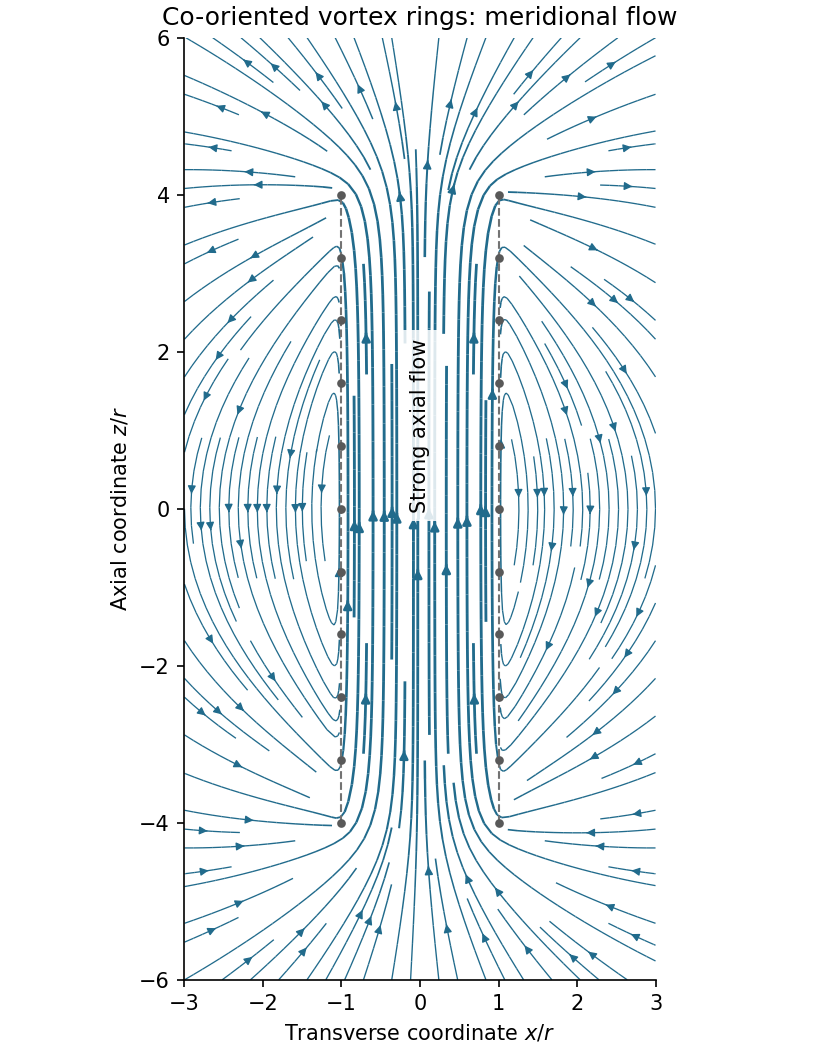
Assume all rings have the same circulation and orientation, and that there is no imposed background flow. Vortex lines describe the direction of vorticity, not the direction of velocity. For an incompressible fluid, the velocity induced by a thin vortex filament has the same Biot-Savart integral form as the magnetic field of a current filament:A closely spaced coaxial array of vortex rings is therefore analogous to a solenoid. The velocity field passes along the common axis through the rings and returns outside a finite array. Its orientation reverses if every circulation is reversed. In a long array, far from its ends and vortex cores, the velocity field of a dense coaxial vortex-ring array is approximatelyThe exterior field is exactly zero only in the ideal continuous infinitely long limit, with the background velocity set to zero. In a finite array the streamlines spread out at one end, run back outside, and converge into the other. A large number of closely spaced rings alone does not guarantee that the total array length greatly exceeds ; if it does not, the end and return flows remain substantial. Different unspecified ring circulations would require superposing their actual signed contributions.

Articles by others on the same topic
There are currently no matching articles.