Selected final answers: Partial answer sheet, PDF page 175. This sheet does not cover every question.
Write the plate area as and separation as , so the original capacitance is . Neglect edge fields. The greatest capacitance occurs when each material occupies half the plate area and spans the full separation. These two regions are capacitors in parallel, sharing the same electric potential difference:The least capacitance occurs when a dielectric layer of thickness covers the whole area, leaving a vacuum layer of the same thickness. The two layers are capacitors in series: the normal electric displacement field is continuous and the voltage drops add. Their individual capacitances are and , givingThe arithmetic-harmonic bounds for dielectric capacitance show that these are genuine extrema over other arrangements of the same two volumes, within the ideal parallel-plate model. A uniform trial electric field in the fixed-voltage energy principle bounds above by the arithmetic mean of the two permittivities; a uniform trial electric displacement field in the fixed-charge principle bounds it below by their harmonic mean. The two layer arrangements attain those bounds. Both reduce to when .
In steady rigid rotation of the liquid about its vertical axis, centrifugal acceleration is outward. Hydrostatic pressure balance in the rotating frame givesThe free surface is at constant atmospheric pressure, so its slope obeysCompare this parabolic free surface of a rigidly rotating liquid with . For focal length ,Either sense of rotation gives the same shape. The result assumes the liquid has reached rigid rotation before solidifying and that surface-tension and solidification distortions can be neglected.
Use , to recognize the planar quadrupole potential, . Its electric field is minus the gradient:or, in cylindrical coordinates,For , arrows point toward the origin along the axis and away from it along the axis. The off-axis electric field lines satisfyThe axes themselves are the separating field lines; the origin is a field null. Reversing reverses every arrow. The field is independent of , and has units .
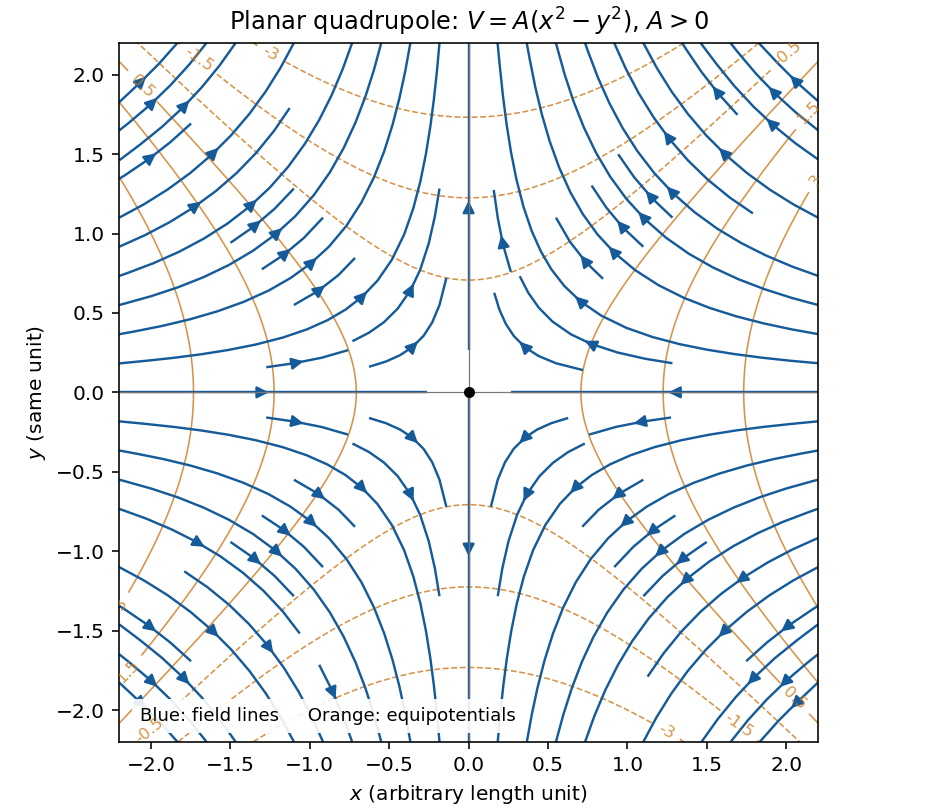
Original calculated electric-field lines and equipotentials for the planar quadrupole with positive A; arrows approach along x and leave along y
. Details. 
First estimate the excess pressure as weight divided by contact area:For the equilibrium estimate, use the Clapeyron equation for melting. The specific volume change on melting is , and the latent heat of fusion gives . Thus the common-pressure melting-point slope isTake and the usual rounded water density , in addition to the supplied and . ThensoThe sign is negative because ice contracts on melting. This is a linear equilibrium estimate treating the load as a common local pressure on coexisting ice and water. The actual contact stress is nonuniform, and frictional heating, deformation and drainage also affect skating; the estimate is not a complete account of the lubricating water film.
Cold air is denser than room air at approximately the same pressure. The ideal gas law gives a fractional mass density contrast of order . The initial outflow is therefore a gravity current driven by reduced gravityFor an illustrative refrigerator height , room temperature and temperature difference , this gives . Balancing the released potential energy with kinetic energy gives . The buoyancy exchange time of a cold-air enclosure is consequentlyUsing constant acceleration over height gives , consistent at this level. Warm air enters as cold air leaves, so unrestricted vacuum free fall is not the right acceleration model. No dimensions or temperatures are specified in the source, so an order-of-magnitude estimate with explicit representative values is the appropriate result; shelves and mixing can delay complete replacement.
Images and uniqueness. The method of images replaces a conducting boundary by fictitious charges outside the physical field region. Choose them so that the resulting electric potential satisfies the required conductor potentials. The Uniqueness of the Dirichlet problem then guarantees the same physical exterior field. For example, a point charge at height above a grounded plane has an image at height : the plane is an equipotential at zero, and the charge is attracted toward it by . The image is a computational device; the physical conductor carries a continuous induced surface charge density.
Potential of a line. Surround an infinite line charge by a coaxial Gaussian cylinder of radius and length . Gauss's law gives , hence . Integrating givesWriting an additive constant instead is equivalent. The reference length makes the logarithm dimensionless; an isolated infinite line cannot be assigned a finite zero potential at infinity.
Locating the two lines. Put the grounded plane at and the physical cylinder at , with axis along and radius . Set , and place line charges and at and . If and are their distances from an observation point, the cylinder-plane image charges giveOn , , so . To check the cylinder, define . The level set is a circle: completing the square givesSince , its centre is and radius is . The positive line lies inside the cylinder; the negative line lies behind the plane. There is consequently no fictitious charge in the exterior physical region. A Gaussian contour around the cylinder encloses only, so the required physical charge per unit length is also correct. These boundary conditions and the far-field behaviour determine the physical solution by Uniqueness of the Dirichlet problem.
Cylinder voltage. The constant distance ratio on the cylinder immediately givesIts capacitance per unit length is . In the thin-cable limit, .
Cable attraction. Because the cable is idealized as infinite, the meaningful answer is force per unit length. For , centre height and ,The electrostatic attraction per unit length of a cylinder above a plane isFor example, this follows without any ambiguity about moving image positions from at fixed voltage, including the work of the voltage source. Its sign is negative because capacitance decreases with height. A cable length experiences approximately downward when end effects are negligible. This is the electrostatic contribution only.
Inductance and interface conditions. For a linear coil, self-inductance is the ratio of its own magnetic flux linkage to current. Its induced electromotive force is for fixed . Across an interface with unit normal from medium 1 to 2,These electromagnetic boundary conditions follow from Gauss's law for magnetism and Ampère's law. Here is free surface current. At the iron–air faces there is no free surface current, so normal magnetic flux density and tangential magnetic field intensity are continuous. In each isotropic linear medium, .
Complete core. A slender toroid has approximately uniform along mean path length . Ampère's law gives , so . The flux per turn is , yielding the inductance of a toroidal winding,This uses constant relative magnetic permeability and neglects leakage, fringing and saturation.
Why the gap lowers inductance. The gap replaces an easy magnetic path in iron with air. Maintaining the same flux now requires a much larger magnetic field intensity in part of the path and therefore more ampere-turns. Equivalently, magnetic reluctance increases, so the flux linkage for a fixed current and hence self-inductance decrease. A narrow gap can matter greatly because its permeability is smaller by the factor .
Oblique-gap calculation. In the original diagram is the perpendicular separation of the cut faces. Let point along the core, and let be normal and tangential to the gap faces. With the face at angle to the core direction, . Write the core flux density as . The boundary conditions givesoThe gap area normal to its nearly normal field is , not . Its leading reluctance is consequently . Adding the core reluctance gives the inductance of a toroid with an oblique narrow air gap,Thus at ,The approximation retains the possibly order-one ratio while neglecting , fringing and the small tangential gap contribution. More precisely, a local uniform-field path along the core, with missing iron length subtracted, gives denominator . Its correction is beyond the stipulated large-, narrow-gap accuracy; simply neglecting would not be justified.
Field in the slot. The component expression above givesFor the gap and ,Its units are . The field is almost perpendicular to the cut faces, rather than following the iron direction straight across the cut. Its small angle away from the face normal satisfies at ; the sense reverses if the current reverses.
Field law and centre value. The Biot-Savart law for a steady thin wire isHere follows the conventional electric current and the displacement points from source to observation point. For a circular loop of radius , every element at the centre has distance and contributes in the same axial direction. Choose by the right-hand rule. Then
On-axis integration. At axial distance , every wire element has distance . Azimuthal symmetry cancels transverse components. Parameterizing gives axial cross-product element , so the on-axis magnetic field of a circular current loop isIt points the same way on the two halves of the axis; its strength is even in .
Directions near the axial point. At a point on the positive axis the field is axial, but nearby lines spread outward because decreases as increases. On the negative-axis side they converge toward the axis while still progressing in the positive axial direction. There is no azimuthal field. The near-axis sketch shows this local spreading; the complete magnetic field lines return around the outside of the loop and form closed curves.
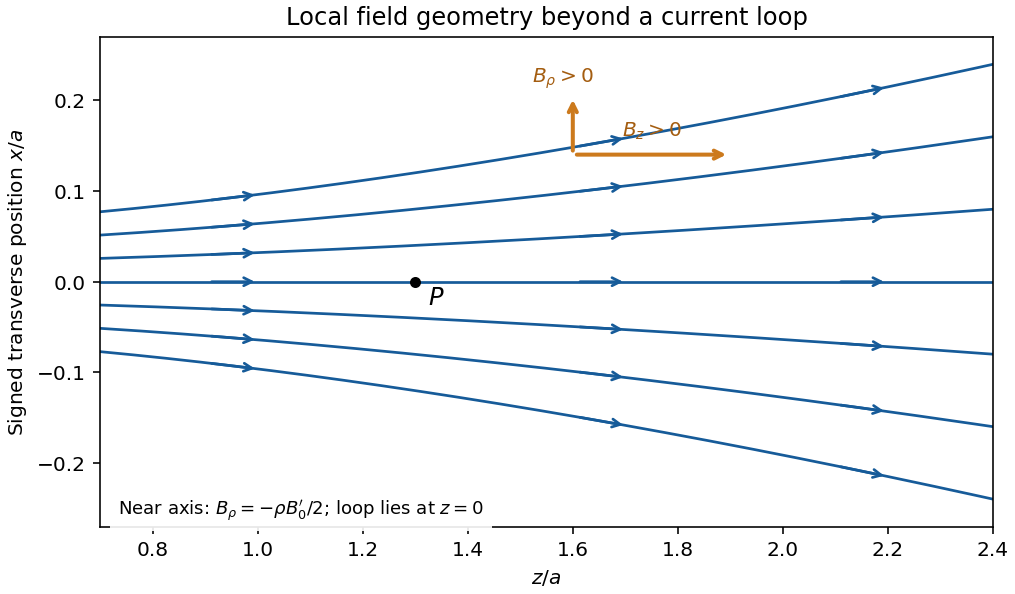
Original calculated leading near-axis field-line geometry on the positive side of a circular current loop; the lines spread as the axial field weakens
. Details. 
Radial component from zero divergence. Smooth axial symmetry gives and . By Gauss's law for magnetism,Integrate radially from zero, excluding a singular term, to obtain the near-axis radial magnetic field, . Differentiating the axial field therefore givesFor it is outward; for it is inward. This supplies the direction reasoning used in the sketch.
Force on the second loop. Put the second loop at and radius . For , the radial field due to the first loop is . The element experiences Lorentz forceThe radial contributions cancel as vectors around the loop. The axial contributions add, giving the force between distant coaxial current loops,The sign follows . Both the small radial coordinate relative to and the dipole approximation are justified by .
Force direction. The second loop is pulled back toward the first: the force is attractive for the same current sense. Reversing one current reverses the force. The much larger axial field chiefly produces radial element forces; retaining the smaller radial field is essential for the net axial attraction.
Field equations. In a homogeneous source-free nonmagnetic medium, and . Maxwell's equations becomeThe first equation follows from for spatially constant nonzero . When the effective relative permittivity is negative below, its charge response is already included in ; it must not also be counted as an extra free source.
Amplitude relations and bulk dispersion. Work with complex phasors proportional to . For , the Ampere-Maxwell law givesso the amplitudes must obeyThey are not arbitrary independent constants: the dispersion relation alone would not make arbitrary amplitudes satisfy the equations. These relations give , so the electric divergence vanishes; the magnetic divergence vanishes because there is no dependence. The only nonzero component of Faraday's law of induction isSubstitution then givesThis proves that all four field equations hold for the specified transverse magnetic polarization when both the amplitude relations and the dispersion relation are imposed.
Interface matching. Let region 1 be vacuum above the interface, with , ; region 2 has , . These signs make the evanescent fields decay as . In the absence of free surface current, tangential is continuous, giving a common interface amplitude. Tangential is also continuous, henceNormal is continuous as well: both sides have . This does not require itself to be continuous; the material can have polarization surface charge. The normal magnetic field is zero on both sides.
Existence and surface dispersion. The opposite signs of and require . The two bulk equations areUse to eliminate the decay constants. For the nontrivial interface branch,A positive together with real propagating gives . A negative permittivity between and zero is insufficient. This lossless planar surface-plasmon dispersion describes a surface plasmon polariton; would instead be identical media and supplies no decaying bound mode.
Frequency range and long wavelengths. With , the existence condition becomesThe upper value is a limiting frequency approached as , not an attained maximum at finite . Substitution into the dispersion relation givesFor , choosing propagation in the positive direction,It approaches the vacuum light line from larger . The vacuum decay constant is then , so confinement becomes weak at low frequency. This calculation assumes the stated real, lossless effective permittivity; dissipation would require complex propagation and decay constants.
Changing basis and acceleration. Attach orthonormal unit vectors to the rotating frame, with a common origin fixed in the inertial frame. An infinitesimal rotation changes a vector fixed in those axes by : its tip moves tangentially to the circle about the rotation axis. More generally, write . Differentiating the components and the rotating basis separately proves the rotating-frame derivative formula,
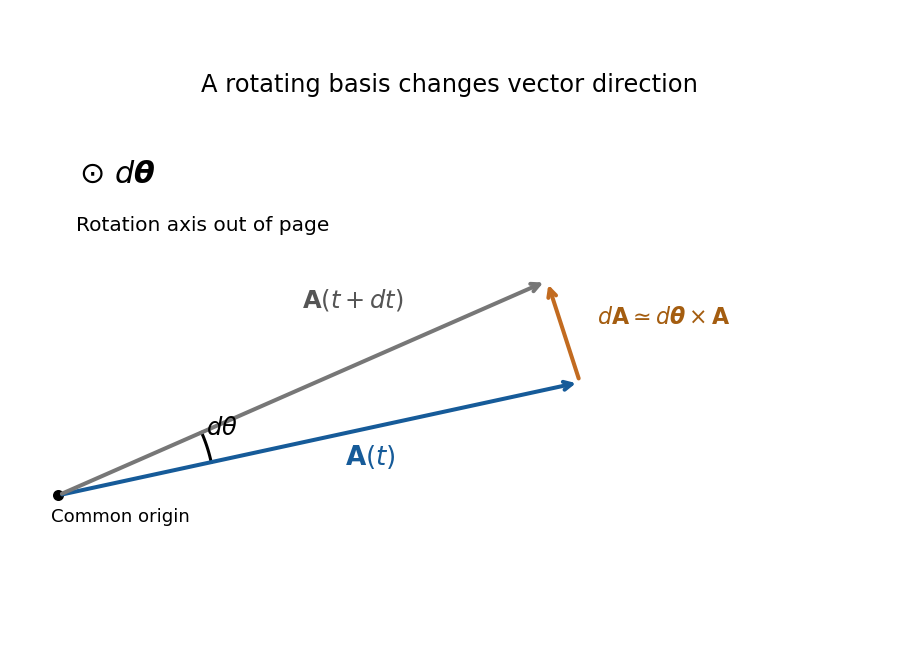
Original geometric construction of the tangential change of a vector during a small positive rotation; the change is dtheta crossed with A
. Details. 
Apply the formula first to position: , where . Apply it again to both terms. For constant ,One cross term comes from differentiating in the inertial frame and another from differentiating in . The displayed source formula implicitly requires constant angular velocity and an unaccelerated common origin. For changing rotation rate there is also ; an accelerating origin supplies its own translational acceleration. Moving the rotation terms to the force side gives the apparent Coriolis force and centrifugal force with negative signs.
Southward motion on Earth. Use local east, north and up axes, with latitude positive northward. Then and . The Coriolis acceleration in local Earth coordinates givesIt is westward in the northern hemisphere, eastward in the southern hemisphere and zero for exactly southward motion at the equator. There is no vertical Coriolis component for this particular velocity.
Correct steering. On the desired meridional track, drag has no eastward component because it is antiparallel to the velocity. If the thrust makes signed angle east of south, its eastward component is . The cross-track force balance is thereforesoThe argument must have magnitude at most one for this simple thrust-only correction to be feasible. The signed angle changes sign at the equator: correction is east of south in the north and west of south in the south. Thus the phrase “east of south” cannot describe a positive correction throughout the entire flight.
Wrong-sign correction and the miss distance. A literally constant velocity vector cannot develop a cross-track displacement. The physically useful interpretation of the last task is constant speed, with an erroneous lateral steering correction. In the usual leading-track model, thrust and drag balance along the actual motion, and the applied transverse correction has the correct magnitude but the wrong sign. It therefore reinforces rather than cancels the Coriolis force. Starting at the equator, use the unperturbed southward track , and let be the eastward departure from that track. To first order in the departure,There is a factor two relative to uncompensated Coriolis deflection because the wrong correction adds an equal lateral force. Integration gives the wrong-sign Coriolis steering error,For southern angular distance , and , the nominal flight time after the equator isTaking givesThe small-latitude approximation gives and , or , confirming the scale and direction.
This is an estimate under an explicit steering model, not an exact trajectory forced by the wording. For example, retaining spherical transport of the local axes while still linearizing in the cross-track motion gives, with , . Consequently and the longitude departure is . The distance along the destination parallel is then . Corrections from the changed track and a more detailed control law are not fixed by the problem. If “keeps the velocity constant” instead means the full vector, the pilot would need an additional compensating force and there would be no miss; if thrust is kept at a specified geographical bearing despite drift, its along-track component and lateral drag must also be modelled.
Radial energy and effective potential. For a central force with potential energy , angular momentum conservation fixes and confines motion to a plane. The kinetic energy separates into radial and angular parts, givingThe second term is the centrifugal barrier. It converts the radial motion to a one-dimensional energy problem: allowed radii have , turning points have equality, and a circular orbit occurs at a stationary point of . Stability of that radial orbit requires a local minimum.
The first-order orbit equation. Write . Since , choose zero potential at infinity to getAlso . Substitute this into the energy equation and multiply by :Here has units of length. A regular bound orbit with a centrifugal barrier requires as well as the appropriate negative energy.
Solving in inverse radius. Let and defineDividing the first-order equation by givesDifferentiating, or directly using the Binet equation, gives . The continuation through turning points follows from this smooth second-order equation. Its noncircular bound solution, with angular origin at a pericentre, isSubstitution into the first-order equation fixes the amplitude through this . Therefore the requested representation holds withsince . A general angular origin replaces by . This is the orbit equation for combined inverse-square and inverse-cube attraction. The circular limit is regular in but is not represented by finite in the source's normalized cosine form.
Precession and the inferred length. The last expression immediately givesSuccessive pericentres occur after angular advance , so the apsidal precession per orbit isFor near one, . Inferring an inverse-cube perturbation from apsidal precession consequently gives . For the stipulated nearly circular approximation, , and Kepler's third law givesusing , and . A century contains about orbits. Convert the observed advance to radians per orbit before using it:HenceThe positive sign strengthens the attraction and gives prograde precession. The fractional perturbation validates the small-deviation expansion. This is the parameter fitting the proposed phenomenological force law under the specified small-eccentricity approximation, not a derivation of that law as the physical explanation of Mercury's anomaly.
Normal-mode idea. Near a stable equilibrium, expand the potential energy to quadratic order and the kinetic energy as a quadratic form in generalized velocities. The Euler-Lagrange equations then take the linear form . A normal mode has fixed displacement ratios, , with . Real systems admit this description for sufficiently small motion, before higher-order nonlinearities or strong damping matter. Superposition permits a general motion to be assembled from the modes. A free symmetry direction may instead be a zero mode, with constant or linearly changing coordinate.
Lagrangian and bead equations. Take each as an arc-length displacement positive in the same sense around the fixed circular wire. Spring length changes are , and . Equal equilibrium spring tensions give no net tangential force; their linear energy terms sum to zero. Dropping an irrelevant constant, the Lagrangian isFor example, differentiating the potential with respect to gives . The three Euler-Lagrange equations therefore areThe wire supplies normal constraint forces but does no tangential work. These are the equal-mass case of the normal modes of three beads connected by springs on a circular hoop.
Frequencies. The stiffness matrix divided by isIt annihilates . On the two-dimensional subspace , its action is multiplication by three. Thus the angular frequencies of the normal modes areThe repeated frequency is a degeneracy of normal modes, while the zero frequency expresses free rigid rotation of all beads along the wire.
General solution. Two independent vectors spanning the vibrating subspace are and . Each amplitude satisfies , with . The uniform coordinate satisfies . HenceThe six freely specifiable real constants give the six initial data; is fixed by and is not an additional independent integration constant. The linear zero-mode term must be included to allow nonzero total tangential momentum.
Shapes and uniqueness. In the first term beads 1 and 2 have opposite equal displacements and bead 3 remains at its equilibrium position. In the second term beads 1 and 3 do this while bead 2 stays fixed. The last term moves all three identically, leaving spring extensions unchanged: is a rigid phase shift and a uniform drift around the wire. The sketches show positive modal amplitudes; all arrows reverse half a vibration period later.
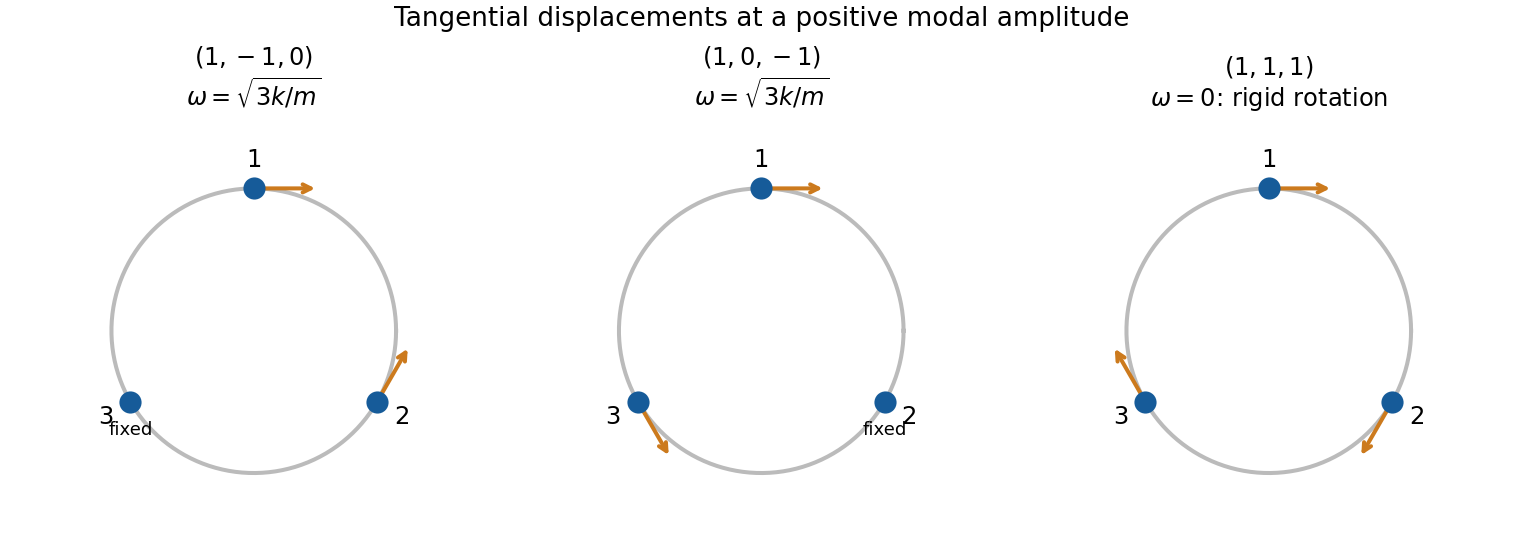
Original displacement sketches for two independent equal-frequency bead modes and the rigid-rotation zero mode; arrows indicate displacement along the ring rather than its radius
. Details. 
The two nonzero-frequency eigenvectors are not unique, because any independent linear combinations in their degenerate two-dimensional eigenspace form an equally valid basis. In particular the displayed pair is independent but not orthogonal; one could use and instead. The zero eigenspace is one-dimensional, so its vector is fixed up to scale and sign.
Specified release. Zero initial velocities permit and require . At , the three displacement conditions become , , . Therefore one convenient set of constants isEquivalently,Their sum remains , as required by zero initial total tangential momentum. Alternative amplitude signs with compensating phase shifts represent the same motion.
Constitutive law and Poisson ratio. Use positive stress for tension. In an isotropic linearly elastic medium, Hooke's law givesThe analogous equations follow by cyclic permutation. Under uniaxial tension in direction 1, and . Thus Poisson's ratio measures transverse contraction relative to longitudinal extension when the transverse stresses are zero. It is dimensionless; it is not the ratio of transverse stress to longitudinal stress.
Radial and hoop strains. Let a material point originally at radius move to , with small axisymmetric displacement. Two neighbouring radii separated by move apart by , so the radial fractional extension is . A circle's circumference changes from to , so its fractional extension is . ConsequentlyThe absence of longitudinal stress is a plane stress condition, not a claim of zero longitudinal strain.
Equilibrium of an annular wedge. Consider a slice of unit axial length, radial thickness and small angular width . The difference of the outward and inward radial face forces is to leading order. The two tangential face tensions have inward radial resultant : each contributes . With no body force, their balance gives the radial equilibrium of a thick elastic cylinder,This hoop contribution is why the radial stress need not be spatially constant in a thick wall.
Displacement equation. With , the two Hooke's law equations readInvert them:Substitute in . After cancelling the common factor, the right-hand side is , soThe cancellation explains why this displacement equation does not depend on the value of Poisson's ratio.
Power laws and wall pressure. Try . The indicial equation is , soThe resulting Lamé stress distribution in a pressurized cylindrical wall can be writtenThe pressure boundary tractions are and . Solving them yieldsHence the positive compressive radial pressure in the wall isIt equals at and at . This directional radial pressure is not an isotropic fluid pressure: radial and tangential stresses differ. The associated displacement is . Also , generally nonzero even though .
Maximum absolute tangential stress. For , and . Therefore the maximum of its absolute value must be at one of the two surfaces. Keeping the specified external pressure gives the fully general answerFor the usual high internal pressure with negligible external pressure, the largest magnitude is the tensile stress on the inner wall:For finite , the inner-wall expression is , but its absolute value is not always the larger endpoint value. For example, nearly equal internal and external pressures can leave the outer surface more compressive. With , both stresses correctly reduce to everywhere. These results use a homogeneous linear elastic wall without axial loading; a closed-ended pipe would require a different longitudinal-stress condition.
Selected final answers: Partial answer sheet, PDF page 181. This sheet does not cover every question.
Assume a hollow square electromagnetic waveguide with perfectly conducting walls, filled with vacuum or air. For side , the waveguide cutoff frequency isA transverse electric mode can have one zero index, but not both. A transverse magnetic mode requires both indices positive. Thus the lowest cutoff belongs to the two degenerate transverse electric modes and , withThe corresponding cutoff vacuum wavelength is . Strictly, a travelling mode carrying power along the guide needs : at the cutoff itself, the axial wavenumber and group velocity are zero. The number above is therefore the lower frequency threshold, not a propagating mode with nonzero longitudinal energy flux exactly at that frequency. A dielectric filling would replace by the wave speed in that medium.
Treat the lake as a large thermal reservoir at , and take the copper's heat capacity constant over the cooling interval from . Although the actual cooling is irreversible, entropy is a state function, so its change can be calculated along a hypothetical reversible path:The lake receives at constant temperature, givingTherefore, neglecting other changes,The positive total is the entropy generated by transferring heat across a finite temperature difference. The copper's entropy decreases, but the colder lake gains a greater amount.
Let be the length of the free straight segment from the current contact point to the mass, and let measure the contact point's rotation from first contact. For an inextensible taut rope, winding through angle uses length :The point mass follows an involute of the pole's circular cross-section. Its instantaneous velocity is perpendicular to the free rope. To verify the geometry explicitly, use planar polar unit vectors at the contact point:The rope's tension therefore does no work, and the speed stays at its initial value . The geometry gives . ConsequentlyThe distance from the pole's axis is , so a point mass first reaches the pole when . The winding time around a circular pole is thusThis has units of time. The model assumes a light inextensible rope, no energy loss at contact and a point mass. The required tension diverges at the ideal final contact, so finite strength and size matter very close to impact.
The symmetry is electromagnetic reciprocity applied to mutual inductance. For thin closed circuits in vacuum, the magnetic vector potential generated by circuit B isStokes theorem converts the magnetic flux through circuit A into its magnetic vector potential circulation. Dividing by gives Neumann's mutual-inductance formula,The dot product and separation are unchanged by interchanging A and B, soEach has units . The winding orientations must be used consistently to determine the common sign. The same reciprocity holds in ordinary linear reciprocal magnetic media; it is not an unrestricted statement about biased nonreciprocal materials. Equivalently, a reversible magnetic energy function has equal mixed derivatives with respect to the two currents.
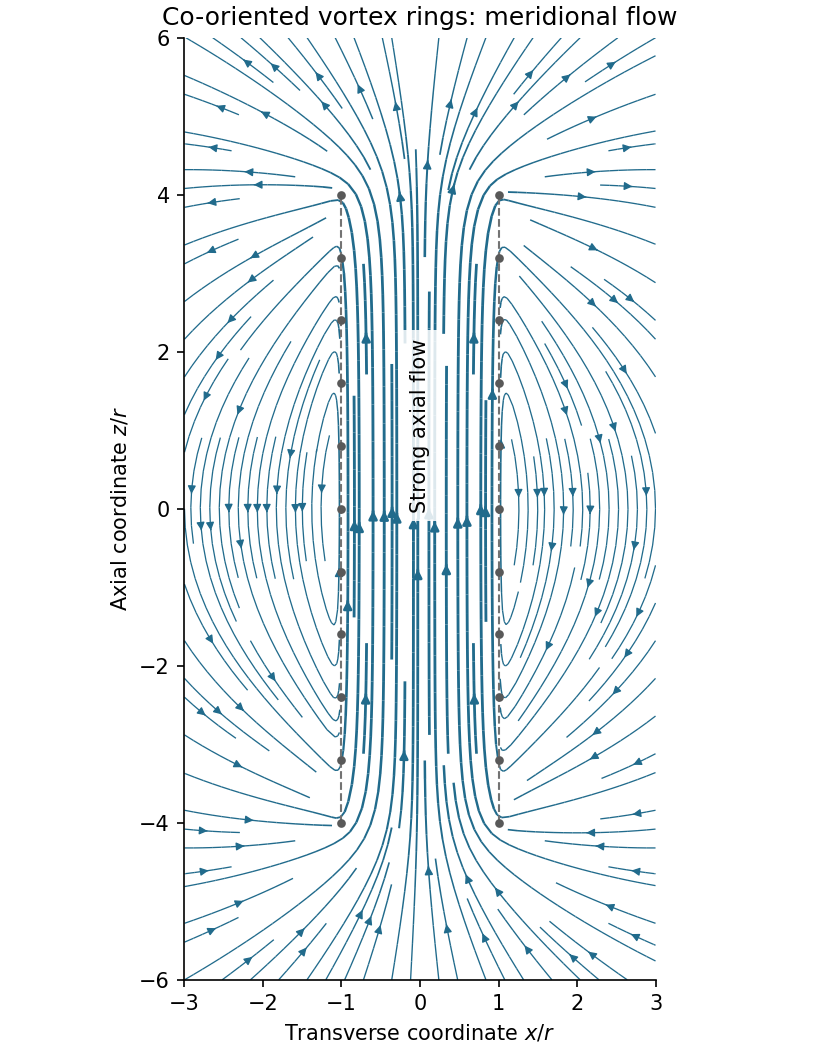
Assume all rings have the same circulation and orientation, and that there is no imposed background flow. Vortex lines describe the direction of vorticity, not the direction of velocity. For an incompressible fluid, the velocity induced by a thin vortex filament has the same Biot-Savart integral form as the magnetic field of a current filament:A closely spaced coaxial array of vortex rings is therefore analogous to a solenoid. The velocity field passes along the common axis through the rings and returns outside a finite array. Its orientation reverses if every circulation is reversed. In a long array, far from its ends and vortex cores, the velocity field of a dense coaxial vortex-ring array is approximatelyThe exterior field is exactly zero only in the ideal continuous infinitely long limit, with the background velocity set to zero. In a finite array the streamlines spread out at one end, run back outside, and converge into the other. A large number of closely spaced rings alone does not guarantee that the total array length greatly exceeds ; if it does not, the end and return flows remain substantial. Different unspecified ring circulations would require superposing their actual signed contributions.

Maxwell's displacement current is the electric-field contribution needed to make Ampère's law consistent with charge conservation. In macroscopic form,The displacement current density has units . Since , it contains the vacuum field term and, in matter, the polarization-current contribution. It need not represent free charge moving through a material.
Taking the divergence gives . Gauss's law, , then yields the continuity equation . Without the displacement term, Ampère's original law would incorrectly require every current distribution to be divergence-free even while charge accumulates.
A charging parallel-plate capacitor makes this concrete. Ignoring fringing, , so the displacement current across its dielectric gap is , equal to the conduction electric current in its wire. The integral lawtherefore gives the same answer whether the spanning surface cuts the wire or passes through the gap. Together with Faraday's law, this field term also permits self-consistent electromagnetic waves in vacuum, with speed .
For a cold, unmagnetized, collisionless plasma, take an equilibrium Electron density , Electrons of mass and charge , and approximately stationary ions. Use fields proportional to . The Electron displacement satisfiesIts electric polarization is , hence the cold collisionless plasma dielectric responseThe negative susceptibility arises from the inertial Electron response, rather than a restoring force binding an Electron to a particular atom.
A transverse electromagnetic wave then obeysFor , the plasma supports propagation, with refractive index . The phase velocity is greater than , while the group velocity is ; their product is , and no superluminal signal is implied. Below the plasma frequency, the bulk wavenumber is imaginary and the field is evanescent. A sufficiently thick plasma largely reflects such radiation in the lossless model.
Including an Electron momentum-relaxation rate replaces the denominator by :Its imaginary part describes absorption with the stated time convention. Finite Electron temperature also produces plasma screening of slowly varying electrostatic fields, with . That spatial, longitudinal screening problem is distinct from simply taking in the cold transverse-wave formula. Magnetic bias, ion motion and kinetic resonances require more general dielectric responses.
For weak fields in a linear isotropic material, magnetization is , with magnetic susceptibility . Paramagnetism has , while diamagnetism has . In either case, . These weak responses generally disappear when the applied field is removed, unlike hysteretic ferromagnetism.
A paramagnet can contain permanent magnetic moments from unpaired Electrons or atomic angular momentum. Alignment lowers the energy , while thermal disorder opposes it. For independent classical moments of magnitude , their weak-field average projection is , soThis is Curie's law; it assumes weak magnetization and no important interactions between moments. With quantum angular momentum , replace by . Strong-field magnetization saturates instead of growing linearly without limit. Conduction Electrons also exhibit Pauli paramagnetism: only occupations near the Fermi surface readily redistribute between spin states, giving a nearly temperature-independent susceptibility when .
Diamagnetism is an induced orbital response opposing the applied magnetic field. For bound Electrons, a weak field changes orbital motion and induces an opposing magnetic moment. For an isotropic collection of atoms, the elementary orbital estimate iswhere the sum runs over the Electrons of one atom. It is usually small and weakly temperature dependent. Delocalized Electrons also have orbital Landau diamagnetism; for an ideal three-dimensional free Electron gas with a quadratic isotropic dispersion and electron spin with , . Both spin and orbital contributions must be included to determine the total response. Diamagnetism is not a consequence of permanent dipoles choosing to align against the field; that orientation would increase their energy.
The Poynting vector is the electromagnetic energy flux density,In vacuum it equals . For a linear nondispersive medium with time-independent constitutive coefficients, Maxwell's equations and the identity give Poynting's theorem,The source term is work done by the fields on free charges; for an Ohmic conductor it is the positive local Joule heating rate . Integrating over a volume states that loss of stored field energy plus outward energy flow equals energy transferred to matter. In dispersive media, such as a plasma, material motion contributes to stored energy and the simple nondispersive expression cannot be used indiscriminately.
For a vacuum plane wave, and , and the propagation direction form a right-handed triad. With real peak field , the time-averaged wave intensity isMore generally, complex peak amplitudes give . Along a transmission line, the cross-section integral of the longitudinal Poynting vector is the transmitted electrical power . Energy flows through the electromagnetic fields in the surrounding dielectric, even though the conductors guide the currents.
Distributed circuit model. A transmission line must be treated as a distributed system when its propagation time is appreciable compared with the signal timescale. Divide a uniform two-conductor line into elements of length . Each has series resistance and inductance , and shunt electrical conductance and capacitance . The primes denote quantities per unit length, with units , , and , respectively.
Kirchhoff's voltage and current laws give the Telegrapher's equations:For a lossless line, , differentiation gives and the same wave equation for . The propagation speed and characteristic impedance areA general lossless signal has and . Thus characteristic impedance is the voltage/current ratio of one travelling wave, not simply the resistance of the wires. It can be real even when the line dissipates no energy, because energy is carried away by propagation.
For sinusoidal quantities with convention , the general lossy-line formulas areChoose the square-root branches for forward attenuation and positive forward power. The real part of is attenuation per unit length; its imaginary part is the phase wavenumber. For small losses, attenuation is approximately , using the lossless real in this estimate.
Fields and geometry. Two separated conductors support a transverse electromagnetic mode, with electric and magnetic fields transverse to the propagation axis. For a homogeneous dielectric and negligible conductor penetration, both examples below have and hence . The distributed circuit model follows from the field energy and charges in each slice.
For a coaxial cable with inner radius and inner surface of the outer conductor at , Gauss's law and Ampère's law giveThe electric field is radial and the magnetic field circles the axis. Integration of voltage and field energy givesThe equal and opposite return current on the outer conductor confines the ideal external field to the annulus.
For wide parallel plates of width separated by , neglect fringing. The electric field crosses the gap, , while the magnetic field lies in the gap parallel to the plates and perpendicular to propagation, . ThereforeFor a forward wave, points along the line. Integrating this Poynting vector over either cross-section gives instantaneous power . For complex peak amplitudes, average power is , or for a single forward wave on a lossless line. The conductors guide an energy flux predominantly in the dielectric between them.
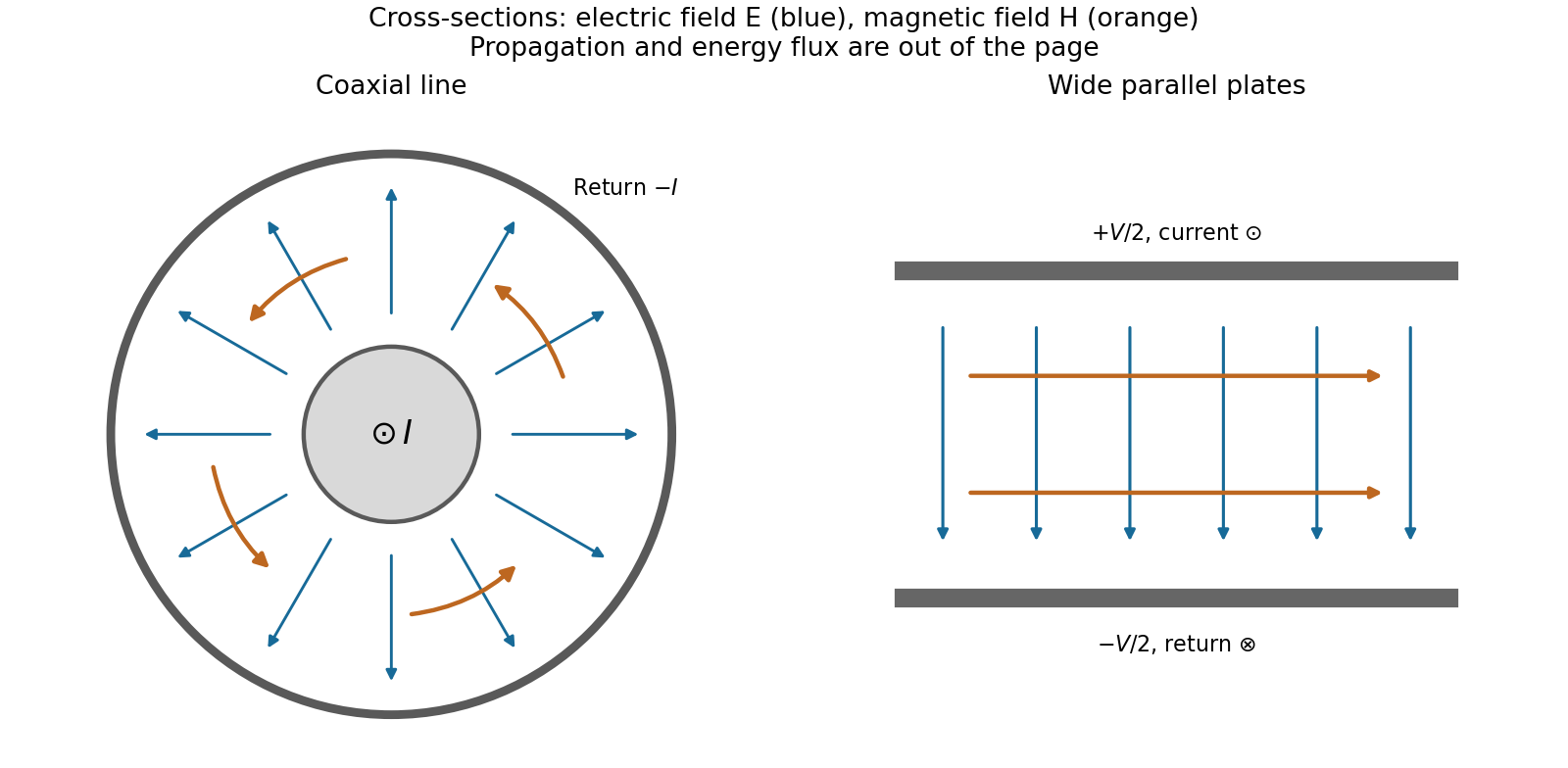

Terminations and reflection. At a load , require . If and are the incident and reflected voltage amplitudes there, the total current is . ThusA matched load, , absorbs the incident power with no reflection. An open circuit has , a current node and a doubled voltage at the end. A short circuit has , a voltage node and a doubled current there. A purely reactive load on a lossless line has and accepts no average power. For real , the reflected power fraction is and the accepted fraction is .
Incident and reflected waves produce a standing-wave pattern with voltage standing wave ratio . The input impedance of a lossless length isThis gives for a short and for an open. A quarter-wave section gives , enabling impedance transformation. After a source launches a pulse, a distant termination affects it only after the reflected pulse returns; the return time is . Real conductor resistance, dielectric loss and departures from a TEM field profile limit the ideal model at high frequency.
An Euler strut is a slender elastic column under axial compression. Let its bending stiffness about the weaker section axis be and its length be . With small lateral deflection and a dead compressive load , the quadratic total potential energy isThe first term is bending energy; the negative term is work released by the load as bending shortens the end-to-end distance. Stationarity gives . For pinned ends, at , and requires . The first instability is Euler's critical load,Below this load, the straight state has positive quadratic energy against these perturbations. At the threshold, the lowest bending mode has zero quadratic restoring energy; above it the straight state is unstable. For a rectangular section, about the appropriate bending axis, so the smaller second moment of area controls the first buckling direction.
Endpoint constraints matter. Write : for pinned-pinned, for fixed-free and for fixed-fixed conditions. This elastic instability differs from compressive material failure. Imperfections cause bending before the ideal threshold, and a short column may yield before Euler buckling occurs.
A gravitational assist changes a spacecraft's velocity relative to the Sun by scattering it in the gravitational field of a moving planet. In the planet's rest frame, ignore other forces during the encounter and take the spacecraft mass negligible. The incoming and outgoing asymptotic velocities have equal magnitude,because the encounter is conservative, but their directions differ along a hyperbolic orbit. If the planet has approximately constant heliocentric velocity , the heliocentric spacecraft velocities are . Its specific energy change isThus a flyby can increase or decrease heliocentric energy depending on its geometry. The planet exchanges momentum and orbital energy with the spacecraft; its speed change is extremely small because its mass is much greater. There is no energy creation and no increase of asymptotic speed in the planet's own frame.
For a point-mass planet, conservation of energy and angular momentum gives the hyperbolic eccentricity and deflection anglewhere is periapsis distance and the impact parameter. The velocity-vector change has magnitude , so the maximum energy-change magnitude for this fixed deflection is . A small periapsis increases the turning angle, but collision, atmosphere and tidal forces limit how close a real spacecraft may pass. Multiple encounters allow large changes without expending the propellant that equivalent direct velocity changes would require.
Take axes fixed in a rigid body, chosen along its principal axes, with moments of inertia . The angular momentum components are . Newton's rotational equation is , while the rotating-frame transport rule givesThus Euler's equations areThe nonlinear cross terms arise because the principal axes rotate. Even with no external torque, the body-frame components of angular momentum can vary while the angular momentum vector stays fixed in inertial space.
With zero torque, the equations conserveUniform rotation about any principal axis is a torque-free solution. If , linearization about the intermediate-axis solution givesThe positive coefficient gives exponential growth: intermediate-axis rotation is unstable, whereas rotation about the largest or smallest moment is linearly stable. For a symmetric body, Euler's equations also describe the precession of the transverse angular velocity around its symmetry axis. Torques from gravity or an applied couple enter through the right-hand sides rather than being absorbed into the inertial cross terms.
Archimedes' principle states that the resultant hydrostatic pressure force on a body equals the weight of the fluid displaced, directed opposite to gravity. Let be the displaced fluid region, with outward normal from the body into the fluid. Since the fluid pressure force is inward,Hydrostatic balance is , with downward gravitational acceleration . Thereforefor uniform fluid density and gravity. Uniform atmospheric pressure gives no net force on a closed surface. For a floating body, the same displaced-volume construction includes the free surface; any significant air buoyancy can be included as a second displaced fluid.
A freely floating body of mass satisfies , so its displaced volume is . A homogeneous body of density floats with submerged fraction ; if , hydrostatic buoyancy alone cannot support it. The buoyant force acts through the centre of buoyancy, the centroid of the displaced volume for constant density, while weight acts through the centre of mass. Their relative positions determine rotational equilibrium and stability. For a fully submerged body, a centre of mass below the centre of buoyancy gives a restoring torque; a floating body's changing displaced shape additionally requires the metacentric height criterion. Surface tension, externally driven flow and contact forces can alter the simple force balance.
Following the moving fluid. The Eulerian velocity field assigns a velocity to each position. A fluid particle satisfies , so the chain rule gives the material derivative, also called the convective derivative,Even in steady flow a particle can accelerate because it moves between regions with different velocity. For example, flow around a curved obstacle changes direction despite . Mass conservation isFor a constant-density incompressible fluid, .
Euler equations for an inviscid fluid and Bernoulli's equation. Neglect viscosity and take the body force per unit mass to be . Newton's second law for a fluid element givesFor steady flow, dot with displacement along a streamline. The tangential component of is the derivative of along that line. For constant density, integration givesIn uniform gravity, . Thus pressure, kinetic energy per unit mass and gravitational potential energy per unit mass exchange along a streamline. For a barotropic compressible fluid, replace by . Different streamlines need not have the same Bernoulli constant.
Vorticity and potential flow. Vorticity is . A small fluid element rotates locally with angular velocity after its deformational part is separated. The vector identitygives for steady constant-density inviscid flow. Thus an irrotational region has one common Bernoulli constant on each connected region. In a simply connected irrotational domain, introduce a velocity potential . Incompressibility then gives Laplace's equation, . For unsteady irrotational flow,An impermeable stationary wall fixes , but ideal potential flow does not enforce no slip. In a multiply connected domain, irrotational flow may still have nonzero circulation around an excluded vortex core, so a globally single-valued potential requires care.
For example, uniform two-dimensional flow past a circular cylinder has outside . Its normal velocity vanishes at the cylinder, and its surface tangential velocity is . Bernoulli's equation predicts a symmetric pressure distribution and zero drag. This is D'Alembert's paradox: the assumptions omit the viscous boundary layers, separation and wake responsible for real drag.
For an incompressible fluid of constant kinematic viscosity , the curl of the motion equation givesThe first term stretches and tilts vortex lines; the second diffuses vorticity. In two-dimensional incompressible inviscid flow the stretching term is absent and vorticity is carried with the fluid. In a three-dimensional inviscid flow it can be amplified by stretching. Density gradients not parallel to pressure gradients provide an additional source in a general compressible fluid.
Viscous flow. A Newtonian fluid's shear stress is proportional to rate of strain. For constant viscosity and incompressibility the Navier-Stokes equation iswith dynamic viscosity and kinematic viscosity . At an ordinary solid wall, the no-slip boundary condition sets fluid velocity equal to the wall velocity. Viscosity transfers momentum between neighbouring layers and converts mechanical energy into heat; unlike the pressure force, its shear contribution depends on velocity gradients.
For plane Couette flow between plates , with the upper plate moving at , the steady solution is , with shear stress . For pressure-driven flow through a pipe of radius , a constant pressure gradient gives the parabolic Poiseuille profileThe Reynolds number compares convective inertia with viscous force. Small Reynolds number often permits the Stokes-flow approximation; large Reynolds number can produce thin boundary layers and, under suitable conditions, turbulence. It does not justify neglecting the wall conditions. Bernoulli's inviscid constant is generally not conserved along a viscous streamline, and pipe flow instead shows a pressure loss corresponding to dissipation.
A Carnot cycle consists of four reversible stages: isothermal expansion at the hot-reservoir temperature , adiabatic expansion to , isothermal compression at , and adiabatic compression back to the starting state. The adiabatic stages exchange no heat. For one mole of an ideal gas, the two isothermal stages have heats and in magnitude. The reversible adiabatic relations ensure .
More generally, the total entropy change over any reversible cycle is zero. The two heat exchanges therefore satisfyWith work output , its thermal efficiency isThe temperatures must be absolute. The second law makes this the maximum efficiency for an engine exchanging heat only with those two reservoirs; irreversible entropy production lowers the efficiency.
Label the initial state 1, the end of compression 2, the end of constant-pressure heating 3, and the end of adiabatic expansion 4. The volume sequence is , with . The Diesel cycle has a compression adiabat , a horizontal constant-pressure heat-input segment , an expansion adiabat , and a vertical constant-volume cooling segment .
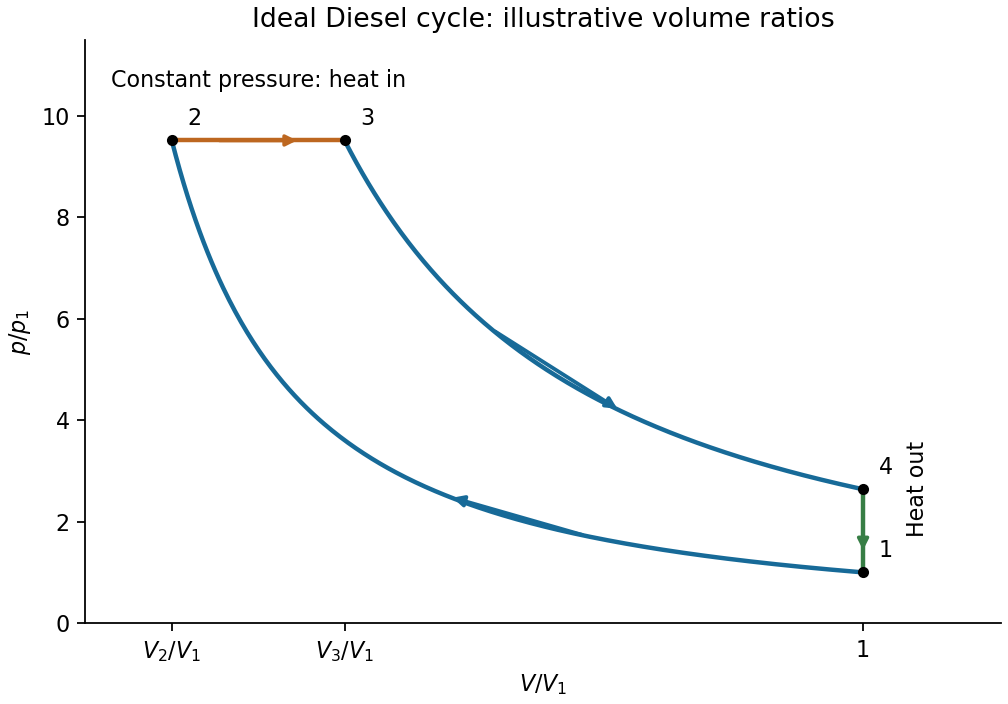

For an ideal gas, a reversible adiabat obeys , so it falls more steeply than an isotherm. The expansion adiabat lies above the compression adiabat at equal volume between and , giving a clockwise cycle with positive work output.
For one mole, , and constant heat capacities satisfy . The specified diatomic-gas model hasA reversible adiabatic process satisfies . Constant-pressure expansion satisfies . Applying these in order givesEvery volume ratio is dimensionless, so the expressions have units of temperature. For the intended volume ordering, the minimum temperature is and the maximum is .
Use heat into the gas as positive. The two adiabatic stages have . During constant-pressure heating and constant-volume cooling,The first law over a complete cycle gives , since the internal energy returns to its initial value. ThereforeSubstitute the temperatures:HenceEquivalently, define compression ratio and cutoff ratio :These formulas use the ideal constant-heat-capacity model and reversible adiabatic strokes. The heat-addition and heat-rejection strokes occur over changing gas temperatures, unlike the isothermal heat exchanges of a Carnot engine.
For , Taylor expansion gives . The vanishing-cutoff limit of the Diesel cycle isThe maximum temperature tends to , while the minimum stays at . A Carnot engine between those limiting extrema hasso the limiting efficiencies coincide. At exactly , however, both heat input and net work vanish, and the cycle retraces its compression adiabat. The efficiency there is an undefined ; the boxed value is the continuous limit for neighbouring nonzero cycles, not finite work at zero heat input.
For a finite cutoff ratio , the Carnot comparison uses , giving . The Diesel cycle has smaller efficiency. For example,which makes its rejected/input heat ratio larger than the Carnot ratio.
An equation of state relates equilibrium state variables such as pressure, volume, temperature and material amount. At fixed composition, it reduces the number of independent thermodynamic variables. It does not by itself specify all caloric properties: information such as heat capacity or internal energy is also needed.
At a liquid-gas first-order transition, an equilibrium isotherm can contain a constant-pressure interval in which changing total volume changes the phase fractions. A metastable single-phase extrapolation can instead show a region with ; that region has negative isothermal compressibility and is mechanically unstable. Thermodynamic phase coexistence requires equal temperature, pressure and chemical potential, and a consistent free-energy description replaces the unstable region by coexistence. For an appropriate analytic fluid equation of state, a liquid-gas critical point occurs where .
These tests diagnose the phase behaviour represented by that equation of state. They do not guarantee detection of every possible transition involving an additional order parameter which the mechanical equation omits.
For the given one-mole model,At fixed positive temperature its isotherm is an ideal-gas hyperbola shifted right by : pressure diverges as and tends to zero as . Higher temperatures give higher pressure at any fixed allowed volume.
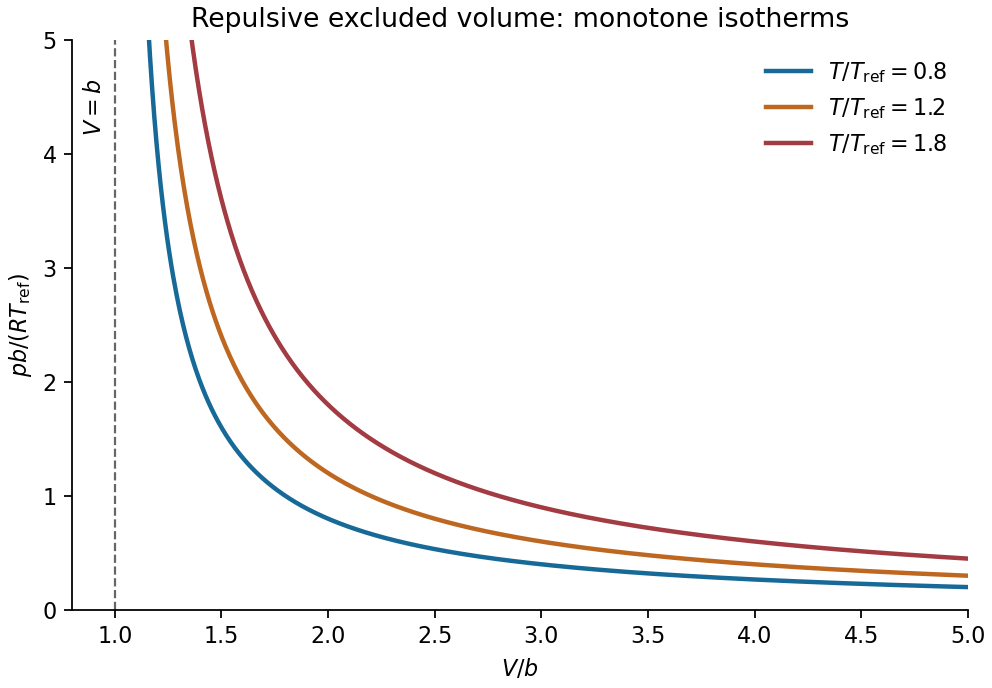

For positive , the volume is the effective volume available to molecular motion. Thus describes excluded-volume repulsion or an effective incompressible molecular core. It is a molar volume in this one-mole equation, not necessarily the literal sum of molecular geometric volume. Setting recovers the ideal gas law. No attractive-energy term is included.
Start with the fundamental relation at fixed material amount, , and expand entropy in independent variables :The last equality uses the supplied Maxwell relation. ConsequentlyFor the excluded-volume ideal gas, , so the bracket vanishes:Once depends only on temperature, cannot depend on volume either. Its stipulated temperature independence therefore makes it a constant, giving with arbitrary energy reference . Excluded volume changes the pressure without adding the volume-dependent attractive internal energy that a more general interacting-gas model might have.
Use the enthalpy . The equation of state gives , soAt fixed pressure, is constant. ThereforeSince and are constants, this ratio is independent of both temperature and pressure. Although the gas is not mechanically ideal when , its constant-pressure/constant-volume heat-capacity difference remains in this model.
For a reversible adiabatic change, , equivalently . Substitute :Integration, with fixed positive reference values , givesSince and ,The relation applies to the quasistatic reversible adiabat. Adiabatic heat isolation alone does not enforce it for an irreversible process which generates entropy. The shifted volume , rather than itself, is the appropriate coordinate in this model.
At every , ,There is no constant-pressure coexistence interval, unstable loop or finite-temperature critical inflection. The isothermal compressibility is positive:Thus this equation of state predicts no liquid-gas phase transition in its physical domain. Its divergence at the excluded-volume boundary is a repulsive constraint, not a liquid-gas coexistence mechanism. This conclusion concerns the stated model and cannot rule out an ordering transition requiring additional physics or an additional thermodynamic variable. Extrapolation to absolute zero is also outside the classical gas model's reliable regime.
For a classical dilute ideal gas in thermal equilibrium, the probability of a single-particle velocity is proportional to the Boltzmann factor for kinetic energy, . Velocities with speed between and fill a spherical shell of velocity-space volume . The normalized Maxwell speed distribution is thereforeThe factor counts states, rather than representing an extra Boltzmann energy factor.
Set and use . Normalization cancels in ratios, so the given recurrence givesConsequentlyThe root mean square speed is larger than the mean speed, consistent with the positive variance of the speed distribution.
Choose a flat wall and let measure the angle from the direction towards it. Particles of speed in solid angle occupy fraction of an isotropic gas. In time , those within normal distance reach the wall. Their number per area per time is therefore .
Only the incoming hemisphere contributes. Integrating gives the one-way collision rate per unit area,Its units are . This is not : selecting the incoming half of the particles must also account for their mean normal velocity. For effusion through a thin hole whose diameter is much less than the mean free path, the same one-way rate applies because collisions within the opening can be neglected.
Wall arrivals are not an unbiased sample of the gas: faster atoms arrive more frequently. The normalized speed distribution among incident atoms isThe angular factor in the arrival rate cancels when calculating the mean kinetic energy. ThusUsing givesBy contrast, an atom chosen randomly from the bulk has mean kinetic energy . The arrival weighting raises the normal-direction contribution to while each tangential direction still contributes . This is also the mean energy carried by atoms effusing through a thin aperture from an equilibrated reservoir.
Denote the heated and cold vessels by subscripts . For argon, the opposing effusive particle rates are equal in the steady state:Because and ,This is thermal transpiration in the free-molecular limit. It fixes a ratio; the initial conditions determine the absolute pressures.
For the stated two identical vessels, take their fixed volume to be and the combined system sealed. Initially it contains atoms. HenceLet . Combining this inventory with gives the closed-vessel thermal transpiration resultHeating makes the hot side less dense but at higher pressure. Both expressions reduce to when . For a small imposed temperature rise , the pressure difference starts as .
If instead the cold vessel is interpreted as an externally maintained pressure reservoir with , the answer becomes . That alternative requires the fixed-pressure reservoir assumption; it does not conserve the initial particle inventory of two sealed equal-volume vessels. Merely describing the vessels as large does not keep their pressures fixed through the redistribution. The pressures in the boxed answer assume the natural closed-vessel interpretation.
Let L be the vessel initially containing argon and R the vessel initially containing helium. Both have volume and fixed temperature , and the aperture has area . The incoming and outgoing rates of each species must be considered separately. For species ,Thus its density difference relaxes exponentially with time constantThe two-vessel effusive mixing solution for the four densities isUsing atomic masses of approximately and atomic mass units gives . Helium therefore transfers faster. Each species eventually reaches in each vessel, but its transient is different. In particular, the total density temporarily rises in the initially argon vessel and falls in the initially helium vessel, before both return to .
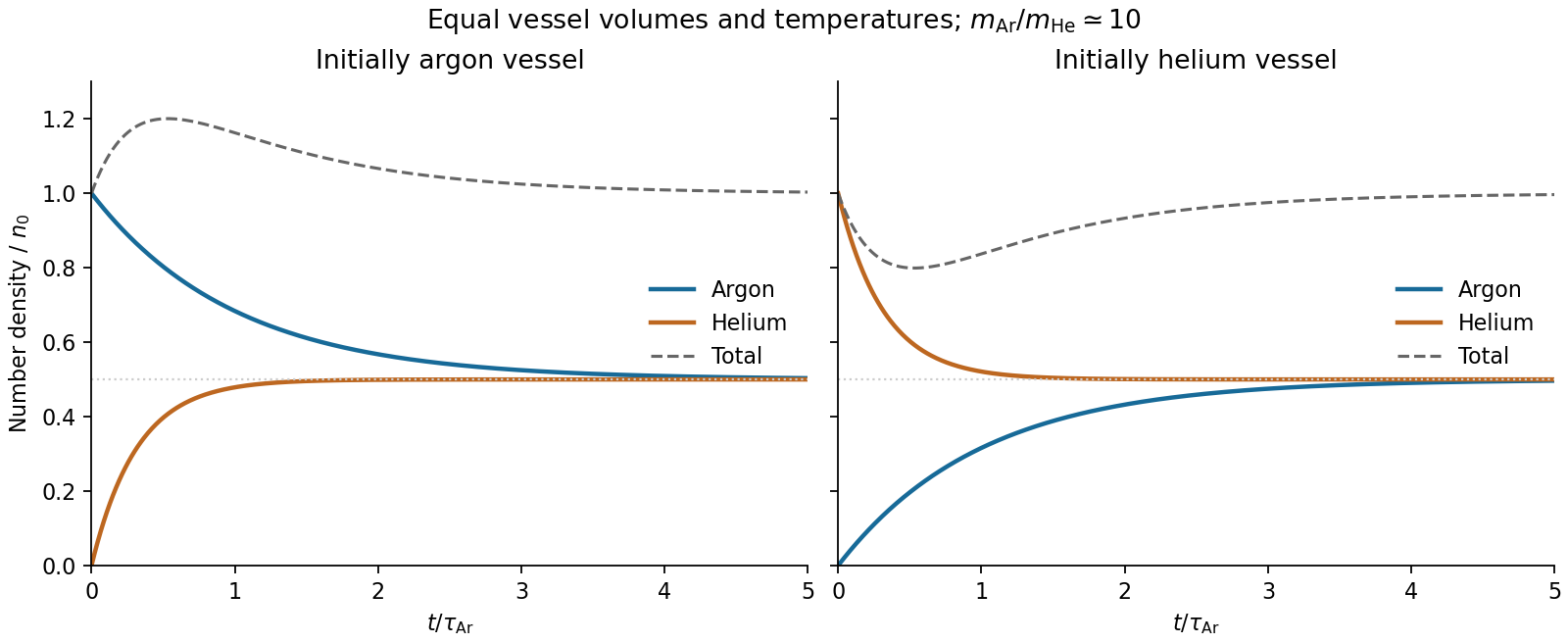

For unequal maintained temperatures , replace the rate equation byWith each species' total density sum still , its final densities and relaxation time areEvery species has the same final density ratio and partial-pressure ratio . Thus there is no permanent composition separation in this ideal steady state, although the rates remain mass dependent. A maintained hot side has lower density and higher pressure. Equal particle rates do not imply thermal equilibrium: atoms arriving from the hotter side carry more energy, so external heating and cooling are required to hold different temperatures. The model assumes thin-hole effusion, local equilibrium within each vessel and negligible aperture volume.
Articles were limited to the first 100 out of 101 total.
Articles by others on the same topic
There are currently no matching articles.