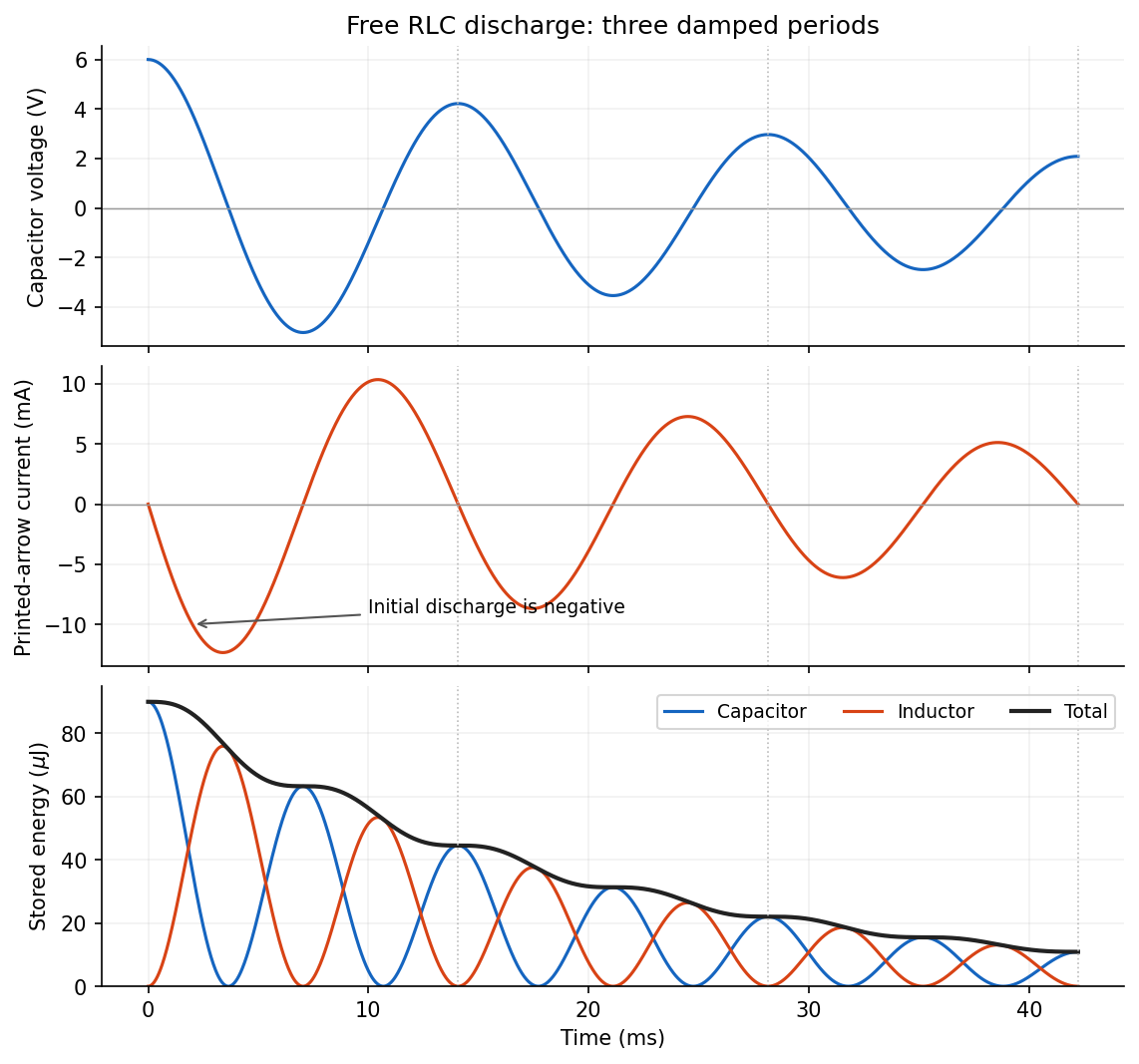
Put . The initial conditions giveThe printed electric current arrow points toward the positively labelled capacitor plate, so its signed electric current is , not the positive discharge magnitude. HenceFor the stated electrical resistance,The voltage starts at with zero slope; the signed electric current starts at zero and initially becomes negative. Its initial slope is . Both oscillate with an envelope and a amplitude time constant. The phase difference is close to a quarter period, with the small damping correction displayed explicitly in .

Articles by others on the same topic
There are currently no matching articles.