The ground-state energies are and , respectively. For a particle in a box of width , the wave function must vanish at both infinite walls. The lowest nonzero standing wave therefore has wavelength , giving the kinetic energy eigenvalueUsing the electron mass and converting joules to electronvolts givesDoubling the confinement length divides this kinetic energy by four. A zero potential energy inside the box does not imply zero total energy: a constant, zero-momentum wave function cannot satisfy both wall conditions unless it vanishes everywhere. This is a concrete manifestation of quantum confinement and the Heisenberg uncertainty principle.
Write the proposed Jeans mass as , with dimensionless . The dimensions of speed, the gravitational constant and pressure areEquating the exponents of mass, length and time givesThus , and , so the pressure-confined Jeans mass scales asA larger speed of sound gives stronger support against gravitational collapse; stronger confinement at fixed speed of sound lowers the characteristic unstable mass. Dimensional analysis determines the scaling, not , which requires a particular cloud model and instability criterion.
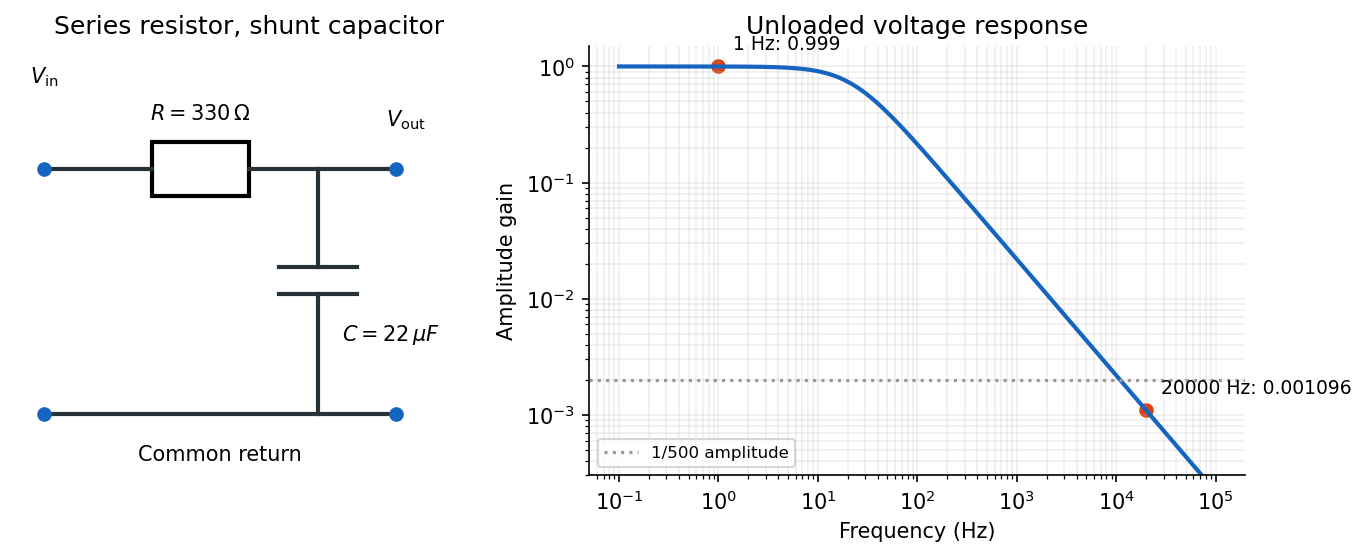
Use an RC low-pass filter: put the resistor in series with the input and the capacitor between the output node and the return conductor. Measure the output voltage across the capacitor, with negligible output loading. The voltage divider then has transfer functionAt the high frequency, the attenuation requirement isAt the low frequency, approximately unchanged amplitude means , soThe upper relation is an asymptotic design condition, because “approximately” specifies no numerical tolerance. For example, retaining at least of the low-frequency amplitude would sharpen the upper bound to approximately .
A practical illustrative choice is . Its voltage gain is approximately at and at : the latter amplitude is reduced by a factor of about . Its cutoff frequency is .
For an ideal air-gap parallel-plate capacitor, neglecting fringing, the electric field between oppositely charged plates is . Dielectric breakdown therefore limits the magnitude of the electric charge on either plate toThe two plates carry and ; the quoted stored electric charge is the magnitude on one plate, rather than the net electric charge of the whole capacitor. The gap does not enter this ideal bound: and make independent of . Edge enhancement of the electric field can lower the practical limit.
Far from its ends, approximate the body by an infinite uniform cylinder. By cylindrical symmetry, the Newtonian gravitational field is radial. Applying Gauss's law for gravity to a coaxial cylindrical surface of radius and length outside the material givesAt the surface, , soThe gravitational acceleration points inward toward the axis. Its small magnitude reflects both the small size and the modest density. The infinite-cylinder approximation uses the specified distance from both ends; a spherical approximation would discard the relevant geometry. No rotational contribution is included, since no rotation rate is supplied.
The threshold must conserve both energy and momentum. For head-on photons, the total energy is , while the total momentum has magnitude . Their combined invariant mass satisfiesAt the threshold for photon-photon pair production, the electron and Positron have no relative momentum in their centre-of-momentum frame, so . ThereforeSimply equating the laboratory energy to would miss the very large laboratory momentum: the newly produced pair must carry it away.
The moment of inertia about a specified axis is , where is perpendicular distance from the axis. The parallel axis theorem states for two parallel axes separated by , one passing through the centre of mass of a body of mass .
It is easiest to calculate the eccentric disc by subtraction. Let be the mass of the unperforated disc and the removed mass. Uniform thickness and density give and , hence and . The hole is tangent to the rim, so its centre, and therefore the shaft axis, lies from the original disc centre. About the shaft axis,The shaft contributes . ThusThe motor's torque is at nonzero angular velocity, while the resisting torque is . The rotational equation of motion and its equivalent energy balance areAt the steady state, input power equals dissipated power, givingFor the acceleration, use . Then with , soThe approach to takes infinite time. This constant-power rotational acceleration idealizes the start: diverges at rest, although the energy balance has a well-defined limiting solution. A real motor has finite starting torque.
Conservation of energy states that the total energy of an isolated system is constant. In a mechanical problem with conservative forces and no dissipation, it gives . It often determines a speed or turning height directly, without solving the full time-dependent equation of motion. With external work or dissipation, use the corresponding energy balance instead.
After a drop leaves the wheel, neglecting air resistance, the conservative force of the Newtonian gravitational field acts. Put the origin at the wheel axis and choose positive horizontal displacement to the right. In the printed diagram is measured upward from the leftward horizontal radius, and rotation is clockwise. The release position and velocity are thereforeFor upward release, . These conventions fix the signs used below.
With zero gravitational potential energy at the wheel axis, the release energy and the energy at the apex of the projectile motion areOnly the vertical velocity vanishes at the apex: the horizontal kinetic energy remains. Equating the two energies gives
Set . The maximum height becomes the concave quadratic functionUnder the stated high-angular frequency assumption, , its interior maximum isThus the optimum release lies on the upper-left quarter of the wheel for the printed clockwise rotation. The largest attained height isIf extended to , the maximum over release positions is the limiting height at the top of the rim. The interior solution is the relevant branch for reaching a ceiling above the wheel.
To avoid contact with the ceiling, require . Writing giveswhose roots are . Because , the lower root is less than , while the assumed branch has . The lower inequality is therefore automatic on this branch, leavingEquality is the first grazing contact. This branch check is essential: retaining both algebraic roots as independent lower and upper speed limits would introduce a spurious lower limit on avoiding the ceiling.
At first contact the globally highest trajectory just touches the ceiling at its apex. Its flight time to that point is . The horizontal displacement from the wheel axis isHence the first point struck is directly above the rotation axis, independently of . The release starts to the left of the axis, but the drop's horizontal travel exactly cancels that offset at the optimum apex. The first-contact angular velocity satisfies .
The Michelson-Morley experiment splits coherent light into two perpendicular arms, reflects the beams and recombines them to observe interference fringes. Rotating the apparatus interchanges each arm's orientation relative to a proposed stationary luminiferous aether. The historical experiment used multiple reflections to increase the effective optical path and a rotatable support to compare orientations.[ref]
On the Relative Motion of the Earth and the Luminiferous Ether by Albert Abraham Michelson and Edward W. Morley. 1887, printed pp. 333–341: optical arrangement, rotation and fringe-shift comparison
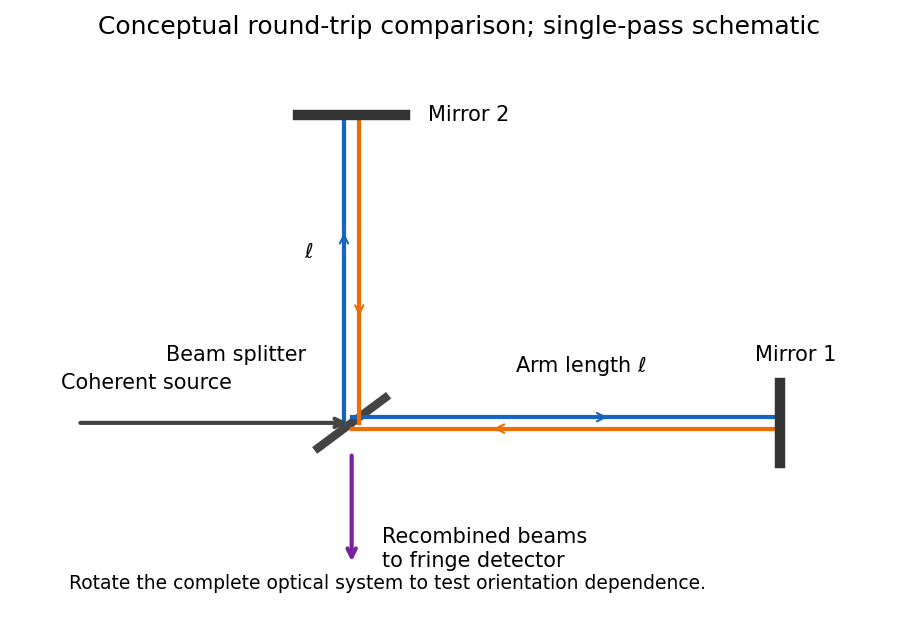
For equal one-way effective arm lengths , a classical stationary-aether model givesA right-angle rotation should reverse their difference, producing a fringe shift of approximately . The observed orientation-dependent shift was much smaller than the stationary-aether prediction. In special relativity, the apparatus rest frame has the same vacuum speed of light along both arms, so no such orientation-dependent shift is expected. The result supports special relativity but does not, by itself, uniquely establish every postulate or exclude every modified aether theory.
For the rocket, take its tail at and nose at , with coincident frame origins when . Denote emission, reflection and return by . In the rocket's inertial frame, their coordinates areThe inverse Lorentz transformation is , , where . Thus the same spacetime events, in coordinates , areThere is no requirement that emission have in this chosen laboratory coordinate system.
The nose-to-tail travel time is . If is the laboratory length measured at one laboratory time, a left-moving pulse and the right-moving tail close their initial separation at speed . ThereforeThis derives length contraction from the pulse's travel. Comparing the positions of the two endpoints at different laboratory times would not measure the rocket's laboratory length.
After switching, Kirchhoff's voltage law gives the free series RLC circuit equationIts characteristic roots are , whereA real, nonzero oscillation frequency requires . For a passive resistor,The endpoint is the undamped limit; strictly decaying oscillations have . The critical endpoint itself does not have a nonzero .
Let denote the initial electric charge, so and . Distinguish from the amplitude coefficient in an exponential-times-cosine representation: imposing zero initial electric current generally requires a nonzero phase.
Put . The initial conditions giveThe printed electric current arrow points toward the positively labelled capacitor plate, so its signed electric current is , not the positive discharge magnitude. HenceFor the stated electrical resistance,The voltage starts at with zero slope; the signed electric current starts at zero and initially becomes negative. Its initial slope is . Both oscillate with an envelope and a amplitude time constant. The phase difference is close to a quarter period, with the small damping correction displayed explicitly in .
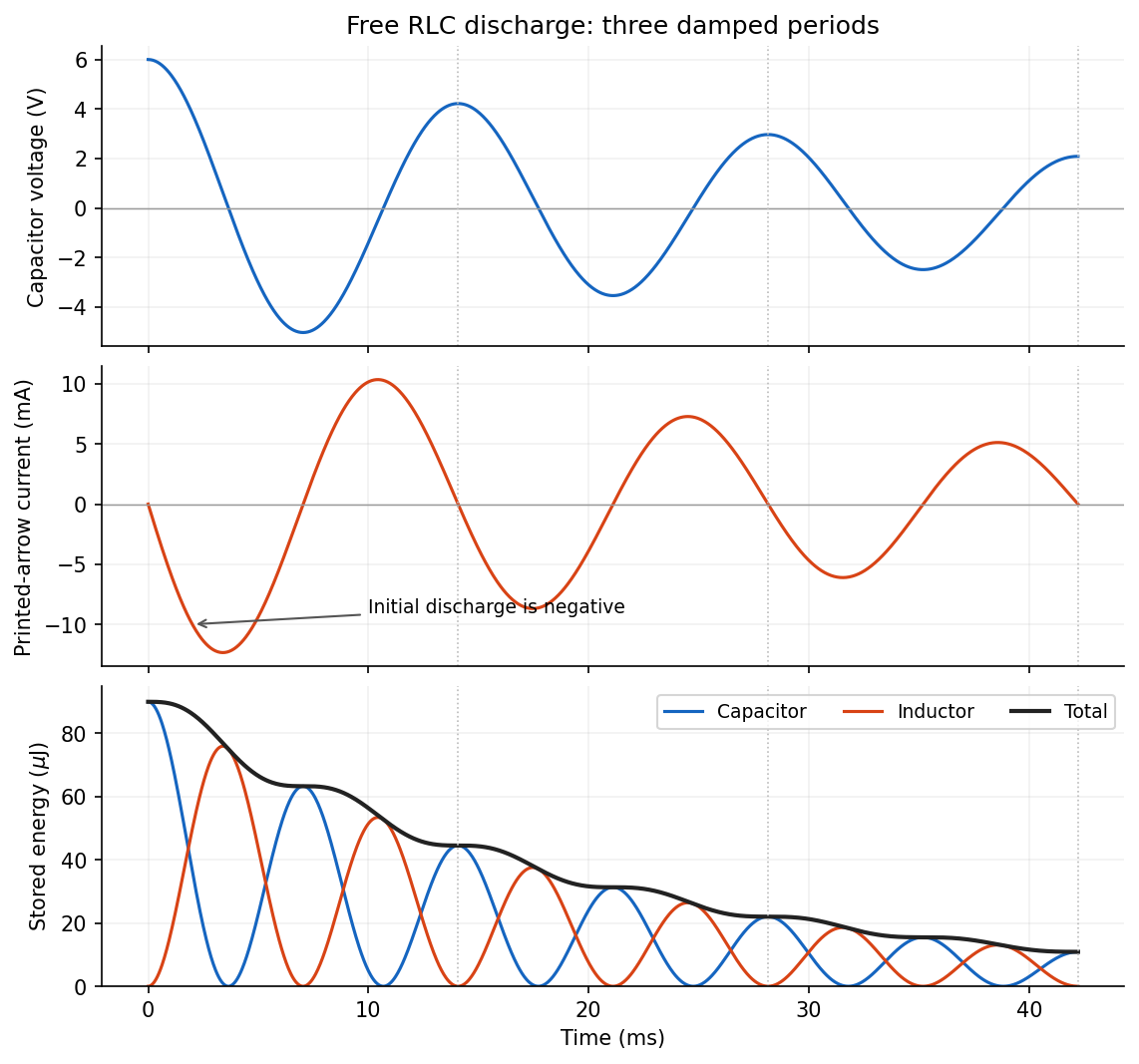
Signed capacitor voltage and printed-arrow current, with the exchange and dissipation of circuit energy over three periods
. Details. The capacitor stores electrostatic energy, the inductor stores magnetic energy, and the resistor converts energy into heat. Their instantaneous values areThe sign convention for electric current does not change these expressions. With the initial voltage, and .
The two stored energies follow directly by squaring the expressions for electric charge and electric current:Both are nonnegative, with alternating maxima. Initially all stored energy is in the capacitor; at a zero of it is entirely in the inductor. The total isThe total energy decreases monotonically, with a horizontal tangent whenever the electric current is zero. Its envelope decays on the scale, but the exact total is not a featureless exponential: the resistor's instantaneous loss varies within each oscillation. The figure in part (a) shows this gradual modulation of the downward slope as well as the component energies.
Measure the mass's displacement from its static equilibrium height. This removes the constant spring extension supporting its weight. If the spring's top moves with the box, its incremental extension is , so its incremental upward force is . The specified damping force is against the mass's velocity in the static frame. Newton's second law therefore givesIn absolute height coordinates an additional constant on the right expresses the spring's rest length, its fixed attachment height and gravity; translating to static equilibrium removes it. Replacing the given damping by would describe a different base-excited oscillator.
After the decaying transient, write the steady-state response as . Using a complex sinusoid givessoFor positive frequency, the phase lag lies between zero and , passing through at . For small , the frequency response begins at , develops a narrow resonance near , and falls asThe precise amplitude-peak frequency is when that expression is positive.
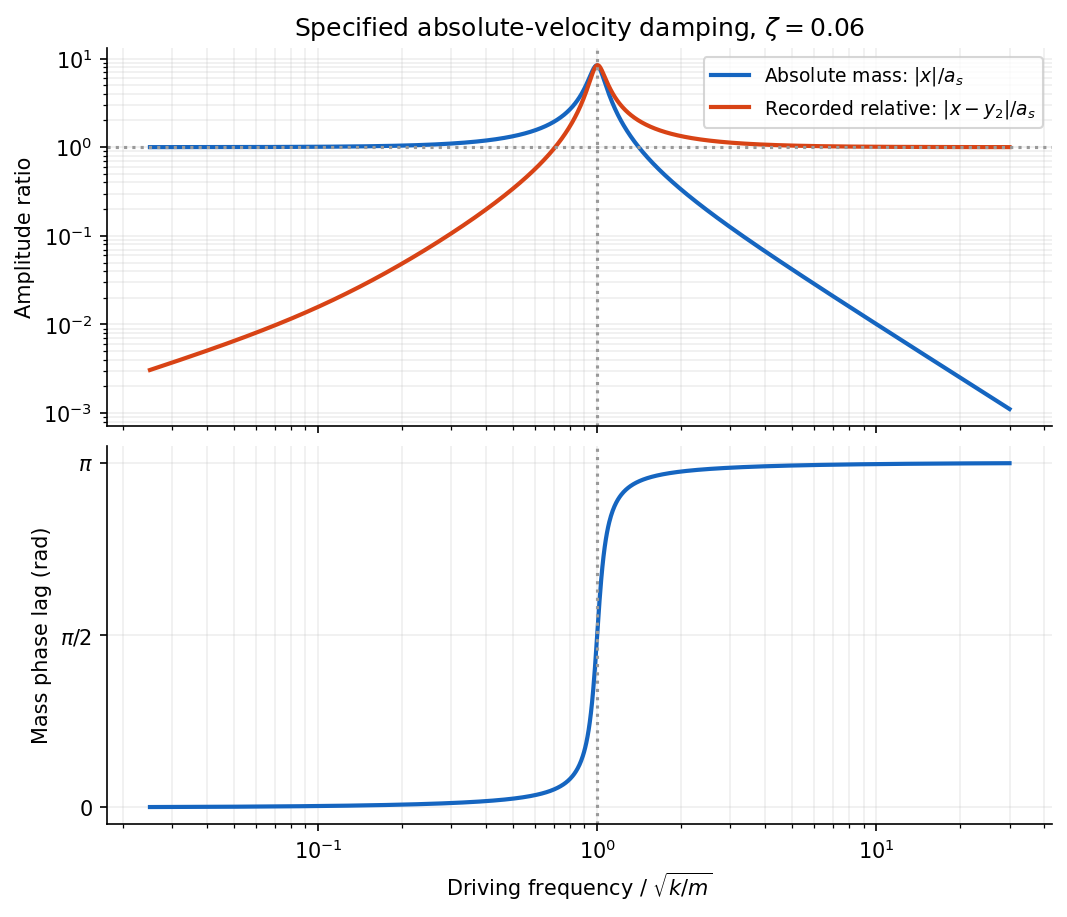
Absolute and relative motion of the stated seismograph model, and the phase lag of its inertial mass
. Details. The pen records the relative displacement . Its complex transfer function isAt high frequency, is small while . The inertial mass then stays nearly stationary and the recorded relative motion reproduces the ground displacement, with reversed sign. At low frequency the mass follows the box and their relative motion is small; near resonance the response is strongly frequency-dependent. Here “high” means compared with the suspension's natural frequency, rather than an absolute seismic-frequency threshold.
Comparing with the standard wave equation gives the shallow-water wave speedTwice differentiating the proposed standing wave multiplies its spatial factors by and , and its temporal factor by . It solves the wave equation precisely whenTo obtain the local gravitational potential energy, integrate through a water column of height and unit horizontal area:The time averages are and . ThusThe constant is retained because the specified zero of gravitational potential is the tank bottom. This is local time-averaged potential energy, not the sum of potential energy and kinetic energy.
The no-normal-flow wall conditions are Neumann boundary conditions. Differentiating the cosine factors at the opposite walls givesNegative integers give the same cosine modes. The formal case has : it is a uniform change of the mean level, not a finite-frequency oscillation. In a closed tank with fixed water volume even that mean-level change is excluded from the oscillatory disturbance.
Since , the lowest finite frequency is the mode :It is uniform across the shorter direction, has opposite-sign displacement antinodes at the two ends of the longer direction, and a displacement node midway along it.
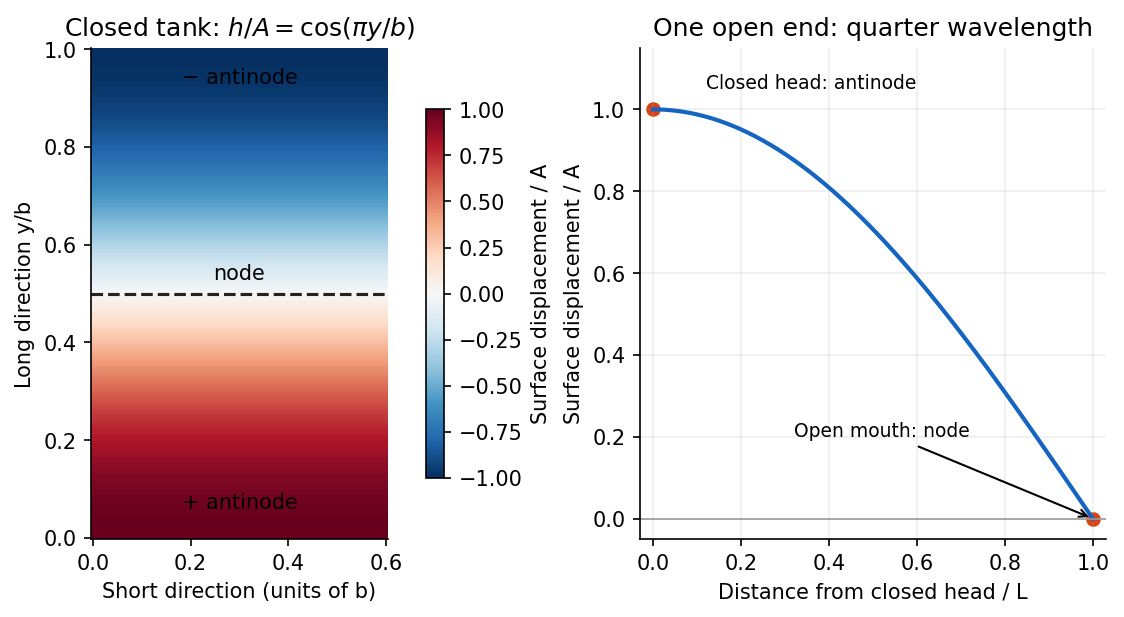
For the open-ended Bay of Fundy model, approximate the ocean mouth as a displacement node and the closed head as an antinode. The fundamental is a quarter-wave basin resonance, so its wavelength is andTaking a roughly -hour semidiurnal tide gives . Using the principal lunar period of approximately gives . The idealized estimate is therefore about . The lunar period is half of a roughly -hour -minute lunar day.[ref]
About Harmonic Constituents by National Oceanic and Atmospheric Administration. Examples M2 and S2: two lunar peaks per 24 hours 50 minutes, compared with two solar peaks per 24 hours
This estimate treats the mouth as an ideal open boundary and replaces the real basin by a uniform depth. The supplied large tidal height motivates resonance; it is not enough by itself to determine damping or an amplification factor in this model.
Snell's law is , with angles measured from the interface normal. The Huygens-Fresnel principle explains it by constructing the transmitted wavefront from secondary wavelets: during the same time interval, distances travelled in the two media are proportional to and . The geometry of the advancing plane wavefront then gives .
For incidence from index into vacuum, the transmitted angle is . The ray bends away from the normal, so its positive deviation isFor ,Thus the graph rises monotonically from zero to a finite endpoint with a vertical tangent:At the endpoint the transmitted ray grazes the interface. Beyond the critical angle for total internal reflection, no propagating transmitted ray exists and total internal reflection occurs.
Inside a prism, the two ray angles with the face normals sum to its apex angle. For the equilateral cross-section, they are and . The entry deviation equals the corresponding exit deviation under ray reversal. Adding the two changes of direction therefore givesThis is symmetric about . Symmetry alone gives a stationary point; to establish that it is a minimum, differentiate once more:within the transmitted-ray interval. The sum is therefore strictly convex, andThese expressions require for a non-grazing path through both faces; is a grazing limit, and admits no such two-face transmitted path. More explicitly, both internal angles must be at most , which is possible only if .
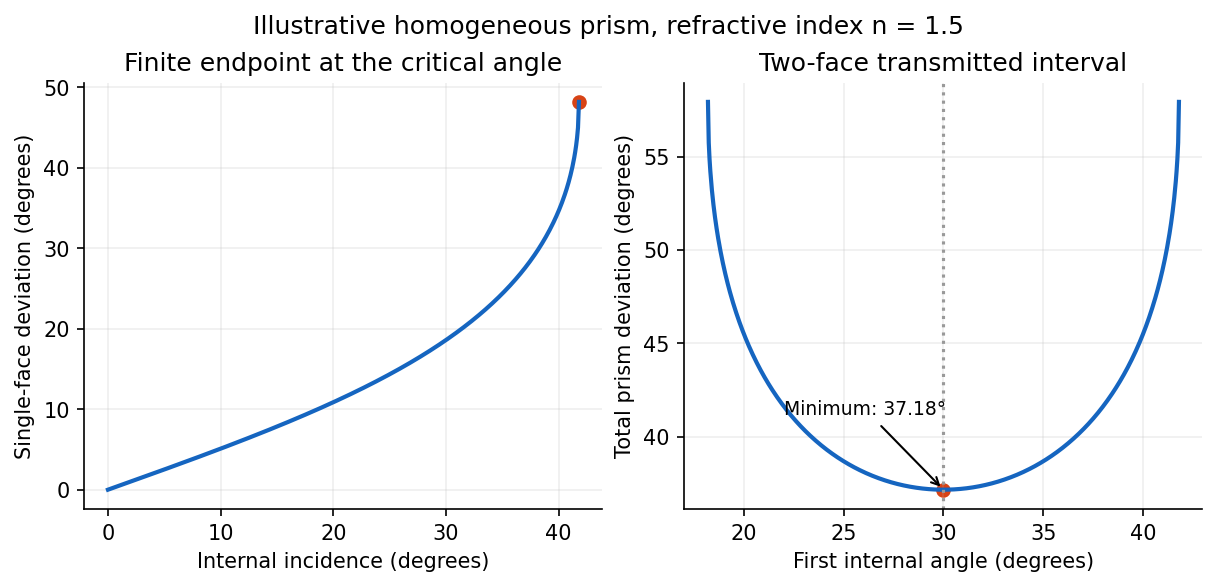
Single-interface deviation and the symmetric minimum of an equilateral prism, illustrated for index 1.5
. Details. Atmospheric hexagonal ice crystals can present pairs of faces with a angle, acting as small prisms. Their orientations turn the minimum-deviation cone around the Moon into an optical halo. No transmitted ray of this family is deflected less than the minimum deviation of a prism. Moreover, near the minimum, is quadratic in the departure from the symmetric ray, so a range of incident directions is compressed into a small outgoing angular range. This caustic makes the inner rim sharp and bright, with the ray density decreasing farther outside. The common 22-degree halo has an angular radius near about either the Sun or Moon, hence a diameter near .[ref]
For a steady thin-wire electric current, the Biot-Savart law iswhere points from the source element to the field point and follows positive electric current. On a circular loop's axis the transverse contributions cancel by symmetry. The axial numerator is and the distance is , givingIts graph is positive and even, with maximum at the centre and a far-field decay. Reversing the electric current reverses its sign.
For two equally oriented -turn coils centred at , superposition givesConsequentlyThis is an even differentiable function, so every odd derivative at zero vanishes, including the first and third. To check the second derivative explicitly, let . ThenThus makes the quadratic variation vanish, which is the Helmholtz coil condition. The central value and leading axial variation are
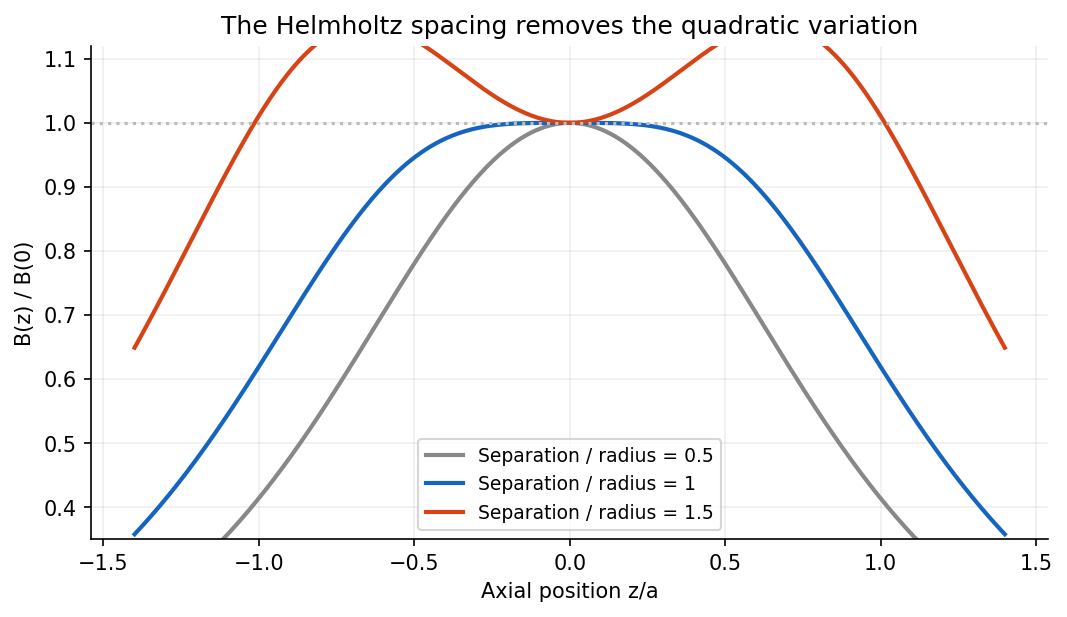


Near the centre, the coils' magnetic field lines are nearly straight and parallel to the axis. On the axis rotational symmetry makes exactly; in the central plane the radial components from the two coils cancel. More quantitatively, in the current-free central volume, axisymmetry and implyThe suppressed axial derivatives therefore also suppress transverse magnetic fields near the centre. The smallness applies locally compared with the coil radius; it is not a claim of an exactly uniform field throughout the apparatus.
In a fixed point-mass Newtonian gravitational field, a test mass experiencesBecause this is a central force, its torque about the attracting centre vanishes and angular momentum is conserved. The orbit lies in a fixed plane and sweeps out equal areas in equal times. Since the force is also conservative, the specific orbital energy is constant:The last two terms form an effective potential. They show how the angular-momentum barrier competes with attraction and determines the turning radii. For nonradial motion the orbit is a conic section:Negative energy gives an ellipse, with ; zero energy gives a parabola; positive energy gives a hyperbola. The circular limit has , and . For a bound ellipse of semimajor axis , and the orbital period is . The local escape speed is . These are the point-mass, test-particle limits; extended mass distributions or noncentral perturbations change the orbit laws.
An electric dipole consists of opposite electric charges separated by a short displacement. Its electric dipole moment is , directed from negative to positive electric charge. At distances large compared with the separation, its leading electric potential and electric field in vacuum areThe absence of net electric charge removes the monopole term; the dipole electric potential therefore falls as rather than . On its axis the electric field is parallel to with magnitude ; on the equatorial plane it points oppositely with half that magnitude.
In a uniform applied electric field, the two forces cancel as a net translation but form a couple. The torque and potential energy areAlignment parallel to the electric field is stable. A nonuniform electric field can also exert a net force, for a fixed permanent electric dipole moment. An induced electric dipole instead depends on the applied electric field, so its energy must account for the work needed to create it.
Electromagnetic induction is the production of an electromotive force by changing magnetic flux or by moving a conductor through a magnetic field. With the loop and surface orientations related by the right-hand rule, Faraday's law of induction isHere is the local wire velocity. For a stationary loop, the induced electric field can have a nonzero closed-path integral; its differential form is . For a straight rod moving perpendicularly to itself and to a uniform magnetic field, the motional electromotive force has magnitude .
The minus sign expresses Lenz's law: the induced electric current produces a magnetic field that opposes the change in linked magnetic flux. Pulling a conducting loop through a magnetic field therefore requires work against an electromagnetic resisting force; that work supplies the resulting heat or stored energy.
For an inductor with constant self-inductance, and its stored magnetic energy is . A changing electric current in one coil can induce an electromotive force in another through mutual inductance, the operating principle of a electrical transformer. These examples connect the flux law, the direction of the response and conservation of energy.
The Lorentz force determines the motion of a charged particle:At nonrelativistic speeds, . The electric field does work at rate , while the magnetic part of the Lorentz force is perpendicular to velocity and does no work. A uniform electric field gives constant acceleration ; with a transverse initial velocity, the trajectory is a parabola.
In a uniform magnetic field, the parallel velocity is constant, while the perpendicular component undergoes circular motion. The angular cyclotron frequency, orbit radius and helical pitch areThe sign of determines the sense of rotation. For perpendicular uniform electric fields and magnetic fields, the guiding centre has the electric drift velocityIndeed, , so the remaining motion is cyclotron rotation about that drifting centre, with possible motion along the magnetic field. The drift is independent of electric charge sign and mass. At relativistic energies, retain and the corresponding relativistic orbit radius rather than assuming constant nonrelativistic acceleration.
Articles by others on the same topic
There are currently no matching articles.