After switching, Kirchhoff's voltage law gives the free series RLC circuit equationIts characteristic roots are , whereA real, nonzero oscillation frequency requires . For a passive resistor,The endpoint is the undamped limit; strictly decaying oscillations have . The critical endpoint itself does not have a nonzero .
Let denote the initial electric charge, so and . Distinguish from the amplitude coefficient in an exponential-times-cosine representation: imposing zero initial electric current generally requires a nonzero phase.
Put . The initial conditions giveThe printed electric current arrow points toward the positively labelled capacitor plate, so its signed electric current is , not the positive discharge magnitude. HenceFor the stated electrical resistance,The voltage starts at with zero slope; the signed electric current starts at zero and initially becomes negative. Its initial slope is . Both oscillate with an envelope and a amplitude time constant. The phase difference is close to a quarter period, with the small damping correction displayed explicitly in .
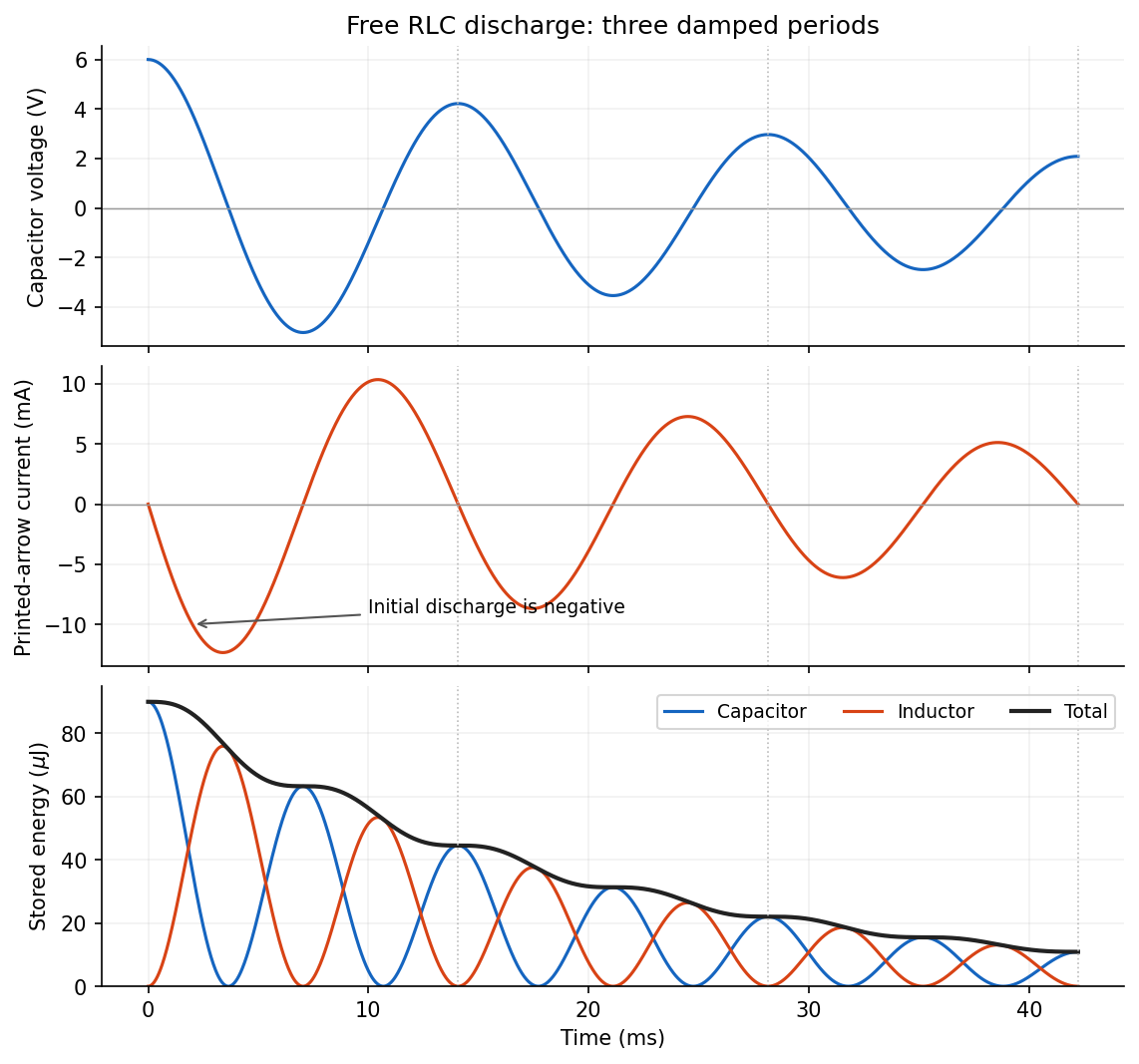
Signed capacitor voltage and printed-arrow current, with the exchange and dissipation of circuit energy over three periods
. Details. 
The capacitor stores electrostatic energy, the inductor stores magnetic energy, and the resistor converts energy into heat. Their instantaneous values areThe sign convention for electric current does not change these expressions. With the initial voltage, and .
The two stored energies follow directly by squaring the expressions for electric charge and electric current:Both are nonnegative, with alternating maxima. Initially all stored energy is in the capacitor; at a zero of it is entirely in the inductor. The total isThe total energy decreases monotonically, with a horizontal tangent whenever the electric current is zero. Its envelope decays on the scale, but the exact total is not a featureless exponential: the resistor's instantaneous loss varies within each oscillation. The figure in part (a) shows this gradual modulation of the downward slope as well as the component energies.
Articles by others on the same topic
There are currently no matching articles.