The collinear relativistic velocity addition formula isWith both velocities directed toward Earth,The denominator keeps the result below . Adding the two speeds by the Galilean rule would give an inadmissible .
The separation simultaneous in the mothership frame at launch is the length contraction of the Earth-frame simultaneous separation:In that frame Earth approaches the launch position at while the lander travels toward Earth at . Their coordinate separation closes at , soA closing rate between two objects can exceed ; it is not either object's speed in the other's rest frame. Simultaneity matters: simply transforming the Earth event at Earth-frame launch time would not give the simultaneous mothership-frame separation.
For the lander, , soThe relativistic kinetic energy isThe rest energy is excluded from kinetic energy.
Set the launch event to and measure toward Earth in light-years and in years, so light has coordinate slope magnitude one. Earth's worldline is , and the lander's is . The outgoing signal is and reaches Earth at . Earth's reply is sent at .
The return signal has . Its intersection with the lander gives . Both signal lines are null; the lander's worldline lies inside the light cone. The drawing exaggerates the small gap near Earth in an inset so that B, C and D remain distinguishable.
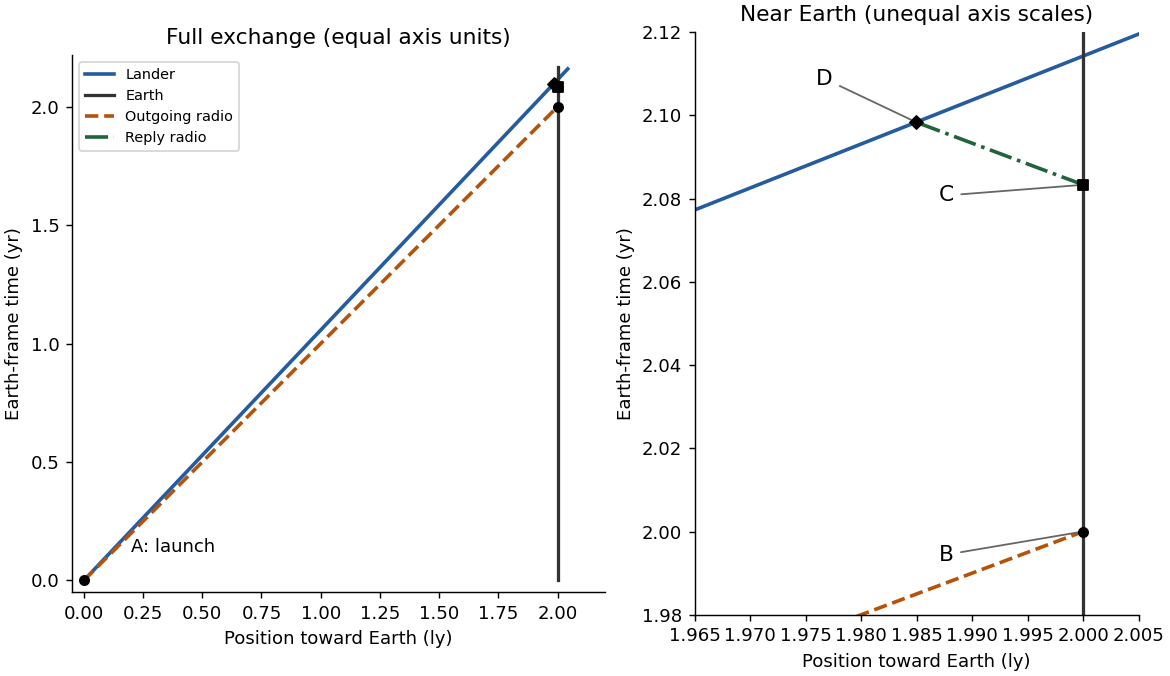

Equating the lander and return-signal positions givesThis is measured from launch, so about 25.18 months pass on Earth-frame synchronized clocks. D occurs slightly before the lander reaches Earth at .
The two events A and D lie on the inertial lander's own worldline, and their proper time difference isEquivalently, applying the Lorentz transformation with gives .
Articles by others on the same topic
There are currently no matching articles.