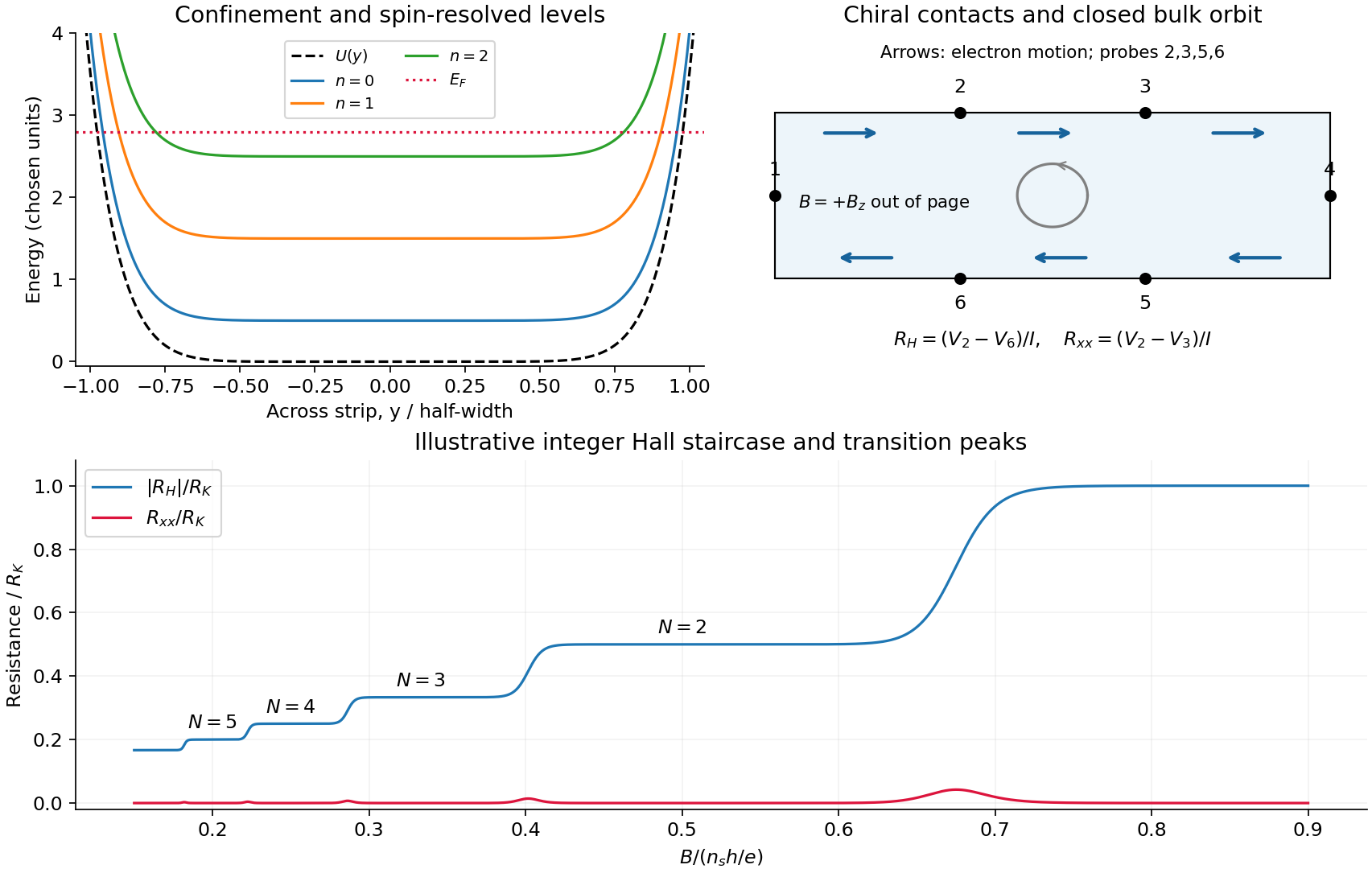
Take the two-dimensional electron gas in the plane, the Hall bar along , and with perpendicular to it. An electron has charge . The confining electron potential energy is approximately flat inside a wide strip and rises at either boundary; smooth quenched disorder adds hills and valleys. For a slowly varying edge, each spin-resolved Landau level approximately followsHere , and is the guiding centre. For , and the edge group velocity isThus electrons move along at the upper edge and at the lower edge. The Lorentz force gives counterclockwise bulk cyclotron motion in this convention. At a hard boundary its interrupted circles become directed skipping orbits; a smooth boundary gives the corresponding guiding-centre drift. Smooth bulk quenched disorder generally gives closed drift contours around localized hills or valleys, with extended trajectories appearing near a broadened level's critical energy. Realistic electrostatic screening can produce alternating compressible quantum Hall edge strips and incompressible quantum Hall edge strips, so the unscreened bending curves are an effective sketch rather than an exact self-consistent edge profile.
In the original diagram, contacts are ordered around the electron propagation direction: upper-left , then lower-right . Let , and the other leads be ideal equilibrating voltage probes. Define and . These choices fix the voltage sign; reversing the field reverses chirality and the Hall polarity. For spin-resolved plateau index ,At fixed sheet carrier density and increasing field, decreases, giving successively higher Hall plateaus; longitudinal peaks occur between them. Unresolved spin branches can suppress odd plateaus. The sketch uses resistance magnitudes, and every integer step is not promised in an arbitrary sample.
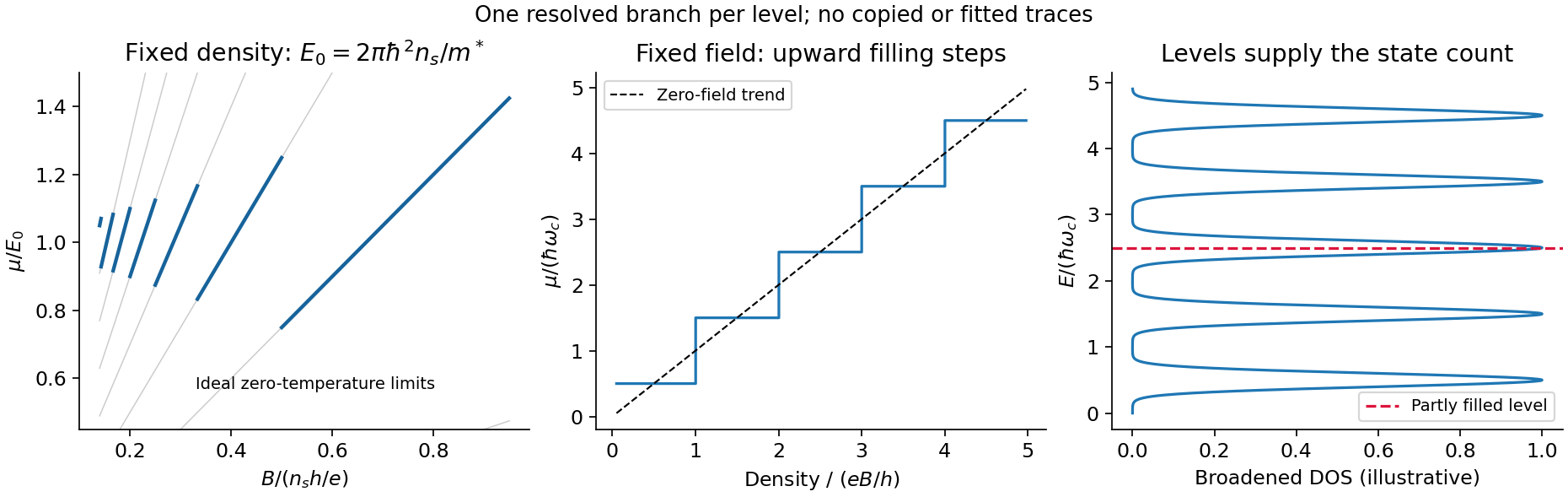
For Fermi-energy oscillations in a two-dimensional electron gas, first distinguish fixed density from fixed reservoir chemical potential. At negligible temperature the former is determined by state counting. Each resolved Landau level contains states per unit area, soIgnoring spin and broadening for the counting illustration, if then levels are full and level is partly full: . At fixed , increasing increases both level energy and degeneracy. The partly filled level rises in energy until the lower levels can contain all electrons; then drops to the next lower level. The resulting sawtooth is periodic in , with per resolved branch. At an exactly integer filling in an ideal gap, any chemical potential within the gap gives the same zero-temperature particle number; the plotted discontinuity denotes its limiting values.
At fixed while increases, the ideal chemical potential stays at a partly occupied level and steps upward after each additional density . It therefore has a staircase superposed on the rising zero-field trend, not a repeated downward sawtooth. Landau-level broadening and finite temperature smooth both ideal graphs. With an externally pinned chemical potential, density changes instead; the fixed-density sawtooth cannot simultaneously be imposed. In a realistic disordered sample, the Fermi energy sweeps localized states between transport-carrying level centres. The following schematic omits spin for clarity and does not attempt an interaction-corrected density of states.
Landau filling and chemical potential
. Details. For transmitted spin-resolved quantum Hall edge states, the Landauer-Büttiker formula reduces, in that contact order, toZero probe currents imply and . Hence and the boxed resistance results follow. The spin-resolved conductance quantum arises because the one-dimensional density of states times velocity is per unit energy; a reservoir imbalance supplies per channel. Its value does not depend on edge slope or sample width.
On a plateau, opposite-moving edge channels are separated by a wide bulk with a mobility gap. Ordinary elastic scattering on one edge has no counterpropagating channel into which to reflect; closed bulk orbits do not connect the contacts. Changing or can alter the occupancy of localized states without changing the number of transmitting edge channels. This accounts for the finite plateau width, which an entirely clean set of sharp levels would not explain. Accuracy requires negligible backscattering between opposite edges, low enough current to avoid breakdown, equilibrating contacts and negligible probe loading. The finite-width plateau and the precision of its quantized value are related but distinct observations.
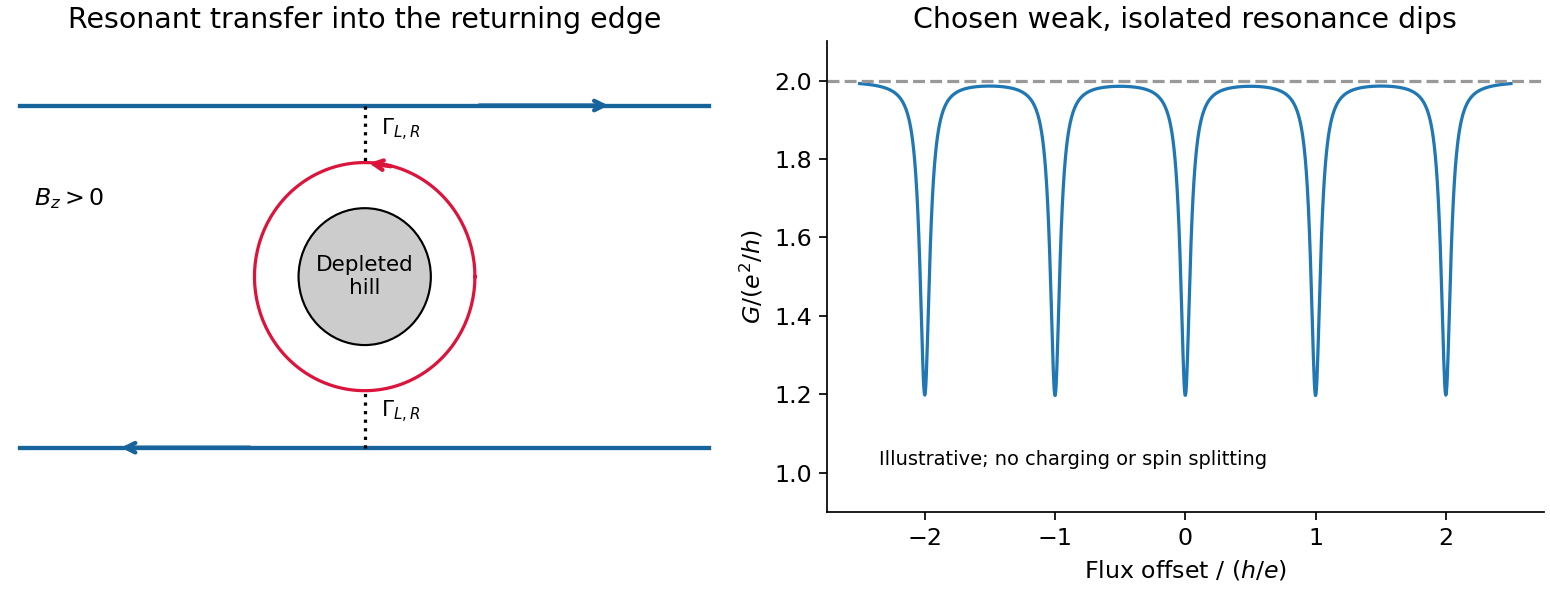
An antidot is a depleted potential hill, not a potential well. Its closed edge circulates oppositely to the outer boundary. In a constriction, tunnelling through an antidot orbit can transfer an electron from a forward edge into the returning edge: resonant antidot backscattering produces conductance dips. For otherwise open spin-resolved channels and one active resonance,At symmetric coupling a single resonance can remove ; asymmetry or thermal averaging reduces its depth. If the background constriction is closed and the resonant route instead supplies forward transmission, peaks occur. The lead connectivity must therefore accompany the conductance sketch. In the fixed-area single-particle limit, successive alignments change enclosed flux by , giving the Aharonov-Bohm antidot periodThe effective orbit area, not merely the etched island area, enters. Charging, screening and spin can modify this simple sequence; two coupled spin branches can yield a near- pattern without changing the elementary flux quantum.[ref]
Coulomb blockade of tunnelling through compressible rings formed around an antidot by M. Kataoka and others. 2000 author abstract: charging model and two resonances per flux cycle


Articles by others on the same topic
There are currently no matching articles.