Original paper: Public original, physical PDF pages 500–501.
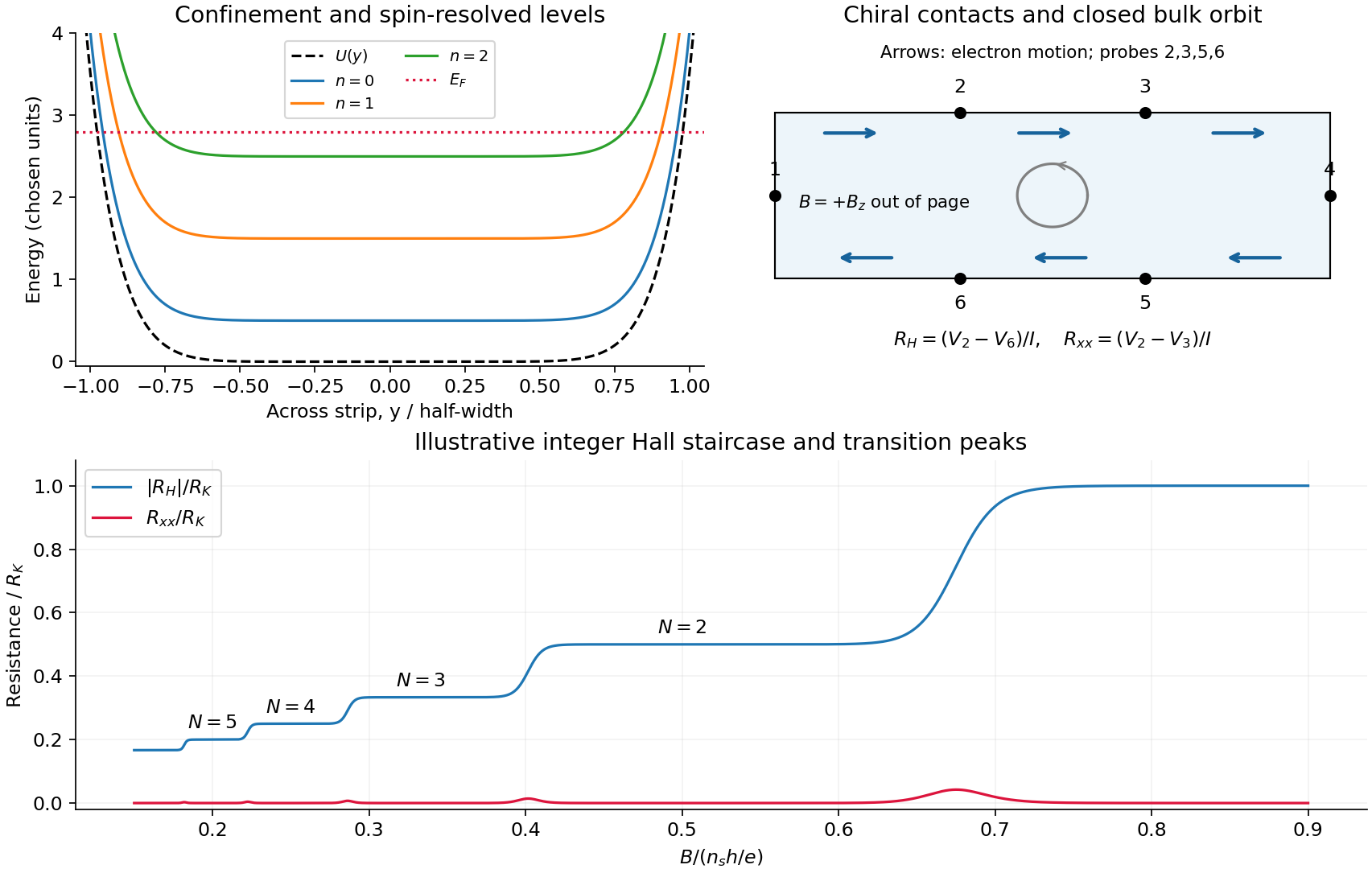
Take the two-dimensional electron gas in the plane, the Hall bar along , and with perpendicular to it. An electron has charge . The confining electron potential energy is approximately flat inside a wide strip and rises at either boundary; smooth quenched disorder adds hills and valleys. For a slowly varying edge, each spin-resolved Landau level approximately followsHere , and is the guiding centre. For , and the edge group velocity isThus electrons move along at the upper edge and at the lower edge. The Lorentz force gives counterclockwise bulk cyclotron motion in this convention. At a hard boundary its interrupted circles become directed skipping orbits; a smooth boundary gives the corresponding guiding-centre drift. Smooth bulk quenched disorder generally gives closed drift contours around localized hills or valleys, with extended trajectories appearing near a broadened level's critical energy. Realistic electrostatic screening can produce alternating compressible quantum Hall edge strips and incompressible quantum Hall edge strips, so the unscreened bending curves are an effective sketch rather than an exact self-consistent edge profile.
In the original diagram, contacts are ordered around the electron propagation direction: upper-left , then lower-right . Let , and the other leads be ideal equilibrating voltage probes. Define and . These choices fix the voltage sign; reversing the field reverses chirality and the Hall polarity. For spin-resolved plateau index ,At fixed sheet carrier density and increasing field, decreases, giving successively higher Hall plateaus; longitudinal peaks occur between them. Unresolved spin branches can suppress odd plateaus. The sketch uses resistance magnitudes, and every integer step is not promised in an arbitrary sample.
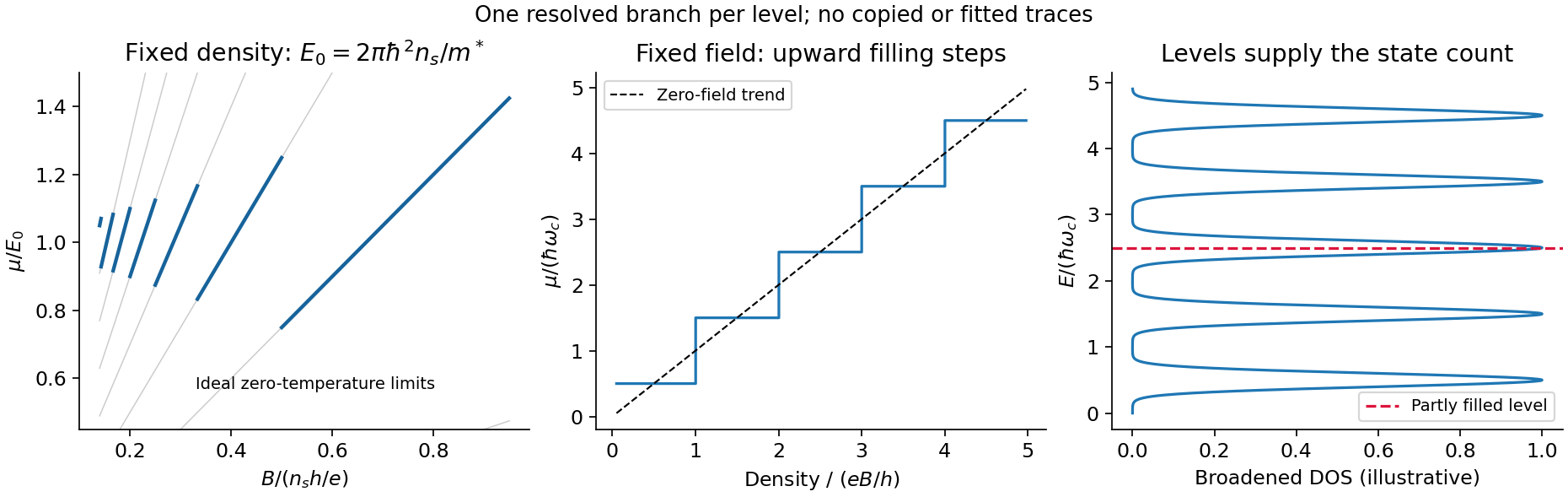
For Fermi-energy oscillations in a two-dimensional electron gas, first distinguish fixed density from fixed reservoir chemical potential. At negligible temperature the former is determined by state counting. Each resolved Landau level contains states per unit area, soIgnoring spin and broadening for the counting illustration, if then levels are full and level is partly full: . At fixed , increasing increases both level energy and degeneracy. The partly filled level rises in energy until the lower levels can contain all electrons; then drops to the next lower level. The resulting sawtooth is periodic in , with per resolved branch. At an exactly integer filling in an ideal gap, any chemical potential within the gap gives the same zero-temperature particle number; the plotted discontinuity denotes its limiting values.
At fixed while increases, the ideal chemical potential stays at a partly occupied level and steps upward after each additional density . It therefore has a staircase superposed on the rising zero-field trend, not a repeated downward sawtooth. Landau-level broadening and finite temperature smooth both ideal graphs. With an externally pinned chemical potential, density changes instead; the fixed-density sawtooth cannot simultaneously be imposed. In a realistic disordered sample, the Fermi energy sweeps localized states between transport-carrying level centres. The following schematic omits spin for clarity and does not attempt an interaction-corrected density of states.
Landau filling and chemical potential
. Details. For transmitted spin-resolved quantum Hall edge states, the Landauer-Büttiker formula reduces, in that contact order, toZero probe currents imply and . Hence and the boxed resistance results follow. The spin-resolved conductance quantum arises because the one-dimensional density of states times velocity is per unit energy; a reservoir imbalance supplies per channel. Its value does not depend on edge slope or sample width.
On a plateau, opposite-moving edge channels are separated by a wide bulk with a mobility gap. Ordinary elastic scattering on one edge has no counterpropagating channel into which to reflect; closed bulk orbits do not connect the contacts. Changing or can alter the occupancy of localized states without changing the number of transmitting edge channels. This accounts for the finite plateau width, which an entirely clean set of sharp levels would not explain. Accuracy requires negligible backscattering between opposite edges, low enough current to avoid breakdown, equilibrating contacts and negligible probe loading. The finite-width plateau and the precision of its quantized value are related but distinct observations.
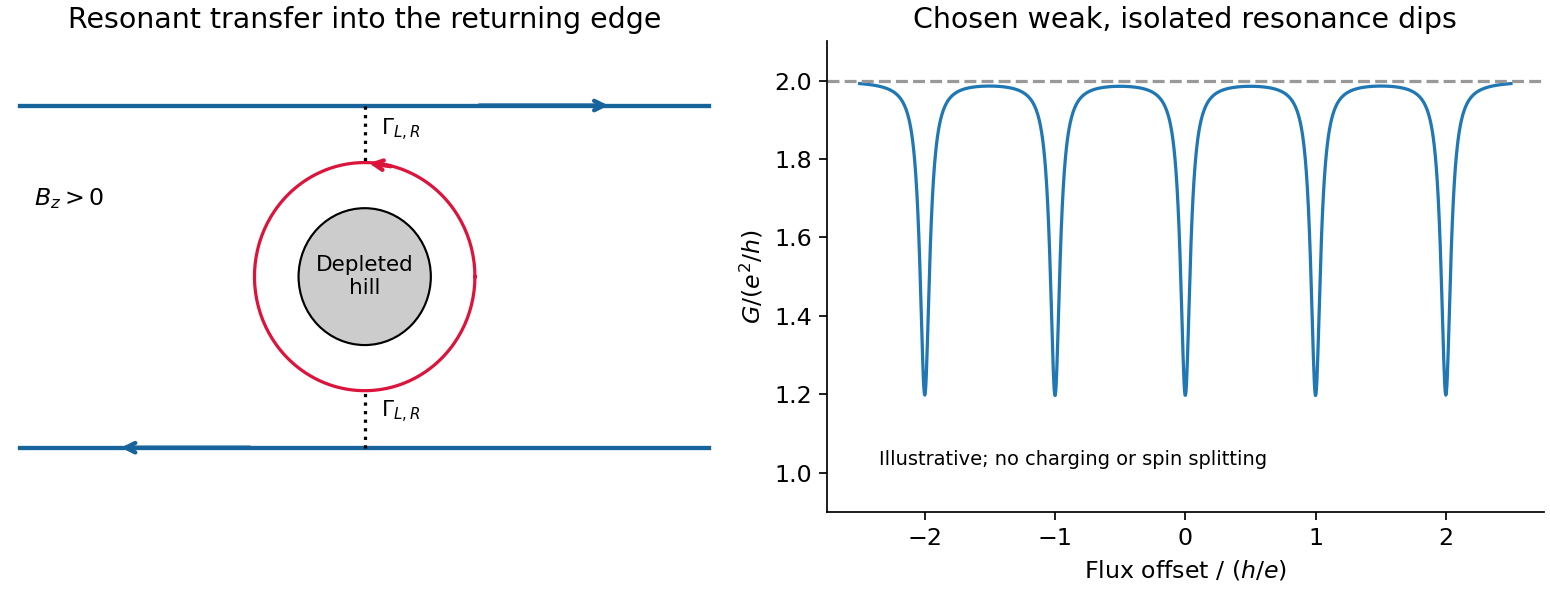
An antidot is a depleted potential hill, not a potential well. Its closed edge circulates oppositely to the outer boundary. In a constriction, tunnelling through an antidot orbit can transfer an electron from a forward edge into the returning edge: resonant antidot backscattering produces conductance dips. For otherwise open spin-resolved channels and one active resonance,At symmetric coupling a single resonance can remove ; asymmetry or thermal averaging reduces its depth. If the background constriction is closed and the resonant route instead supplies forward transmission, peaks occur. The lead connectivity must therefore accompany the conductance sketch. In the fixed-area single-particle limit, successive alignments change enclosed flux by , giving the Aharonov-Bohm antidot periodThe effective orbit area, not merely the etched island area, enters. Charging, screening and spin can modify this simple sequence; two coupled spin branches can yield a near- pattern without changing the elementary flux quantum.[ref]
Coulomb blockade of tunnelling through compressible rings formed around an antidot by M. Kataoka and others. 2000 author abstract: charging model and two resonances per flux cycle
A Landau quasiparticle is an electron-like excitation dressed by the interacting medium. Adiabatic continuity connects low-energy states of an ordinary Fermi liquid to those of a free Fermi gas without changing their particle statistics or conserved quantum numbers. The excitation has a renormalized dispersion, effective mass, magnetic response and finite lifetime. Pauli exclusion principle restricts collisions near the Fermi surface; in a regular three-dimensional Fermi liquid,Thus the width is small compared with excitation energy sufficiently near the surface at low temperature. This permits particle-like counting and transport even when microscopic interactions are strong. It does not make every interaction disappear: the Landau quasiparticle energy functional contains residual interactions,Specific heats and magnetic susceptibilities need not equal their bare-gas values. Logarithmic corrections can modify the lifetime scale in two dimensions, and a Luttinger liquid or a fractional Hall fluid is not an ordinary weakly perturbed electron gas.
An electron-like excitation in a normal metal and a neutral fermionic excitation in normal helium-3 are Landau quasiparticles. More generally, phonons, magnons and excitons are particle-like collective excitations, with their own statistics and quantum numbers; they are not all Landau quasiparticles. composite fermions are another emergent description, reorganizing correlations in a partly occupied Landau level rather than simply replacing the electron mass in an ordinary band.
Attach two statistical flux quanta to each electron. Even attachment preserves fermionic exchange statistics, while the average statistical field opposes the applied field:This is an effective description of correlations, not literal flux tubes produced by small solenoids. An integer number of filled effective levels can give an incompressible electronic fractional Hall state. This is the correspondence between integer Hall quantization of composite fermions and selected fractional Hall states of electrons.[ref]
Composite-fermion approach for the fractional quantum Hall effect by J. K. Jain. 1989 publisher abstract: fractional Hall states as integer states after even flux attachment
Setting the signed effective filling to integer givesPositive gives below . Negative , , gives above it, including . The sign records reversed . At , the mean effective field vanishes, so the simplest description is a compressible composite-fermion sea rather than another member with finite integer . Fractional charged excitations of gapped Hall states and the charge used in this semiclassical composite-fermion orbit description should not be conflated.
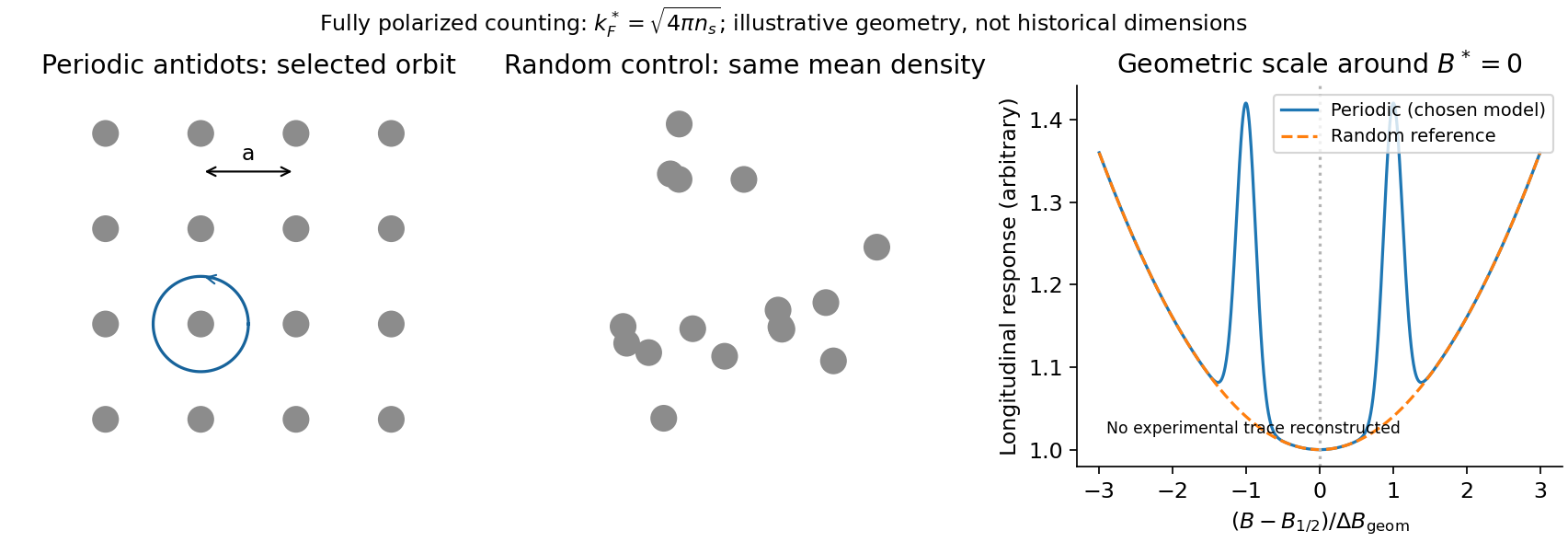
A direct probe away from the incompressible fractions is composite-fermion geometric resonance. One implementation patterned a high-mobility GaAs/AlGaAs Hall bar into periodic and random antidot arrays. electron beam lithography followed by an approximately reactive-ion etch made arrays with periods –. Four-terminal low-current measurements swept a perpendicular magnetic field at low temperature; red-light illumination varied density and the modulation. Periodic arrays showed commensurability structure near half filling and a Hall anomaly; matched random arrays did not. Unpatterned sections supplied another reference.[ref]
Composite fermions in periodic and random antidot lattices by J. H. Smet and others. pp.3598–3600, fabrication, measurement method and Figs.1–3
The semiclassical explanation uses, for a fully spin-polarized sea,The mass cancels from the orbit radius. A selected orbit fits the lattice when , with a geometry-dependent constant of order unity. Pinned orbits around antidots then alter longitudinal transport, producing features nearThe simplest single-antidot scale has ; detailed peak positions require the actual potential and orbit family. The two field directions bend orbits oppositely. The diagnostic is an orbit scale controlled by the small residual , rather than the much larger applied . At the same density the fully polarized is times the zero-field spin-degenerate electron value; this is an independent counting test.
Calibrate density from independent Hall/filling measurements and compare several lattice periods. Use small excitation and temperature sweeps, and check periodic, random and unpatterned regions. Density variation changes both and the orbit scale, so simply plotting against uncorrected field can mislead. mean free path and density inhomogeneity limit resolution; illumination can soften or substantially change the imposed potential, so it cannot automatically be treated as density adjustment alone. These qualifications are part of the inference from geometry to emergent particles, rather than a claim that every feature near half filling is a new fractional plateau.
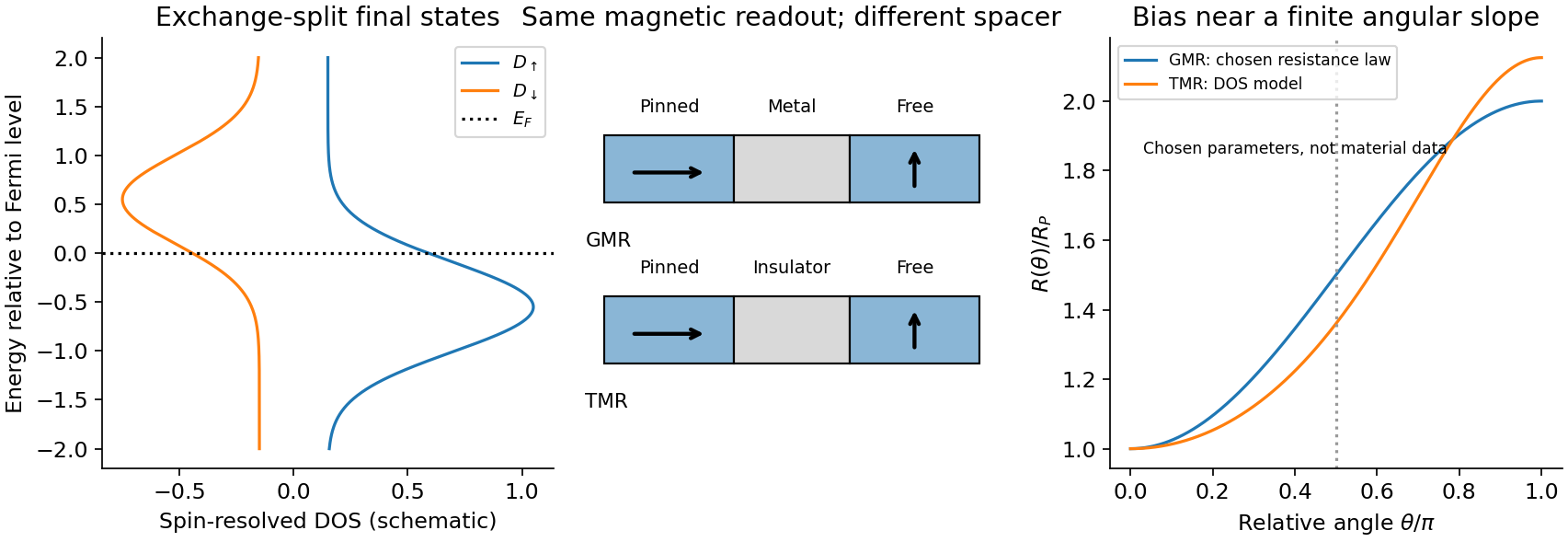
Exchange-split bands in a ferromagnet generally give a different spin-resolved density of states for each spin branch, and . If spin is approximately conserved across a multilayer, its two spin channels conduct in parallel. A spin valve combines a comparatively fixed reference-layer magnetization with a soft free layer that rotates in a small applied field. Its readout depends on the relative angle, not simply the absolute spin population. Biasing the layers near a perpendicular alignment gives a useful linear response instead of operating at the flat parallel/antiparallel extrema.
In giant magnetoresistance, a metallic spacer separates ferromagnetic layers. Spin-dependent bulk and interface scattering make their channel resistances unequal. The density of available final states influences scattering of more mobile states; however, a large total density of states does not by itself guarantee a large conductivity. The scattering-weighted spin-channel asymmetry also involves velocity and scattering matrix elements. In the elementary identical-layer two-current resistor model, let each magnetic layer have resistances in the two spin channels and neglect spacer resistance. Parallel moments give channels and , while antiparallel moments give in each channel. ThereforeOne favorable spin channel traverses both aligned layers efficiently; reversal removes that common easy path. A conducting spacer adds resistance, and spin mixing weakens the separate-channel approximation. The channel asymmetry is material/interface dependent, so positive magnetoresistance is not a theorem for every pair of different ferromagnets.[ref]
Spin dependent transport: GMR & TMR by Alain Schuhl and Daniel Lacour. §§2.1–2.2, pp.947–948, spin-dependent scattering and two-current construction
In tunnelling magnetoresistance, the spacer is an ultrathin insulator and current flows across a magnetic tunnel junction. In the simple spin-conserving density-of-states tunnelling magnetoresistance model, assume spin-independent matrix elements and low voltage. Available initial and final states giveWriting and , these become and . ThusThe effective tunnelling polarization can depend on the barrier and orbital symmetry, not just a bulk density-of-states sketch. Crystalline MgO junctions exploit symmetry-selective transmission, so the elementary product model is not a quantitative universal formula for them.[ref]
Giant room-temperature magnetoresistance in Fe-MgO-Fe junctions by Shinji Yuasa and others. 2004 publisher abstract, crystalline MgO junctions and large room-temperature response
Both devices convert a free-layer rotation into an electrical change. A useful approximate GMR interpolation is ; the elementary tunnelling model instead gives . The spin-valve small-field sensitivity is a chain rule,magnetic anisotropy, biasing and pinning set the rotation susceptibility. Conducting-spacer GMR usually offers low resistance and supports current-in-plane or current-perpendicular geometries. TMR uses perpendicular tunnelling, often offers a larger fractional signal and a larger resistance-area product, but demands uniform, stable barriers and has bias dependence and breakdown limits. Neither is automatically the better small-field sensor: heating, Johnson and low-frequency noise, domain switching, hysteresis and stability set the detectable field. Reverse sweep direction, vary current and temperature, and independently test reference-layer pinning to distinguish a reproducible magnetic signal from drift or heating.


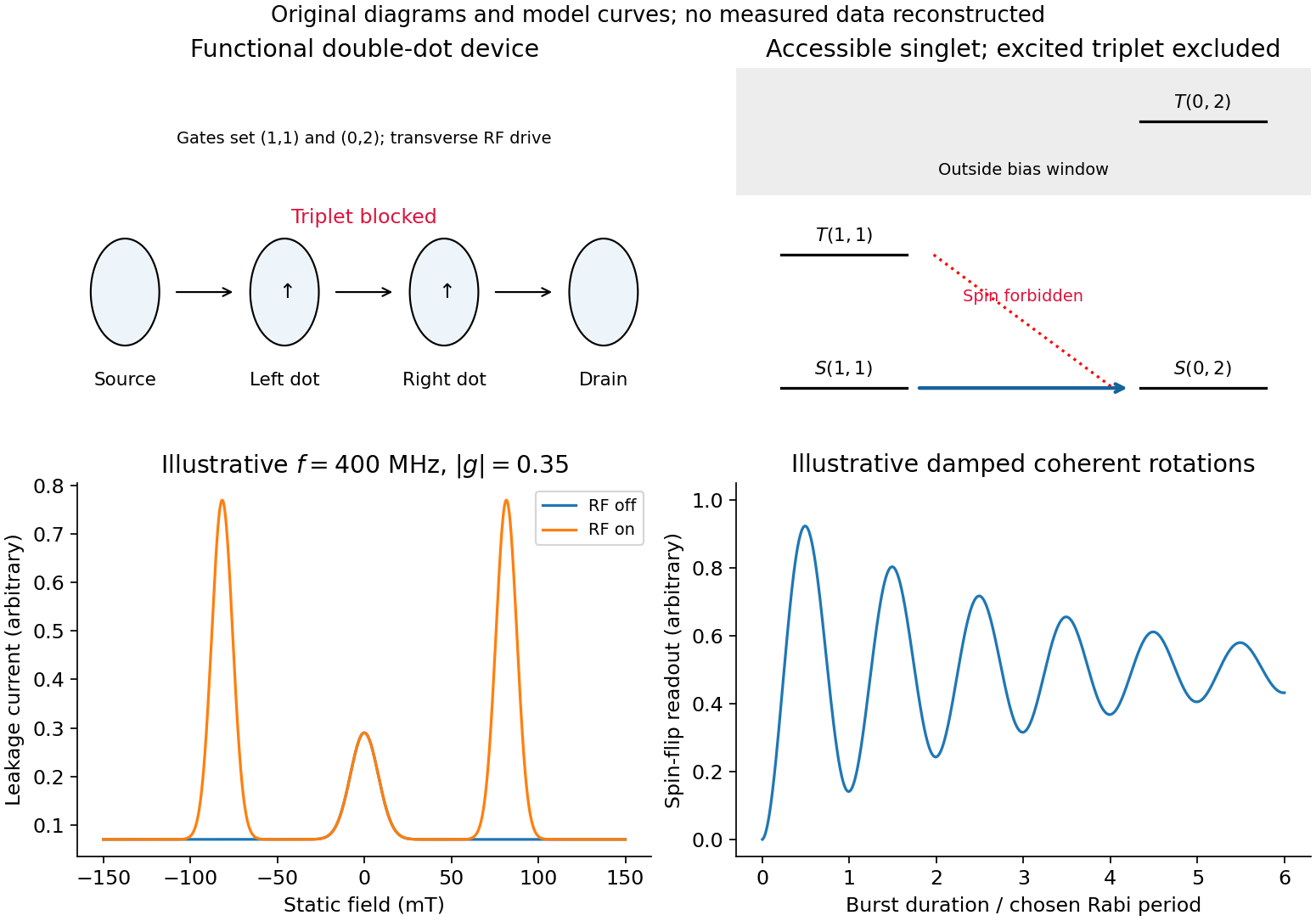
For a double quantum dot, write for occupation. Tune a bias window allowing the cycle . Two electrons in the same lowest orbital must form a singlet state by the Pauli exclusion principle. The triplet requires an excited orbital, with an energy cost above the accessible window. Approximately spin-conserving tunnelling transfers into , but cannot transfer into that singlet. Once a triplet loads, transport stops until spin relaxation or mixing occurs: this is Pauli spin blockade. The reverse bias can avoid trapping in this sequence, producing rectification. Coulomb charging sets the allowed occupancies, but the extra blockade is a spin-selection restriction, not merely an energetically forbidden charge state.
magnetically driven spin-blockade lifting uses electron paramagnetic resonance. A transverse oscillating magnetic field drives spin transitions atFlipping one spin in gives , which has a singlet component and can resume charge transfer. A perfectly uniform simultaneous rotation of two identical spins preserves their triplet character; effective relative rotation needs unequal local resonance conditions or another singlet–triplet mixing mechanism. In a real GaAs double dot, inhomogeneous nuclear fields can supply that difference. Hyperfine mixing, spin-orbit effects, cotunnelling and ordinary relaxation also produce leakage and must be distinguished from driven resonance.
A demonstrated device used surface Ti/Au gates to define two dots in a GaAs/AlGaAs electron gas below the surface. An insulated on-chip gold coplanar stripline supplied the oscillating magnetic field. With the dots biased in spin blockade, RF excitation produced current peaks at the two field polarities satisfying resonance. Peak positions varied linearly with frequency, giving . RF applied to a side gate instead gave negligible response, testing magnetic rather than electric excitation. Gate pulses and RF bursts further produced coherent spin-rotation oscillations in the charge readout.[ref]
An ideal isolated resonant spin has Rabi oscillation probability . For a linearly oscillating field of peak amplitude , the rotating-wave convention is . Repeated initialization, isolated manipulation and blockade-sensitive readout can therefore map a damped oscillatory singlet yield into an average current. Nuclear fluctuations, readout rates and dephasing change the envelope and contrast; an ideal sine squared is not a reconstruction of experimental data. Compare RF on/off, resonance tracking with frequency, drive-amplitude dependence and detuning controls. Current enhancement alone does not prove coherent rotations; the pulse-duration oscillations provide the further time-domain test.
Spin blockade and magnetic resonance
. Details. 
Articles by others on the same topic
There are currently no matching articles.