Quenched disorder is randomness held fixed while the other degrees of freedom equilibrate. For a sample with couplings , first compute its partition function and Helmholtz free energy , then average over samples. One must not silently replace by .[ref]
Out of equilibrium dynamics of complex systems by Leticia Fernanda Cugliandolo. §4.2, pp. 83–86, averaging the free energy after computing each fixed-disorder partition function
Choose two Ising spins with Hamiltonian , where independently takes or with equal prior probabilities and . This original finite example has no geometrical frustration and no phase transition. Its four spin assignments give . ThereforeThe concave function puts . For this two-value case the claim is just , obtained by squaring . Thus no formal continuation of replicas is needed to see the distinction.
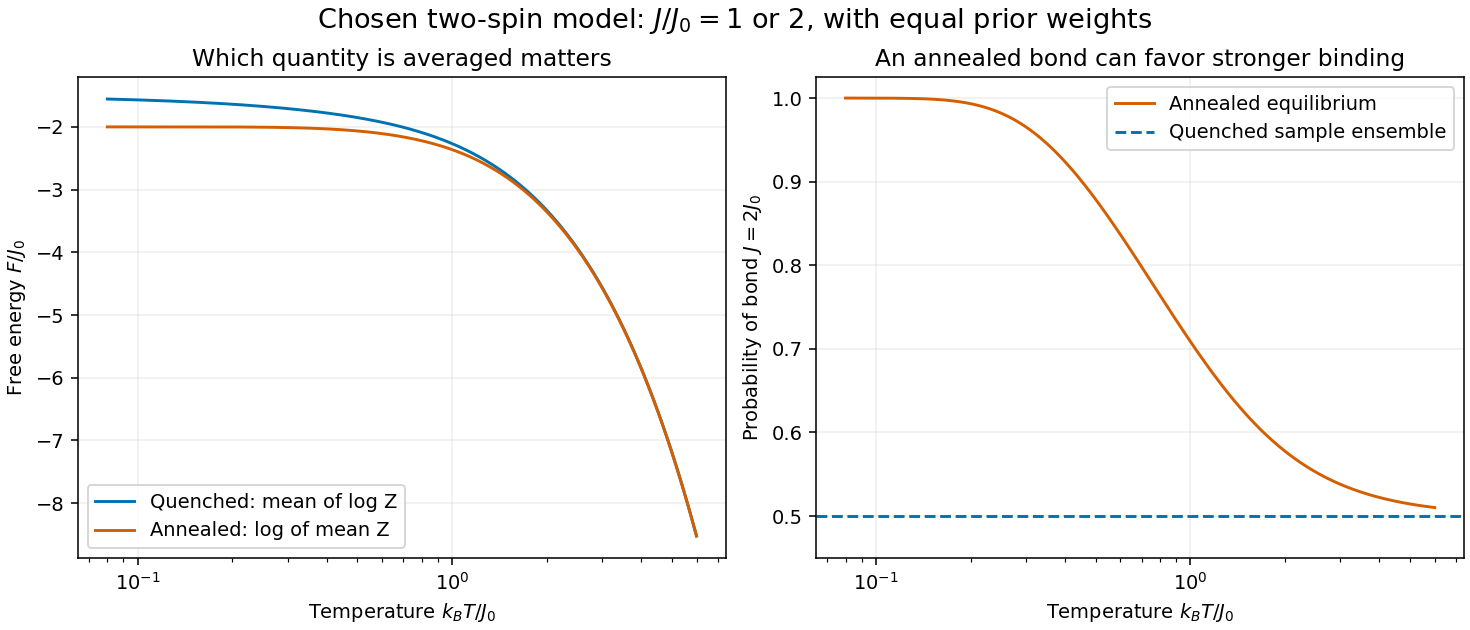

In the annealed disorder ensemble, the stronger bond has probability , approaching one at low temperature. A quenched disorder collection instead retains one half at each coupling. As , and : averaging samples and allowing the material variables to equilibrate describe different physics.
For positive , the displayed identity follows by differentiating at zero.
Integer powers of a partition function represent independent copies with the same disorder. Integer moments alone do not justify analytic continuation or interchanging disorder averages and thermodynamic limits.[ref]
Citation Classic commentary on Theory of spin glasses by Sam Edwards. Edwards, 1985 commentary, replica averaging and acknowledged mathematical limitations
Articles by others on the same topic
There are currently no matching articles.