A Landau quasiparticle is an electron-like excitation dressed by the interacting medium. Adiabatic continuity connects low-energy states of an ordinary Fermi liquid to those of a free Fermi gas without changing their particle statistics or conserved quantum numbers. The excitation has a renormalized dispersion, effective mass, magnetic response and finite lifetime. Pauli exclusion principle restricts collisions near the Fermi surface; in a regular three-dimensional Fermi liquid,Thus the width is small compared with excitation energy sufficiently near the surface at low temperature. This permits particle-like counting and transport even when microscopic interactions are strong. It does not make every interaction disappear: the Landau quasiparticle energy functional contains residual interactions,Specific heats and magnetic susceptibilities need not equal their bare-gas values. Logarithmic corrections can modify the lifetime scale in two dimensions, and a Luttinger liquid or a fractional Hall fluid is not an ordinary weakly perturbed electron gas.
An electron-like excitation in a normal metal and a neutral fermionic excitation in normal helium-3 are Landau quasiparticles. More generally, phonons, magnons and excitons are particle-like collective excitations, with their own statistics and quantum numbers; they are not all Landau quasiparticles. composite fermions are another emergent description, reorganizing correlations in a partly occupied Landau level rather than simply replacing the electron mass in an ordinary band.
Attach two statistical flux quanta to each electron. Even attachment preserves fermionic exchange statistics, while the average statistical field opposes the applied field:This is an effective description of correlations, not literal flux tubes produced by small solenoids. An integer number of filled effective levels can give an incompressible electronic fractional Hall state. This is the correspondence between integer Hall quantization of composite fermions and selected fractional Hall states of electrons.[ref]
Composite-fermion approach for the fractional quantum Hall effect by J. K. Jain. 1989 publisher abstract: fractional Hall states as integer states after even flux attachment
Setting the signed effective filling to integer givesPositive gives below . Negative , , gives above it, including . The sign records reversed . At , the mean effective field vanishes, so the simplest description is a compressible composite-fermion sea rather than another member with finite integer . Fractional charged excitations of gapped Hall states and the charge used in this semiclassical composite-fermion orbit description should not be conflated.
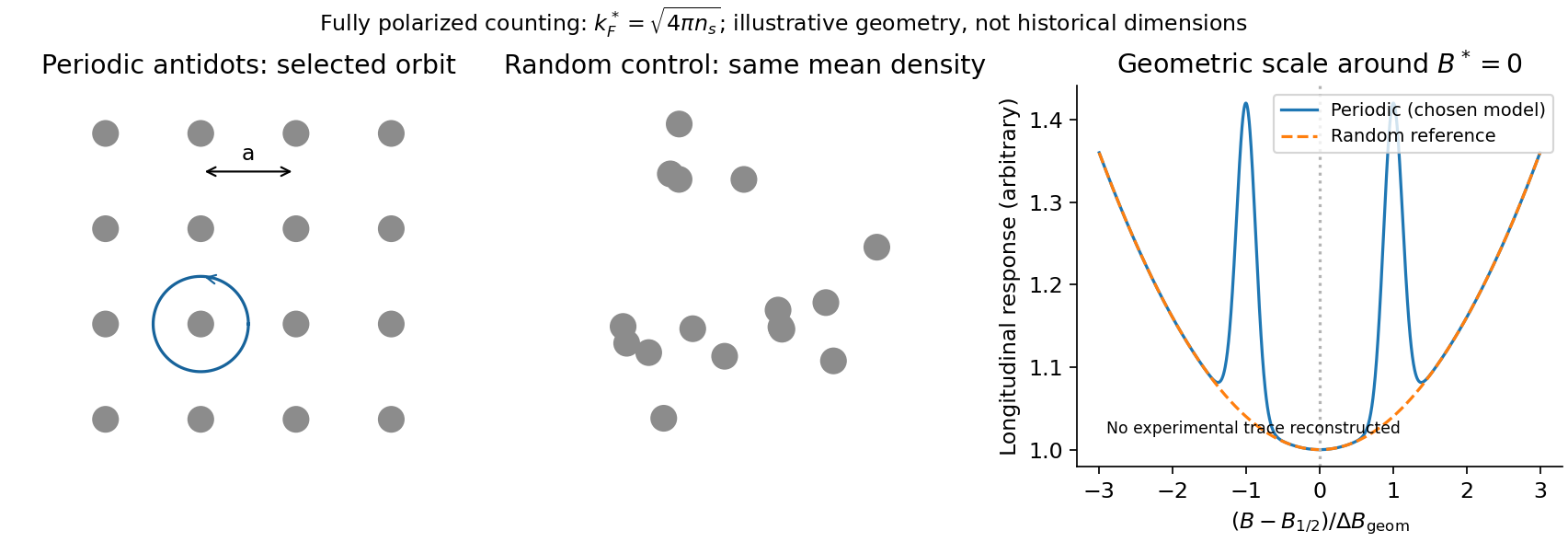
A direct probe away from the incompressible fractions is composite-fermion geometric resonance. One implementation patterned a high-mobility GaAs/AlGaAs Hall bar into periodic and random antidot arrays. electron beam lithography followed by an approximately reactive-ion etch made arrays with periods –. Four-terminal low-current measurements swept a perpendicular magnetic field at low temperature; red-light illumination varied density and the modulation. Periodic arrays showed commensurability structure near half filling and a Hall anomaly; matched random arrays did not. Unpatterned sections supplied another reference.[ref]
Composite fermions in periodic and random antidot lattices by J. H. Smet and others. pp.3598–3600, fabrication, measurement method and Figs.1–3
The semiclassical explanation uses, for a fully spin-polarized sea,The mass cancels from the orbit radius. A selected orbit fits the lattice when , with a geometry-dependent constant of order unity. Pinned orbits around antidots then alter longitudinal transport, producing features nearThe simplest single-antidot scale has ; detailed peak positions require the actual potential and orbit family. The two field directions bend orbits oppositely. The diagnostic is an orbit scale controlled by the small residual , rather than the much larger applied . At the same density the fully polarized is times the zero-field spin-degenerate electron value; this is an independent counting test.
Calibrate density from independent Hall/filling measurements and compare several lattice periods. Use small excitation and temperature sweeps, and check periodic, random and unpatterned regions. Density variation changes both and the orbit scale, so simply plotting against uncorrected field can mislead. mean free path and density inhomogeneity limit resolution; illumination can soften or substantially change the imposed potential, so it cannot automatically be treated as density adjustment alone. These qualifications are part of the inference from geometry to emergent particles, rather than a claim that every feature near half filling is a new fractional plateau.

Articles by others on the same topic
There are currently no matching articles.