The fractional quantum Hall effect occurs when interactions produce an incompressible correlated state within a partially occupied Landau level. The orbital kinetic energy is already quantized; the important degeneracy is among many possible arrangements of electrons within the level. Repulsion can lift that degeneracy and create a many-body excitation gap. The interaction scale is of order , where magnetic length ; it is not a gap predicted by independent-electron fractional occupation alone.
A composite fermion description incorporates strong correlations by attaching statistical flux quanta to each electron, with positive integer . The attachment is a representation of correlated wavefunction phases and zeros, not a literal solenoid attached to a particle. Attaching an even number preserves fermionic exchange character. In a mean-field approximation for positive applied field,The particles consequently experience a reduced effective field. Define the signed effective filling and electronic filling . Their relation isWhen effective levels are filled with the same field orientation, , giving . Reversed effective-field orientation has , giving . Thus the Jain sequence isFor , examples are , , on one branch and , on the reversed branch. Fractional electronic plateaus can be understood as integer effective Hall states of these composite objects. The original proposal explicitly makes this connection.[ref]
Composite-fermion approach for the fractional quantum Hall effect by J. K. Jain. 1989 publisher abstract: even flux attachment and integer Hall interpretation of fractional electronic states
At a gapped fractional state, longitudinal dissipation becomes very small and the Hall magnitude approachesDisorder can localize quasiparticles and allow the plateau to persist over a filling interval, provided it does not overwhelm the interaction gap. The Laughlin wavefunction at is a particularly simple correlated example; its charged excitations carry fractions of the electron charge. More generally the basic quasiparticle charge in the simple Jain sequence has magnitude . Such excitations are distinct from noninteracting bare electrons occupying a fraction of a level.
At , the mean effective field vanishes. This permits a compressible composite-fermion Fermi-sea description, rather than an ordinary integer effective-level gap. The external field remains large: cancellation is in the effective description. Not every fractional state is explained by the simplest integer composite fermion sequence, and the effective masses and gaps reflect interactions rather than simply the GaAs band mass. The utility of the construction is that it organizes many observed fractions and their nearby excitations into one understandable pattern.
A quantum point contact is made by using negative surface split gates to leave a short narrow channel in a clean two-dimensional electron gas. Its length should be smaller than the transport mean free path; transverse confinement should be strong enough that subband spacing exceeds thermal and lifetime broadening. Low-resistance Ohmic contacts connect large reservoirs. Apply a small source–drain bias, measure current and differential conductance, and sweep the gate to change the channel width or barrier height. Contact and wiring series resistance must be accounted for when comparing plateau values.
The Landauer formula explains the conductance without treating the short channel as a diffusive wire. For each propagating one-dimensional mode, the density of states and group velocity cancel in the incident flux, leaving per spin per energy interval. The reservoir occupation difference supplies the net current:The factor two assumes unresolved spin degeneracy. In zero-temperature linear response,A well-transmitted channel has , giving steps as modes open. A finite two-terminal resistance persists even for a perfectly ballistic channel because reservoirs inject only a finite number of modes; it is not evidence of resistive scattering inside the channel. Gate-controlled point-contact conductance quantization was demonstrated in a two-dimensional electron gas.[ref]
Quantized conductance of point contacts by B. J. van Wees and others. 1988, primary publication: gate-controlled quantized conductance of ballistic point contacts
The saddle-point model of a quantum point contact resolves how modes open. Near the bottleneck, choose the channel direction as and writeTransverse harmonic confinement gives barrier tops . Scattering through the inverted longitudinal harmonic barrier givesSmall longitudinal curvature makes a sharp transmission threshold compared with the transverse subband spacing; finite curvature rounds each conductance step. This is the explicit smooth-barrier model developed for a saddle constriction.[ref]
Quantized transmission of a saddle-point constriction by M. Büttiker. 1990, saddle potential and mode-resolved transmission
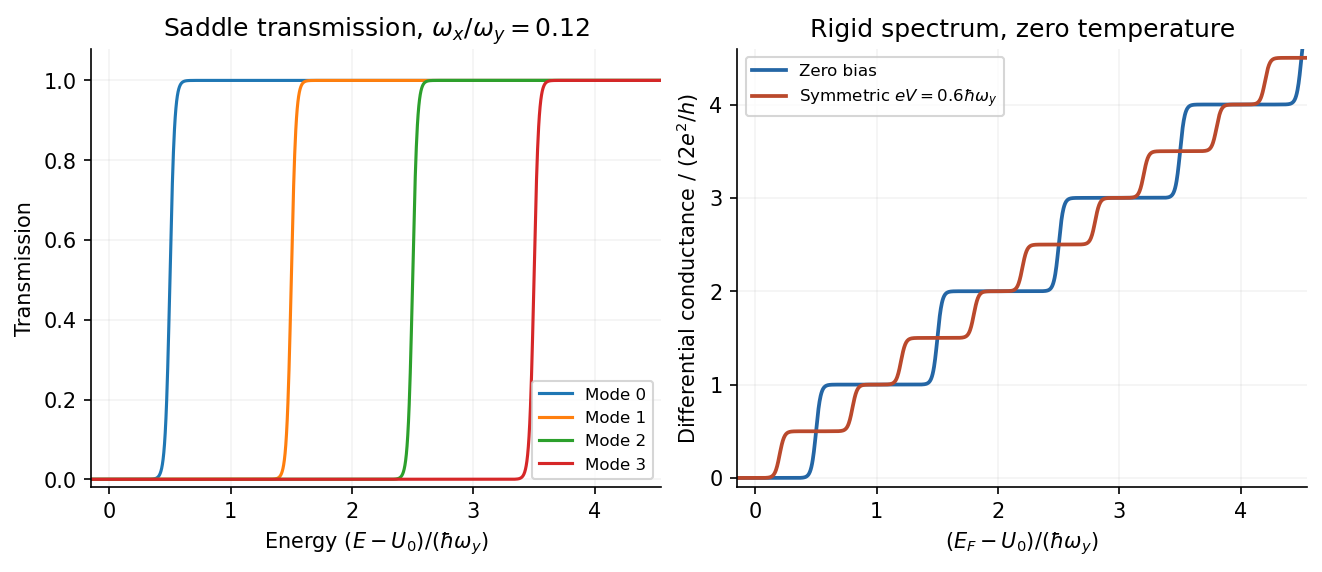
At larger source–drain bias, the current samples a finite energy window. For a rigid transmission spectrum at zero temperature,With symmetric bias, , the nonlinear conductance of a quantum point contact isIf both window edges sample open modes, the usual plateau remains. If one edge samples and the other , differential conductance approaches : a half-integer plateau relative to the zero-bias step. It is a bias-window effect, not half an electron spin degeneracy. Ridges in gate–bias transconductance occur when a reservoir chemical potential crosses a subband threshold; their separations can measure subband energies.
The half-plateau expression assumes symmetric bias and an approximately bias-independent barrier. An asymmetric voltage drop or self-consistent shift of changes the numerical relation. At still larger biases, heating and inelastic scattering can invalidate a rigid elastic saddle model. Thus the zero-bias quantization counts transmitted modes, while nonlinear spectroscopy compares mode counts at the two ends of the bias window.
An electrostatically defined quantum dot uses depletion gates to confine a small island laterally in a two-dimensional electron gas. Two narrow barriers allow weak tunnelling to source and drain; a plunger gate tunes the island's electrochemical levels, and additional gates can form a double quantum dot. Adjusting the gates resolves successive charge states and eventually reaches the single-electron regime. An electrical dot is defined by confinement and tunnel coupling, not simply by the drawn metal area.
In a constant interaction model,Here is gate-induced charge and total island capacitance. Successive additions cost , with spin, exchange and correlations modifying the orbital term. Coulomb blockade appears when no allowed charge transition lies in the source–drain energy window. Gate sweeps give charge steps and transport peaks; finite-bias Coulomb diamonds constrain charging and orbital energies under a stated bias convention. Resolved single-electron operation requires thermal and tunnel broadening smaller than the relevant addition energies.
Quantum-dot charge sensing avoids relying on a measurable current through a nearly isolated dot. A nearby quantum point contact biased on a sensitive conductance slope, or a single-electron transistor, responds capacitively when one electron enters or leaves the dot. A time trace of sensor current can therefore distinguish from and resolve individual tunnelling events. The sensor measures charge; a spin-dependent step is needed to measure spin.
For one electron, Zeeman splitting gives a lower and a higher spin level separated by . In energy-selective spin readout, initialize an empty dot and pulse both levels below the reservoir chemical potential to load one electron. Then move to a readout configurationAn electron in the higher state can tunnel out, temporarily leaving the dot empty, after which a lower-state electron can refill it. An electron initially in the lower state remains trapped. The charge sensor records a pulse for the first outcome and no escape pulse for the second. This is spin-to-charge conversion; it measures the spin projection along the field through a state-dependent tunnelling probability. A primary single-shot experiment uses this conversion with a quantum-point-contact charge detector.[ref]
Single-shot read-out of an individual electron spin in a quantum dot by J. M. Elzerman and others. 2004 author abstract: electrical single-electron spin readout, spin-to-charge conversion and nearby quantum point contact
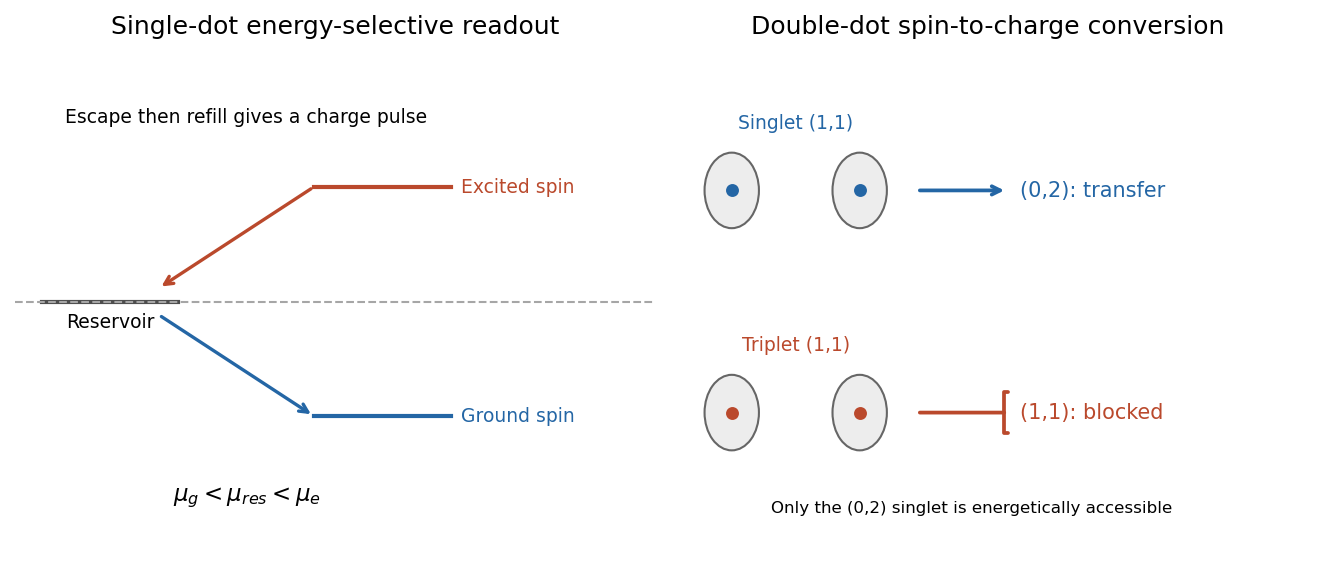


The readout window must be long enough to detect escape but short compared with excited-spin relaxation:Detector bandwidth must also resolve the empty-state dwell time before refilling. Thermal activation, relaxation before escape, missed fast events and sensor backaction cause errors. Since the excited electron can leave and be replaced, this simple sequence does not preserve an arbitrary initial spin state.
For coupled dots, label charge occupation by . Gate-controlled detuning can make and accessible. Two electrons in the lowest orbital of one dot must form a singlet state; a triplet state requires a different orbital or another higher-energy configuration. Choose a measurement window where the singlet is available but the triplet is not. Thenunder spin-conserving tunnelling. The second process is forbidden by spin symmetry and the Pauli exclusion principle, producing Pauli spin blockade. Charge sensing distinguishes transfer from a blocked state. This measures singlet versus triplet content; without a reference spin or additional control it is not a measurement of each electron's absolute spin direction separately.
The exchange interaction in a double quantum dot provides control of these states. In an effective spin description,For a symmetric weak-tunnelling two-site model with onsite charging cost , . Gates change tunnel coupling and detuning, allowing preparation and evolution followed by a charge-conversion measurement. Spin mixing from local magnetic-field differences or spin-orbit effects can lift blockade, so the sensing interval must be chosen before unwanted relaxation obscures the initial state. Single-dot readout uses spin-dependent escape; double-dot readout can use spin-dependent charge transfer. In both cases the measurable signal is a resolved charge change.
Articles by others on the same topic
There are currently no matching articles.