The fractional quantum Hall effect is quantized transverse sheet conductivity at fractional filling factors, produced by interacting Electrons. The Laughlin wavefunction describes the sequence , with odd , including .[ref]
For an original ideal readout example, take a Hall bar on the plateau with negligible longitudinal sheet conductivity. The quantum Hall conductivity tensor inversion givesHere is the von Klitzing constant; denotes transverse electrical resistance, rather than the bulk Hall coefficient. Thus a fractional sheet conductivity corresponds to a larger transverse electrical resistance. The fraction labels a collective quantum state: it does not mean that each Electron has acquired one third of its usual electric charge.
Daniel Tsui, Horst Störmer and Arthur Gossard reported the effect in 1982. They grew gallium arsenide–aluminium gallium arsenide layers by molecular beam epitaxy, separating the two-dimensional electron gas from its semiconductor doping. They cut Hall bars and made indium contacts. Low-field measurements established number density and charge carrier mobility. A perpendicular magnetic field sweep measured transverse and longitudinal sheet resistivities at several temperatures. Cooling sharpened the plateau near and the longitudinal minimum at filling factor ; integer plateaus provided an internal comparison. The longitudinal minimum remained finite at the lowest temperature: zero-temperature vanishing was unresolved. This established anomalous transport, without directly measuring excitation electric charge.[ref]
Two-Dimensional Magnetotransport in the Extreme Quantum Limit by Daniel Chee Tsui and others. pp. 1559–1561, sample preparation, Figs. 1–2 and finite longitudinal minimum
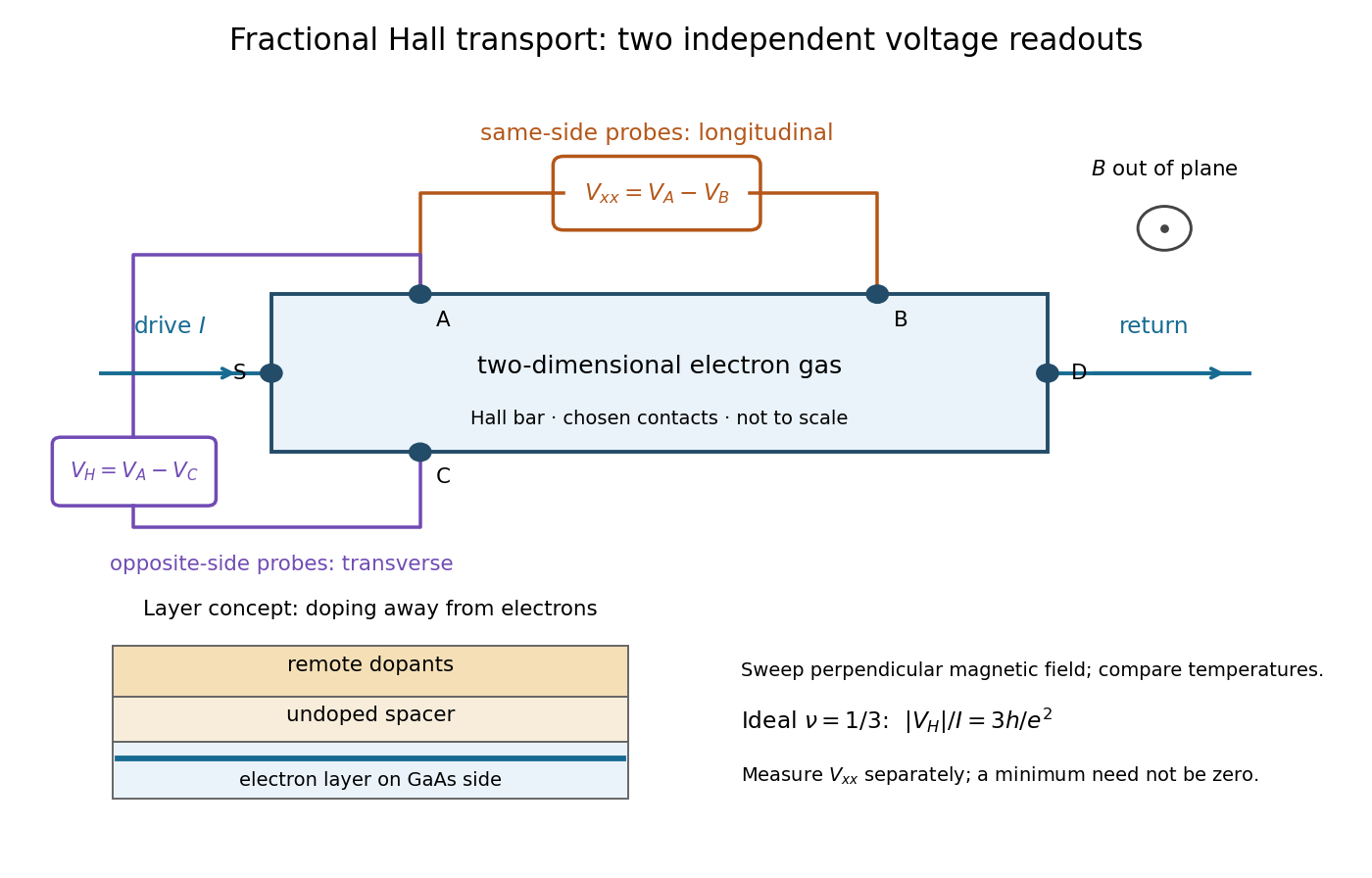
The two readouts test different statements. A single intersection with would also occur on the smooth classical relation at . A quantum Hall plateau instead persists over a magnetic field interval. Comparing transverse and longitudinal signals helps distinguish that plateau from a contact-placement artefact; the quantum Hall conductivity tensor inversion quantifies the contamination when longitudinal sheet resistivity is nonzero.
Later, 1997 shot noise measurements associated with quantum tunnelling at filling factor tested the excitation electric charge separately, finding . That is a different observable from a Hall plateau.[ref]
Observation of the e⁄3 Fractionally Charged Laughlin Quasiparticle by L. Saminadayar and others. Publisher abstract: tunnelling noise and inferred quasiparticle charge
Robert Laughlin's 1983 variational method uses pairwise zeros to suppress close Electron encounters within the lowest Landau level. For aligned spin, odd gives fermionic exchange symmetry.[ref]
Here enforces wavefunction normalization, is the magnetic length, and complex coordinates describe Electrons in a magnetic field , , with the symmetric gauge. Reversing the orientation conjugates the polynomial without changing probability densities. The Gaussian function confines the wavefunction.
The exchange check is especially simple for two Electrons. Writing , exchange sends , so . An aligned two-Electron spin state is symmetric, requiring the spatial wavefunction to change sign. Hence works, whereas would give the wrong sign. At a close encounter, the probability density vanishes as : imposes a sixth-order zero, stronger than the quadratic zero at . This is the local geometric mechanism for avoiding a large repulsive Coulomb potential energy.
A useful large- counting outline follows directly from the polynomial. Each complex coordinate has maximum degree . A lowest Landau level orbital proportional to has its areal probability density maximum at , by differentiating its logarithm. This suggests droplet area , neglecting the boundary correction. Dividing by the degeneracy of a Landau level per area, , gives filling factor . This counting is a motivation for the fraction, not an independent proof that the wavefunction minimizes the interacting Hamiltonian.
Consider the original two-Electron example obtained by taking in the Laughlin wavefunction, with no additional polynomial for the centre of mass. Introduce , relative complex coordinate , separation , and dimensionless separation . Since , the probability density factorizes:Integrating out leaves an isotropic relative probability density. Define per unit dimensionless area and per unit dimensionless separation:The physical areal probability density is . The probability of a separation between and is . The extra comes from the Jacobian determinant in polar coordinates: a thin annulus has area . Omitting that factor changes the question being answered.
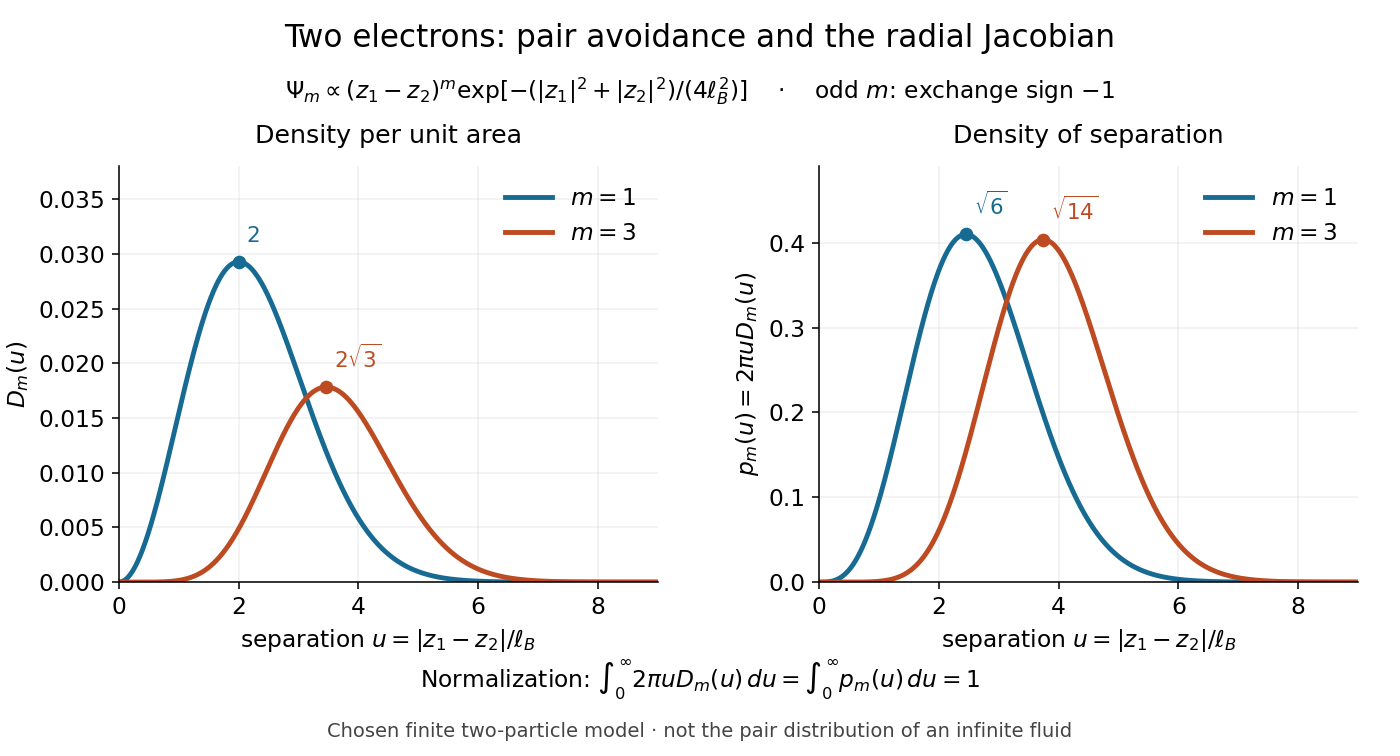
Both wavefunction normalization and the peak shift can be checked exactly. The substitution gives the Gamma function integralFor , logarithmic differentiation givesConsequently the areal maximum lies at , while the most probable separation lies farther out, at . For these are and ; for , and . The same substitution gives , so the root mean square separations are and respectively. The distinction between a probability density maximum and a radial maximum therefore has a directly calculable geometric origin.
This two-Electron model explains exchange and pair avoidance. It does not establish a nonzero many-particle spectral gap, an extended quantum Hall plateau, or the topological properties of a fluid in the thermodynamic limit. Those require additional many-Electron reasoning and experimental tests.
A quasihole adds one zero at per Electron; its local deficit carries positive electric charge .[ref]
Anomalous Quantum Hall Effect: An Incompressible Quantum Fluid with Fractionally Charged Excitations by Robert Laughlin. pp. 1396–1397, Eqs. (13), (15) and screening argument
Here is a transport counting outline, conditional on an incompressible quantum Hall fluid. Inserting one magnetic flux quantum slowly compared with , where is the excitation energy gap, produces a circulating electric field by Faraday's law. The transverse sheet conductivity sends a radial electric current whose time integral has magnitudeThe opposite electric charge moves to the boundary, so the total electric charge remains conserved. The counted deficit belongs to a collective quasiparticle; no individual Electron has been cut into pieces. The argument assumes the gapped fluid and its Hall response, and is not a consequence of the finite two-Electron normalization integral.
An incompressible quantum Hall fluid has a bulk spectral gap against charged excitations; disorder can localize excess quasiparticles.[ref]
Anomalous Quantum Hall Effect: An Incompressible Quantum Fluid with Fractionally Charged Excitations by Robert Laughlin. pp. 1397–1398, incompressibility and impurity localization
Articles by others on the same topic

The fractional quantum Hall effect (FQHE) is a phenomenon that occurs in two-dimensional electron systems subjected to strong magnetic fields and low temperatures. This effect is characterized by the existence of quantized Hall conductance at fractional values of the fundamental quantum of conductance, which is e²/h, where "e" is the charge of an electron and "h" is Planck's constant. The FQHE was first observed in 1982 by David Thouless, F. Duncan M.



TODO original experiment?
Laughlin paper: 1981 Quantized Hall conductivity in two dimensions.