The independence of random variables and is needed for the intended mixture distribution in (ii) and (iii). It is absent from the printed assumptions. We use independence for the main formulas, and then give the answers under the literal assumptions.
The uniform distribution has probability density function on . Therefore, for ,The value at zero follows either directly from the definition of the moment-generating function or by continuity. This answer needs no assumption about .
If and are independent random variables, conditioning on the Bernoulli random variable giveswith the continuous value . Indeed when , while the conditional probability distribution of given is the original uniform distribution.
Under the literal assumptions alone, the law of total expectation gives onlyThis is not determined by and . For an explicit counterexample, put and . Then has the required Bernoulli distribution, butwhich differs from the independent-case formula.
Under independence of random variables, the law of a random variable is the mixed probability distribution . For negative , only the uniform component can contribute to ; at zero the probability mass is included. Thus its cumulative distribution function isThe sketch consists of a horizontal segment at height zero before , a line of slope ending at the open point , a jump of size to the closed point , another line of slope ending at , and a horizontal segment thereafter. The cumulative distribution function is right-continuous at the jump.
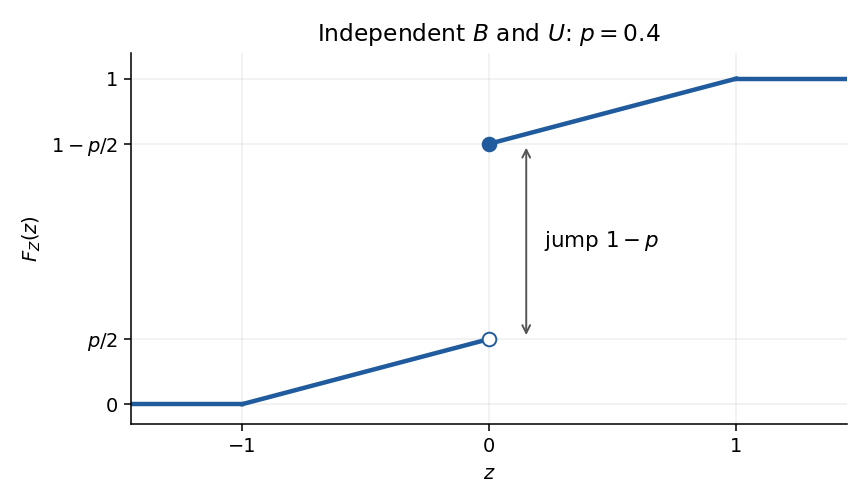
Cumulative distribution function of the independent Bernoulli-uniform product, illustrated at
. Details. 
Under the literal assumptions, write . The general answer is , so the continuous part of the sketch is undetermined. The jump at zero is still exactly , because . In the dependent counterexample from (ii), for , for , and for .
Articles by others on the same topic
There are currently no matching articles.