The uniqueness theorem for moment-generating functions states that if and are finite and equal on an open real interval containing zero, thenFor the convergence theorem for moment-generating functions, suppose that the moment-generating functions are finite on a common open real interval , , and for every , where is finite there. ThenOne may equivalently assume convergence to a finite function on that interval: the theorem then asserts existence of a unique limiting probability distribution with moment-generating function as well as convergence in distribution.
The independence of random variables and is needed for the intended mixture distribution in (ii) and (iii). It is absent from the printed assumptions. We use independence for the main formulas, and then give the answers under the literal assumptions.
The uniform distribution has probability density function on . Therefore, for ,The value at zero follows either directly from the definition of the moment-generating function or by continuity. This answer needs no assumption about .
If and are independent random variables, conditioning on the Bernoulli random variable giveswith the continuous value . Indeed when , while the conditional probability distribution of given is the original uniform distribution.
Under the literal assumptions alone, the law of total expectation gives onlyThis is not determined by and . For an explicit counterexample, put and . Then has the required Bernoulli distribution, butwhich differs from the independent-case formula.
Under independence of random variables, the law of a random variable is the mixed probability distribution . For negative , only the uniform component can contribute to ; at zero the probability mass is included. Thus its cumulative distribution function isThe sketch consists of a horizontal segment at height zero before , a line of slope ending at the open point , a jump of size to the closed point , another line of slope ending at , and a horizontal segment thereafter. The cumulative distribution function is right-continuous at the jump.
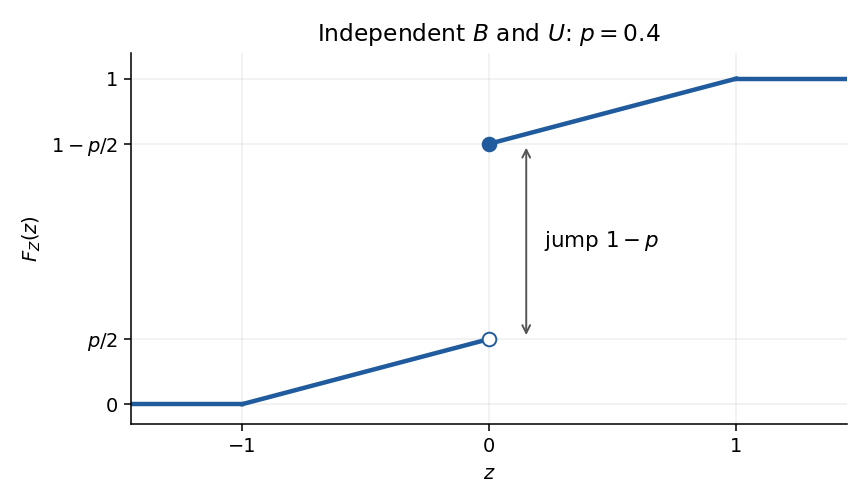
Cumulative distribution function of the independent Bernoulli-uniform product, illustrated at
. Details. 
Under the literal assumptions, write . The general answer is , so the continuous part of the sketch is undetermined. The jump at zero is still exactly , because . In the dependent counterexample from (ii), for , for , and for .
Fix and choose , independently of , with the normal distributionThe linear combination of independent normal random variables is normal. Its expected value is and its variance is . Hence for every , proving that every specified normal distribution is a self-decomposable distribution.
Fix . Since , . Using independence of random variables and the Tonelli theorem for the positive exponential integrands gives the extended-real identityThe left side is finite and the first factor is finite and strictly positive. Consequently is finite andThe same reasoning applies to , so their moment-generating functions are finite and equal throughout . The uniqueness theorem for moment-generating functions yieldsThis proves uniqueness of a self-decomposition remainder while also checking the required finiteness; no independence between and is needed.
For , integration gives for . For , the candidate remainder moment-generating function isThis is the moment-generating function of the mixture distributionConstruct it by taking an exponential random variable of rate and a Bernoulli random variable with , with mutually independent, and setting . Then is independent of , andon a neighborhood of zero. By the uniqueness theorem for moment-generating functions, , so the exponential distribution is a self-decomposable distribution.
For independent and identically distributed random variables , the linear combination of independent normal random variables has expected value zero and variance . ThusThis is exactly the requested -stability. The paper's definition is a strictly stable distribution, since it allows no centering term.
First take integers . For independent copies of , defineThe two blocks involve disjoint families of independent random variables, so and are independent. The assumed strictly stable distribution gives , , andTherefore, on any fixed probability space carrying and an independent copy , their joint probability distribution givesNow fix an arbitrary and choose rationals tending to . Continuity of the real powers gives, on that fixed probability space,The left sides all have the probability distribution of . Since almost sure convergence implies convergence in distribution, their limit has that same probability distribution. HenceThis proves strict stability implies self-decomposability. The limit argument uses no moment-generating function or finite moments, which is essential for general stable distributions.
Articles by others on the same topic
There are currently no matching articles.