False. A connected graph has an Eulerian cycle exactly when every vertex has even degree. In every degree is , so it has an Eulerian cycle precisely when is odd. The complete graph is a counterexample to the statement for all .
True. Label the vertices . The cycle uses existing edges of the complete graph and visits every vertex once before returning. It is a Hamiltonian cycle for every .
True. Draw two nested squares and join corresponding corners. This is the hypercube graph: each square gives one four-cycle and the four connecting edges give the remaining coordinate direction. The edges have no crossings, furnishing a plane graph.
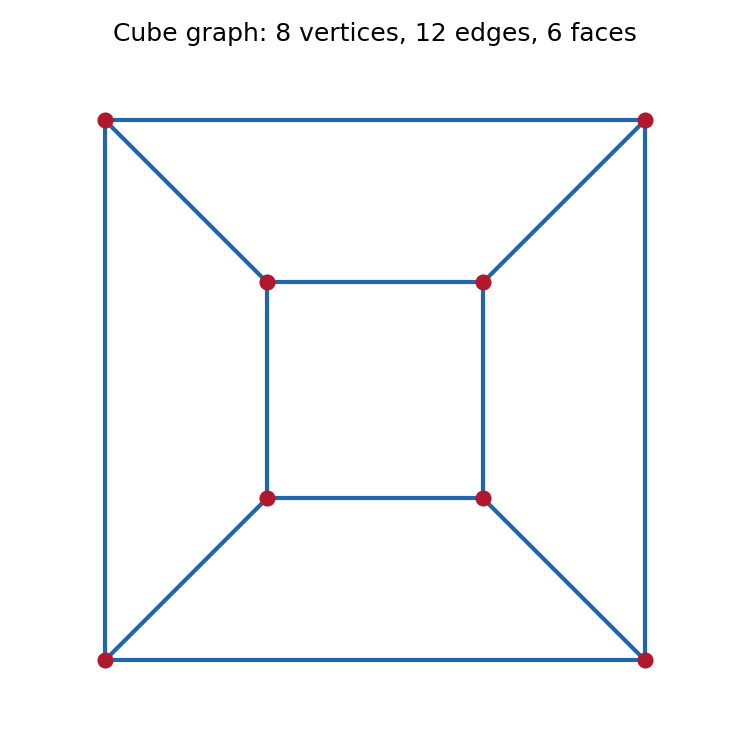

False. The cube has eight vertices and twelve edges. Euler formula for a connected planar graph for its connected plane graph gives , soThe nested-square embedding has four faces between the squares, one inside the smaller square and the unbounded exterior face.
True. Represent a vertex of by a four-bit string, with an edge changing exactly one bit. Color according to the parity of the sum of the bits. Every edge joins opposite parities, giving a proper two-coloring. Since the graph has edges, one color is impossible, so .
False. In the vertices in one class have degree , while the vertices in the other have degree . For positive , connectedness is automatic, and Euler's criterion requires both and to be even. Evenness of their sum alone allows both to be odd. For example has but all four degrees are odd, so it has no Eulerian cycle.
False. The four-cycle is bipartite, with alternating color classes, but contains a cycle and therefore is not a tree.
True. Choose a root of the tree and color every vertex according to the parity of its graph distance from that root. The unique-path property implies that the endpoints of each edge have distances differing by one. Thus every edge crosses the two color classes, proving bipartite graph.
False. In a Prüfer code, the degree of a label is one plus its number of occurrences. Here labels occur once and labels do not occur. Thus the former have degree two and the latter degree one. The decoded tree is the pathwith the evident single-edge interpretation when . Independently, no vertex of a simple tree on vertices can have degree at all. The degree claim in the statement is therefore impossible.
True. Each connected component of a forest is a tree. If the component sizes are , their edge counts are , including isolated vertices as size-one components. Summing gives , hence
Articles by others on the same topic
There are currently no matching articles.