For a finite group action, Burnside's lemma givesPair each vertex with its opposite face. This correspondence is equivariant under every tetrahedral symmetry. Each pair has six possible combined color states: three face colors and two vertex colors. Thus we are coloring four positions with six symbols; the two kinds of coloring must be counted together.
The group of rotations is the alternating group . The identity has four cycles and fixes colorings. Its three half-turns have cycle type and each fix . Its eight third-turns have cycle type and each also fix . Consequently the rotation count isAllowing mirror equivalence gives the full tetrahedral symmetry group . Now all permutations of the four paired positions are allowed, so a coloring is determined by a multiset of four symbols chosen from six. stars and bars givesFor an independent Burnside check, the five cycle types of give numerator , whose quotient by 24 is 126. This is paired face and vertex colorings of a tetrahedron.
The degree of a field extension is the dimension of as a vector space over . The tower law states that for finite extensions ,If the left side is prime, one factor is one. Degree one forces equality of the corresponding fields, so there is no proper intermediate field.
Let have 32 elements. Its prime field is , and its dimension over that field is five, since a dimension- vector space over has elements. Every element outside has minimal polynomial of degree five: its generated intermediate field has degree greater than one and dividing five.
Every element of satisfies , by the multiplicative group of a field of order 31 for nonzero elements. Hence splits completely over and has no repeated roots, since its derivative is minus one. Conversely any irreducible polynomial over gives a quotient ring with 32 elements. Its defining element satisfies , so divides that polynomial and therefore has all five distinct roots in .
The 30 elements of are thus partitioned into disjoint five-element root sets of the irreducible polynomials. Their number isNo classification of the six individual polynomials is needed; the tower degree and separability already count them all.
Euler's theorem states that if , then , where is Euler's totient function. This includes Fermat's little theorem when is prime.
For each prime-power factor , the integer divides the defined least common multiple . Euler's theorem modulo that prime power therefore givesThe prime powers are pairwise coprime, so their product divides . Equivalently the Chinese remainder theorem givesFor the specified composite integer,Raising to the seventh power provesThus 561 is a Carmichael number. We use exactly the source's definition of as the least common multiple of prime-power totients; its validity here does not require replacing it by a smaller exponent at powers of two.
The monotone convergence theorem states that if measurable functions are nonnegative and pointwise, then is measurable andallowing either side to be infinite. The same conclusion holds under almost-everywhere monotone convergence after changing values on a null set. No assumption that the integrals stay bounded is required.
Use the increasing nonnegative measurable functions . Their pointwise limit is the given function except at irrelevant endpoint choices, and the fundamental theorem of calculus on givesmonotone convergence therefore gives . Since , this is also , and is not Lebesgue integrable. Measurability alone does not make a finite integral.
Similarly set . These nonnegative measurable functions increase to almost everywhere. The fundamental theorem of calculus givesBy monotone convergence,The integral is finite and , so is Lebesgue integrable. Identifying Lebesgue and ordinary integrals of continuous functions on compact intervals justifies each truncated calculation.
A dominated differentiation under the integral sign suffices. Suppose is measurable, is integrable at one parameter value, and for almost every the map is continuously differentiable on an interval. If throughout that interval for an integrable , then the parameter integral is differentiable, andOne direct sufficient version assumes is continuous in almost everywhere and has that common domination; dominated convergence theorem then proves the assertion.
Here , so the complex-valued function is integrable for every real . For a real increment , the elementary bound givesThe right side is integrable by hypothesis and the integrand converges pointwise to . dominated convergence theorem, applied to real and imaginary parts, provesThis supplies the domination explicitly rather than merely differentiating a formal Fourier transform.
Convergence to a point meansThe limit must belong to the metric space itself. The definition is equivalent to as a real sequence.
A metric space is sequentially compact if every sequence in it has a subsequence converging to a point of the same space. The sequence lies in , but every subsequence converges in to zero. Uniqueness of limits excludes an alternative limit inside , so the open interval is not sequentially compact.
For the product, take any sequence . sequential compactness of gives a subsequence . Apply sequential compactness of to the corresponding sequence to obtain a further subsequence . Passing to a subsequence preserves the convergence of the first coordinate, and thereforeThus is sequentially compact with the stated sum metric. Taking the second coordinate subsequence inside the first one is essential; two unrelated subsequences would not suffice.
The subspace topology is . For every open ,The inverse-image definition of continuity therefore gives the inclusion is continuous from to .
If the inclusion is continuous from , then belongs to for every . These intersections are precisely all members of , soThus the subspace topology is the coarsest topology on making the inclusion continuous.
Every open set of the subspace is for some . Since takes values in ,The right side is open in by the assumed continuity of the composition. Hence preimages of every -open set are open, proving is continuous.
Choose and let be the identity set map . The composition is the inclusion and is continuous by part (i). The hypothesized universal implication therefore says that the identity mapis continuous. Its preimage of a set is itself, so every such lies in . ThereforeCombining this with part (ii), when both properties hold, characterizes the subspace topology uniquely.
The required condition is . The implicit function theorem then gives a unique local differentiable branch with andThe denominator remains nonzero after shrinking the neighborhood by continuity.
For the specified smooth function,At both equal one, so the condition holds and . Differentiate twice:At zero, , , and . ConsequentlyThe additional derivatives exist because this particular is smooth; the general first-derivative theorem only requires the stated continuous first partial derivatives.
Let be a smooth variation with at both endpoints, and consider . stationary point gives the first variationIntegrate the middle term once by parts and the last term twice. All boundary terms vanish because both and vanish there. Assuming the derivatives needed for the classical formula, the given fundamental lemma of the calculus of variations yieldsWithout assuming those classical derivatives initially, the same calculation with compactly supported variations states this equation weakly; sufficient regularity then gives the classical equation.
For the specific integrand, , , , so the equation is . Its weak solutions here are smooth, and its general classical solution isPut , , . The conditions at zero give and . Those at giveUsing , solve to obtain , , , . Thus an extremal isSubstitution checks all four boundary values. The additive term in the integrand contributes no variation in , so it does not alter this equation.
Autonomy gives conservation of energy, while the cyclic coordinate give conserved momenta:Here is the angular momentum along the body's symmetry axis, and is its component along the fixed vertical. The time symmetry corresponds to , not to an additional angle momentum.
With and , solveInsert this and the conserved spin rate into the energy equation, multiply by , and isolate :
For a fixed nonvertical angle, letThe energy is . A constant angle in requires both and , by the reduced Euler-Lagrange equation and . Sinceboth and , with .
The source's unqualified final sentence omits the nonvertical restriction. A vertical axis has , where the displayed reduction divides by zero and the common root need not be interior. For example, the stationary upright top has , , andIts only repeated root is , so it has no common root with its derivative in . Thus the interior double-root conclusion holds for nonvertical steady precession. The vertical configurations require separate endpoint treatment. This is nonvertical qualification in the steady-top double-root condition.
For a consistently oriented surface and boundary, Ampère's law isStokes theorem gives the left side as , so the given curl equation proves the law.
On a circle of radius around the axis, the assumed azimuthal field is tangent and constant in magnitude. Thus the circulation is . For , the enclosed electric current is ; for , it is . ThereforeThe field is continuous at and vanishes regularly at the axis. Its direction follows the right-hand rule for positive electric current along . The radial component of the curl equation also gives , so the expression is valid at every height; no unmentioned axial dependence remains.
In steady flow, the supplied Euler equations for an inviscid fluid givesTaking its scalar product with gives . Along a streamline with tangent , this is precisely zero derivative of . Hence is constant along each streamline, with possibly different constants on different streamlines.
If the flow is also irrotational, and thus . Therefore has one constant value throughout each connected fluid region. The stronger conclusion uses vanishing of the entire gradient, not just its component along the velocity.
Take the curl of the Euler equations for an inviscid fluid. The gradient on the right has zero curl. Use the stated vector identity with , :incompressible flow gives , while a curl always has zero divergence, so . The remaining terms giveFor a two-dimensional velocity independent of , and . Thus the scalar vorticity is conserved following each fluid particle. It can still vary from particle to particle; this is advection, not a claim of spatially uniform vorticity.
Milne-Thomson's circle theorem states that if is a complex potential of a two-dimensional potential flow whose singularities lie outside , thenhas the circle as a streamline, with the original exterior singularities unchanged. Additive constants in the potential are immaterial.
Take , using the convention that positive is positive circulation. Reflection in the circle gives, up to a constant,The reflected vortex at has strength , while the central term has strength . Their combined circulation around the cylinder is zero; this is the circulation normalization implicit in the requested equation.
The vortex moves with the velocity induced by the other singularities, excluding its own singular term. Since complex velocity is , its value at the vortex is . ThusWriting and multiplying this equation by givesIts real part implies , and its imaginary part givesThe radius is constant and the angular velocity is constant on that orbit. For positive the orbit is clockwise with this convention. Retaining the conjugate on the time derivative is essential for the sign.
Uniform area distribution on the unit disk givesThe Jacobian determinant has absolute determinant , soIntegrating out the other coordinate givesThe joint probability density function factors into these two marginal distribution, proving independence of and . FinallyThe angle at can be defined arbitrarily, since that event has probability zero.
An absorbing state has ; once reached, the chain never leaves it. For a nonabsorbing initial state, condition on its first transition and use the Markov property:Here and . The other equations areSolving givesFor absorption into either state one or four, let be the expected number of steps, with . first-step analysis givesHence andThe expectation is finite because each transient two-step cycle has probability at most of remaining transient; the survival tail is geometrically bounded. This also justifies solving the expectation equations without assuming finiteness in advance.
The moment-generating function is on the real values where this expectation is finite, normally including a neighborhood of zero. Direct substitution giveswhenever the right side is finite.
For the given Gamma distribution and ,using the Gamma function after the scaling . At the positive integral diverges.
independence multiplies moment-generating functions. ThusUniqueness of a moment-generating function on a neighborhood of zero identifieswhere is the rate parameter, as in the printed probability density function.
A confidence interval is a pair of statistics such that, for each parameter value ,In repeated sampling, at least the stated fraction of intervals constructed by this rule cover the fixed unknown parameter. It is not a posterior probability statement about the parameter after one interval has been observed. Discrete exact constructions can have coverage greater than the nominal value.
For independent observations from a Poisson distribution, has a Poisson distribution with mean . Invert equal-tail tests of that total mean. At an observed integer , the lower endpoint solvesand the upper endpoint solvesThen divide both endpoints by . If , use lower endpoint zero. Each inversion allocates at most noncoverage probability to one side, giving at least total coverage.
Here the single total count is 39. The supplied values with the correct adjacent count indices are for the lower endpoint and for the upper one. ThusThe values 28.6 and 52.2 use the other count index and are not the endpoints of this central interval. This is adjacent count tails in an exact Poisson confidence interval.
The statistical power of a test is , its rejection probability at parameter . Its size is ; for a simple null this is just .
The Neyman-Pearson lemma states that for testing a simple null probability density function against a simple alternative probability density function , a test rejecting where , accepting where it is below , and if needed randomizing on equality to attain the desired size is most powerful among all tests of that size. It follows by integrating and using the size constraint.
The proposed probability density function is nonnegative, andFor an independent sample, cancellation of the factors in the likelihood ratio givesFor this is increasing in . The most powerful test therefore has rejection regionThe sum has a continuous positive probability density function on , so no boundary randomization is required. The threshold depends on the null and chosen size, but not on which was specified. The same test is therefore a uniformly most powerful test for the composite alternative .
Minimizing the squared residual norm gives the normal equationsFull column rank makes invertible. With columns corresponding to , the design matrix isSymmetry gives zero cross products between the odd column and either even column, and gives the remaining orthogonality. Their squared norms are seven, 28 and 84, so . ThereforeSince the error covariance is , least squares has covariance . ThusThe estimators have zero covariances. independence would require an additional distributional assumption such as Gaussian errors; the stated mean and variance assumptions alone give only the covariance calculation.
A Givens rotation acts as the identity except on coordinates , where its block can be writtenThe block has orthonormal columns because and their inner product is zero, so . For , choose , . The new coordinates are , eliminating the th entry. If both entries are zero, the identity already works.
For the specified vector, one suitable matrix isIts rows are orthonormal, so it is orthogonal; in fact its determinant is one. The positive nonzero output component must be five because an orthogonal matrix preserves Euclidean norm.
The matrix is not unique. Left multiplication by any orthogonal matrix fixing the second coordinate vector preserves this output. For example arbitrary rotations of the first and third coordinates provide infinitely many alternatives.
Richardson extrapolation combines approximations with a known leading error power to cancel that error. If , then removes .
Let for an even number of equal subintervals, with . The composite trapezoidal rule isThe Simpson's rule isAssume an error expansion , with the same coefficient on refined uniform meshes; is sufficient for this form. The coarser rule is . Direct coefficient collection givesThe leading errors cancel, leaving . The identity of the numerical integration weights is exact; the error-order conclusion additionally uses the smoothness and even-power error assumptions.
False. A connected graph has an Eulerian cycle exactly when every vertex has even degree. In every degree is , so it has an Eulerian cycle precisely when is odd. The complete graph is a counterexample to the statement for all .
True. Label the vertices . The cycle uses existing edges of the complete graph and visits every vertex once before returning. It is a Hamiltonian cycle for every .
True. Draw two nested squares and join corresponding corners. This is the hypercube graph: each square gives one four-cycle and the four connecting edges give the remaining coordinate direction. The edges have no crossings, furnishing a plane graph.
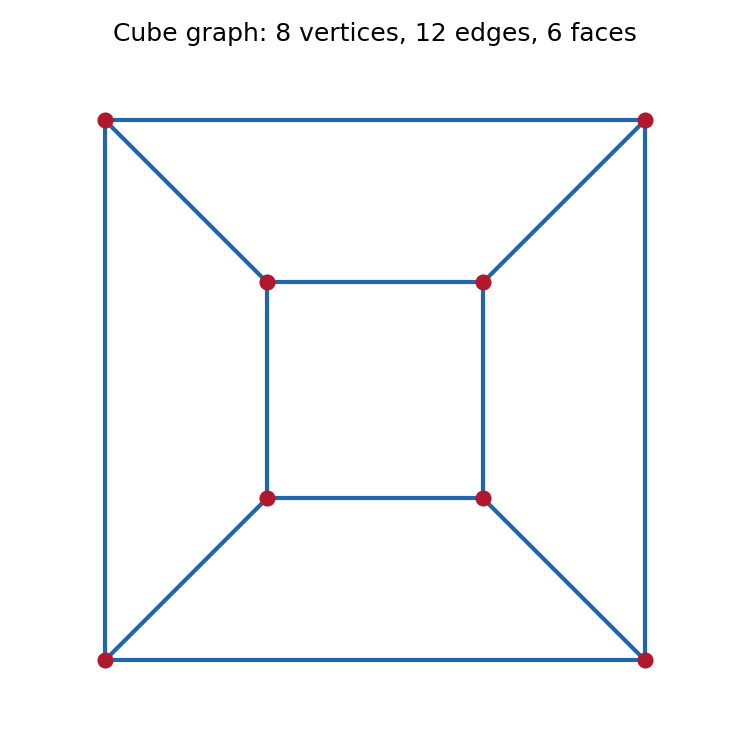

False. The cube has eight vertices and twelve edges. Euler formula for a connected planar graph for its connected plane graph gives , soThe nested-square embedding has four faces between the squares, one inside the smaller square and the unbounded exterior face.
True. Represent a vertex of by a four-bit string, with an edge changing exactly one bit. Color according to the parity of the sum of the bits. Every edge joins opposite parities, giving a proper two-coloring. Since the graph has edges, one color is impossible, so .
False. In the vertices in one class have degree , while the vertices in the other have degree . For positive , connectedness is automatic, and Euler's criterion requires both and to be even. Evenness of their sum alone allows both to be odd. For example has but all four degrees are odd, so it has no Eulerian cycle.
False. The four-cycle is bipartite, with alternating color classes, but contains a cycle and therefore is not a tree.
True. Choose a root of the tree and color every vertex according to the parity of its graph distance from that root. The unique-path property implies that the endpoints of each edge have distances differing by one. Thus every edge crosses the two color classes, proving bipartite graph.
False. In a Prüfer code, the degree of a label is one plus its number of occurrences. Here labels occur once and labels do not occur. Thus the former have degree two and the latter degree one. The decoded tree is the pathwith the evident single-edge interpretation when . Independently, no vertex of a simple tree on vertices can have degree at all. The degree claim in the statement is therefore impossible.
True. Each connected component of a forest is a tree. If the component sizes are , their edge counts are , including isolated vertices as size-one components. Summing gives , hence
The first four jobs all have deadlines at most ten, but their total processing time is . They cannot all be completed by time ten on one machine, so at least one is late in every schedule.
Moore's algorithm processes jobs in nondecreasing deadline order. Whenever the electric current on-time list first misses the new job's deadline, remove from that list a job with the largest processing time and put it on the late list. Continue, then append the rejected jobs after the on-time list. The theorem for this algorithm states that it minimizes the number of late jobs when all jobs are initially available.
The source order is already deadline order. The steps areAfter the first removal the cumulative time is seven; after the second it is eleven. Append jobs two and five. One optimal schedule isIts completion times are . Comparing with the corresponding deadlines verifies that precisely jobs two and five are late. Moore's theorem certifies that no schedule can improve on that number.
Articles were limited to the first 100 out of 111 total.
Articles by others on the same topic
There are currently no matching articles.