Choose one atomic orbital and on the two atoms and approximate a molecular orbital by the linear combination of atomic orbitalsProjecting the Schrödinger equation onto the two orbitals gives a generalized eigenvalue problem , where and . In an orthonormal basis the matrix isThe coupling mixes the atomic states and produces a lower bonding molecular orbital and upper antibonding molecular orbital. For equivalent real orbitals with overlap the normalized combinations are ; the precise energy ordering follows from the Hamiltonian matrix elements. This restricted orbital basis is an approximation to the molecule's wavefunction, rather than a claim that exact isolated-atom orbitals remain unchanged in the molecule.
A concrete example is samarium hexaboride, : narrow, nearly localized -derived states mix with a much more dispersive -derived conduction band. Such band hybridization is the low-energy mechanism behind a bulk Kondo insulator gap. The two-band Hamiltonian is an effective illustration; correlations help set its narrow-band energy and renormalized mixing.[ref]
https://www.nature.com/articles/ncomms3991. Introduction: nearly localized flat f bands hybridize with a dispersive d-derived conduction band in SmB6
Write the dispersive band as with and define . The uncoupled sketch is an upward-opening parabola and a horizontal flat band at positive energy. They cross on the sphere in three dimensions, or at in a one-dimensional cut:Without mixing the crossing is allowed. The left panel of the figure shows this case.
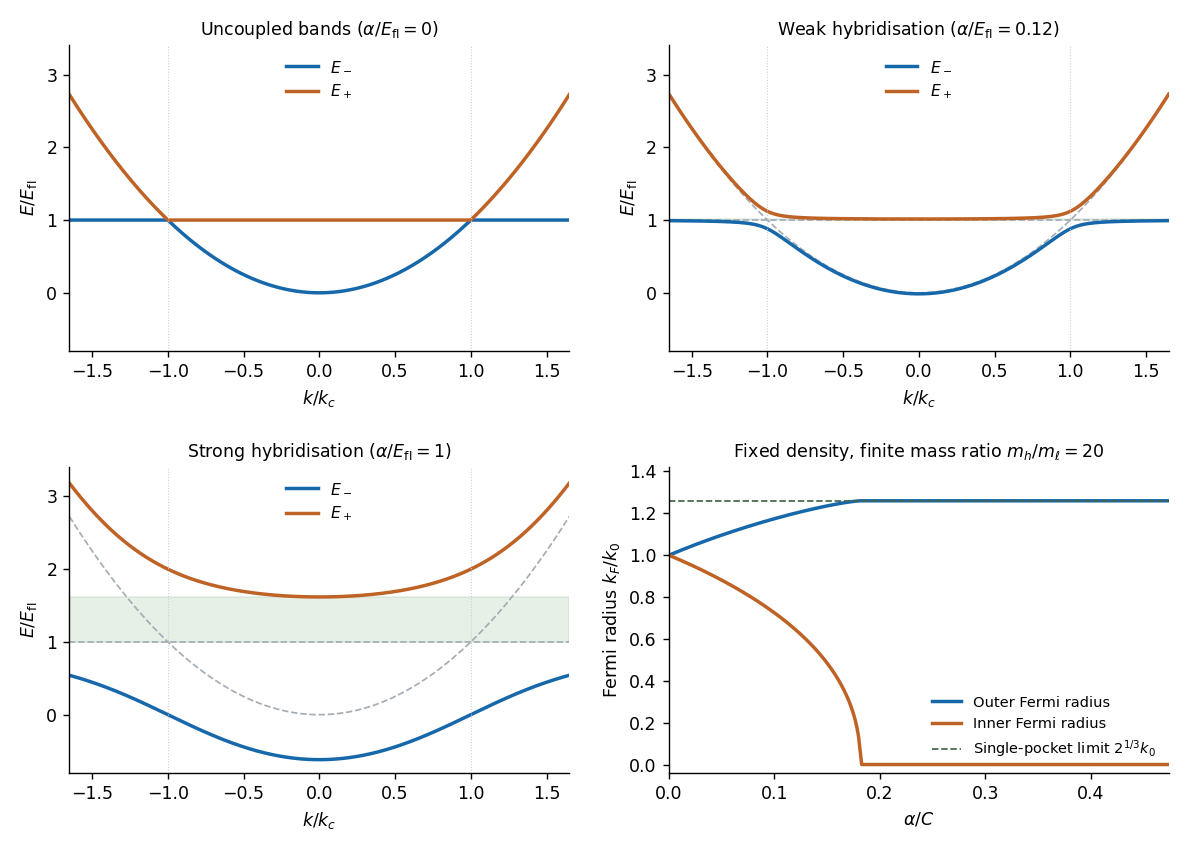

For dimensional clarity in the usual band effective mass convention. The printed product is consistent only if is a curvature coefficient with inverse-mass units; it cannot simultaneously denote the effective mass itself. Using avoids relying on that notation.
At nonzero band hybridization, the crossing becomes an avoided crossing. The separation at is . If , appreciable mixing occurs only where ; away from that region each branch retains nearly its original orbital character. For , the avoided crossing is broad and both branches are substantially reshaped, as shown in the figure.
Use for the lower branch and for the upper one. For ,The lower branch increases towards from below. Thus an indirect gap exists in the exactly flat-band model. In the unbounded-parabola limit its lower bound isA finite Brillouin zone gives a finite maximum of below and hence a slightly larger indirect gap. This hybridization gap differs from the local direct gap .
The material can therefore be a band insulator when the lower band is full and the upper band empty. With two spin-degenerate orbitals per unit cell, the required filling isWith spin degeneracy removed, replace two by one for each independent spin sector. Other fillings are metallic in this noninteracting model.
At each wavevector the orbital-basis Hamiltonian isA phase choice makes the momentum-independent mixing real and nonnegative. The characteristic equation issoFor , an eigenvector obeys . At the bare crossing, the normalized states are with energies . The lower state's parabolic-orbital weight iswhich tends to one below the crossing and zero above it. This makes the exchange of band character in the sketches explicit.
Let the common uncoupled Fermi wavevector be . Equal carrier densities imply equal Fermi surface volumes, and hence equal radii for the spherical spin-degenerate electron pockets. The conserved total density isIf hybridisation leaves only one occupied electron-like band, state counting givesThis is the familiar single-large-Fermi-surface answer. It requires the other hybridised band to be empty.
For finite heavy-band mass, that conclusion does not follow from an arbitrary nonzero coupling. At sufficiently small , the upper band still has an occupied pocket, so there are two Fermi momenta, not one. The exact fixed-density statement is Fermi-volume conservation in two hybridized electron bands:For an explicit weak-coupling check, write , , with , and enforce the uncoupled equality at : , . Put and . The Fermi-surface equation isAt fixed density , givingFor arbitrary coupling, put . The roots of the same characteristic equation, before discarding unoccupied pockets, areChoose the chemical potential so that . This specifies the Fermi momentum of each pocket for any supplied curvatures and coupling.
The transition to one occupied pocket occurs at . Set ; at the transition the two squared radii are and zero. Their sum and product giveFor there are two pockets; for the only nonzero radius is . The outer radius grows continuously and the inner one shrinks. The nearly flat band limit can make depopulation occur at a small coupling, but the mass ratio or a single-surface assumption is needed to turn the question into a unique finite-coupling numerical change.
Articles by others on the same topic
There are currently no matching articles.