The original tree-level Feynman diagrams below use solid arrowed fermion lines and dashed scalar field lines. The labelled internal momenta run in the indicated directions; and label the corresponding interaction vertices.
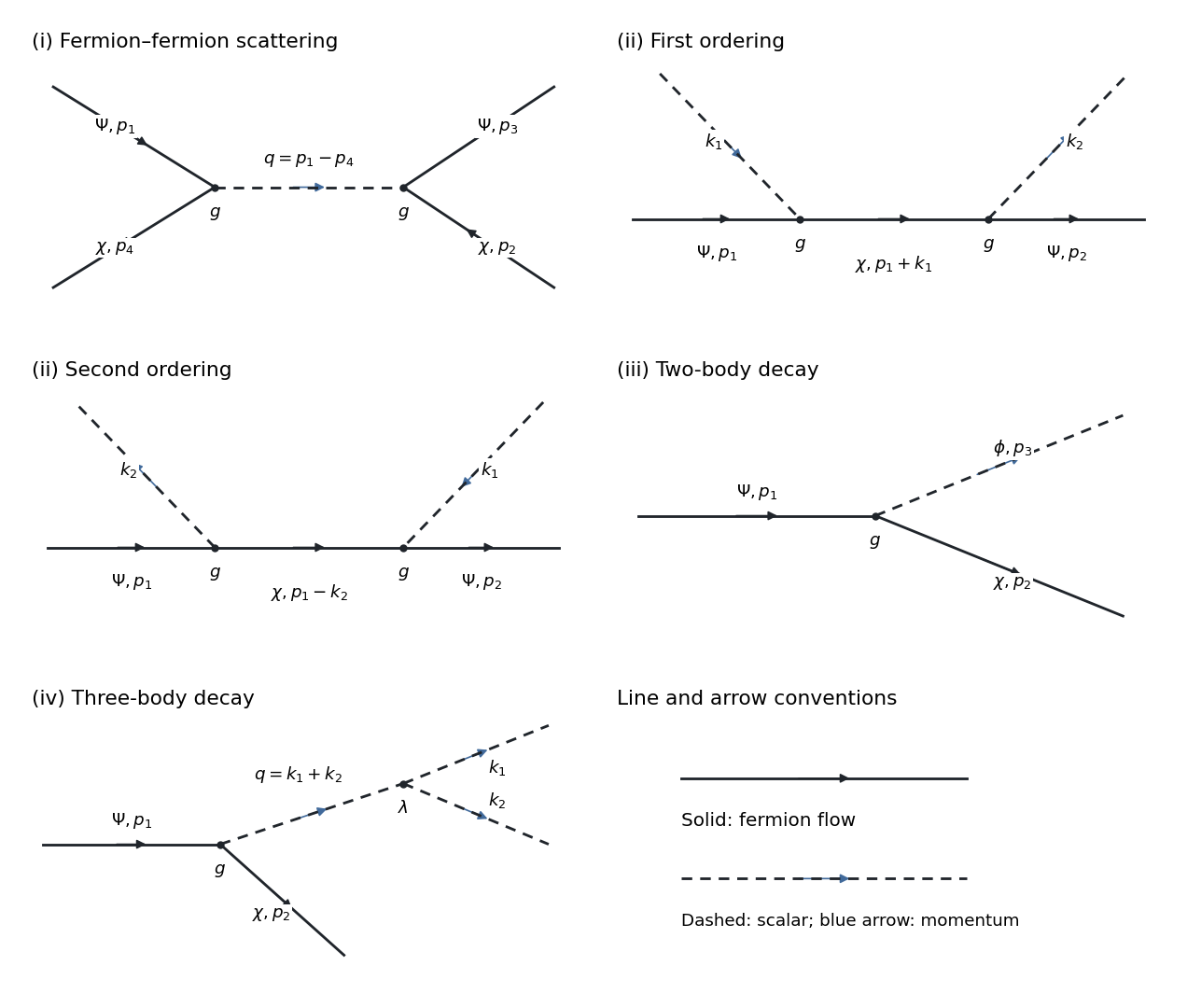
Momentum-labelled tree diagrams for the four processes; the middle row contains the two exchange orderings.
Details. 
Label the external four-momenta by . The only tree-level Feynman diagram exchanges a scalar field particle between the transitions and . Its internal four-momentum is . Thus its scattering amplitude, with a consistent external-state ordering, isIt is the crossed, or -channel, exchange with these labels. A direct -channel scalar field exchange would need a flavour-preserving Yukawa coupling, which the Lagrangian density does not contain. There is no annihilation Feynman diagram for two incoming fermions.
For , there are two tree-level Feynman diagrams, both with an internal fermion. Their internal four-momenta are and . The scattering amplitude isThese are the two possible absorption/emission orderings along the fermion flow. There is no third tree-level Feynman diagram using the cubic scalar field interaction vertex, since attaching its remaining scalar field line to the external line would require a forbidden interaction vertex.
For , the sole tree-level Feynman diagram is a single flavour-changing Yukawa coupling interaction vertex, with . Its invariant decay amplitude isThe solid arrow passes from the incoming to the outgoing ; the dashed outgoing line carries .
For , the sole tree-level Feynman diagram has a Yukawa coupling interaction vertex producing an off-shell scalar field particle of four-momentum , followed by its cubic scalar field interaction vertex. Its invariant decay amplitude isTwo successive Yukawa coupling interaction vertices would change the fermion species twice and leave a , so they cannot produce this final state. Interchanging the two identical outgoing bosons does not create another Feynman diagram; the cubic factorial is already included in the Feynman rule. The integrated decay width instead includes the identical final-state symmetry factor .
Articles by others on the same topic
There are currently no matching articles.