The momentum space Feynman rules use the scalar propagator and two Dirac propagatorsThe cubic scalar field interaction vertex is . Each of the two flavour-changing Yukawa coupling interaction vertices, and , has factor in Dirac spinor indices. A fermion flow arrow continues through each interaction vertex, but its species changes. There is no or interaction vertex.
Every interaction vertex carries with inward four-momenta. Integrate each independent loop momentum with , divide by the Feynman-diagram symmetry factor, and include a minus sign and a gamma-matrix trace for each closed fermion loop. The is the Feynman i-epsilon prescription.
For an amputated scattering amplitude, incoming fermions supply and outgoing fermions supply ; incoming antifermions supply and outgoing antifermions supply . An external real scalar field particle supplies . Use the standard relativistic normalization of a one-particle state; the external factors belong to that normalization and the Lorentz-invariant phase-space measure, rather than an additional factor in the invariant scattering amplitude.
The original tree-level Feynman diagrams below use solid arrowed fermion lines and dashed scalar field lines. The labelled internal momenta run in the indicated directions; and label the corresponding interaction vertices.
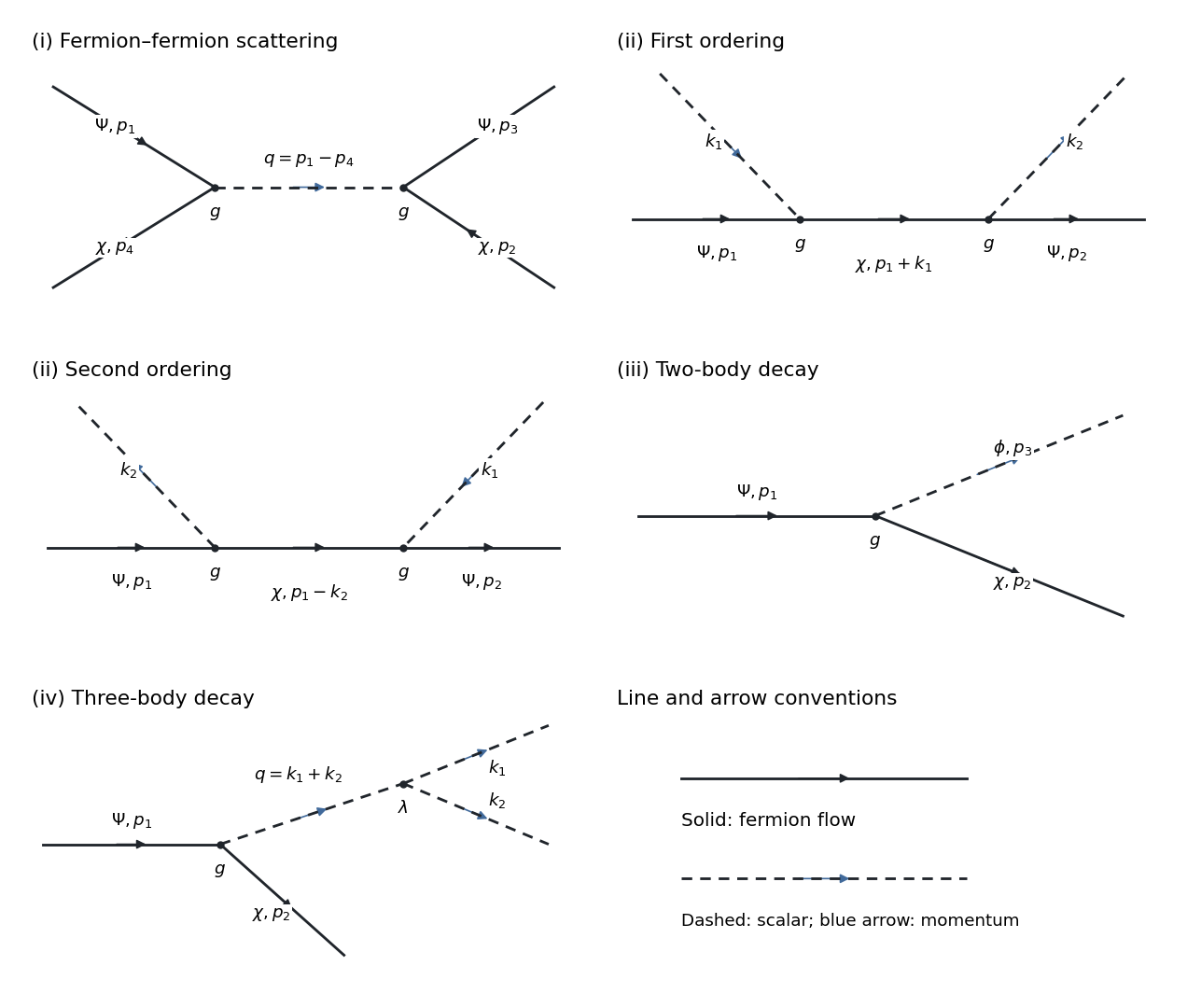
Momentum-labelled tree diagrams for the four processes; the middle row contains the two exchange orderings.
Details. 
Label the external four-momenta by . The only tree-level Feynman diagram exchanges a scalar field particle between the transitions and . Its internal four-momentum is . Thus its scattering amplitude, with a consistent external-state ordering, isIt is the crossed, or -channel, exchange with these labels. A direct -channel scalar field exchange would need a flavour-preserving Yukawa coupling, which the Lagrangian density does not contain. There is no annihilation Feynman diagram for two incoming fermions.
For , there are two tree-level Feynman diagrams, both with an internal fermion. Their internal four-momenta are and . The scattering amplitude isThese are the two possible absorption/emission orderings along the fermion flow. There is no third tree-level Feynman diagram using the cubic scalar field interaction vertex, since attaching its remaining scalar field line to the external line would require a forbidden interaction vertex.
For , the sole tree-level Feynman diagram is a single flavour-changing Yukawa coupling interaction vertex, with . Its invariant decay amplitude isThe solid arrow passes from the incoming to the outgoing ; the dashed outgoing line carries .
For , the sole tree-level Feynman diagram has a Yukawa coupling interaction vertex producing an off-shell scalar field particle of four-momentum , followed by its cubic scalar field interaction vertex. Its invariant decay amplitude isTwo successive Yukawa coupling interaction vertices would change the fermion species twice and leave a , so they cannot produce this final state. Interchanging the two identical outgoing bosons does not create another Feynman diagram; the cubic factorial is already included in the Feynman rule. The integrated decay width instead includes the identical final-state symmetry factor .
In the convention of iii, the invariant decay amplitude is . Including the common overall in the definition changes no squared decay amplitude. An unpolarized ensemble is an incoherent equal mixture of the two initial spin states; hence take a spin average over and a spin sum over the unobserved final . Different final spin states are orthogonal outcomes, so their probabilities, rather than their decay amplitudes, add.
Using the Dirac adjoint and the fermion spin sum givesThe gamma-matrix trace identities used here are and . The mass-shell conditions and , together with four-momentum conservation, implyThereforeIn the parent's rest frame this also says .
The printed integration labels need correction. The parent's four-momentum is fixed, so the two Lorentz-invariant phase-space measures must integrate and , rather than the printed and . Write and , . The physical decay width isThe spatial Dirac delta function sets . Performing the angular integral in spherical coordinates, with , gives the integrated two-body decay phase spaceThe positive root is . Since , the Dirac delta function integration yields . ThusThe two final particles have different species, so there is no identical final-state symmetry factor. The result tends to as and vanishes at the two-particle decay threshold.
Put . For the decay width is zero by conservation of energy. Just above the three-particle decay threshold, all three daughters are nonrelativistic. The decay amplitude of iv remains finite: the internal scalar propagator denominator approaches , and the Dirac scalar bilinear does not vanish at rest. Thus, for nonzero fixed and , the leading suppression comes entirely from three-body threshold phase space.
Use the spatial Dirac delta function to eliminate one daughter momentum. The remaining integral has six independent momentum coordinates and one conservation of energy constraint,Rescaling both momenta by gives from the measure and from the Dirac delta function. The smooth factors do not change the power. Consequentlywith a finite positive leading coefficient when ; for . The for the identical bosons changes only this coefficient. Equivalently, at fixed the opening is quadratic in . If , this leading tree-level Feynman diagram vanishes, so the stated leading coefficient is zero.
Articles by others on the same topic
There are currently no matching articles.