Use , the Minkowski metric , and . The momentum-space Feynman rules for the real scalar field areAt each interaction vertex impose two-dimensional momentum conservation; before removing the overall conservation factor this is . Integrate each independent loop momentum with , and divide a Feynman diagram by its symmetry factor. External lines carry the same scalar propagator in an unamputated two-point correlation function; they are removed in an amputated scattering amplitude.
The quadratic action is inverted with the Feynman i-epsilon prescription to obtain the scalar propagator. Expanding the Dyson series gives per insertion; the attachments in the Wick theorem cancel the factorial. Fourier integration over the insertion point supplies the momentum conservation factor. Automorphisms that leave the labelled external attachments fixed account for the remaining symmetry factor. In two spacetime dimensions the mass dimensions are and .
The one-loop one-particle irreducible correction is a tadpole diagram: two external lines meet one quartic interaction and the other two legs are joined. Interchanging the two ends of its loop gives the symmetry factor .
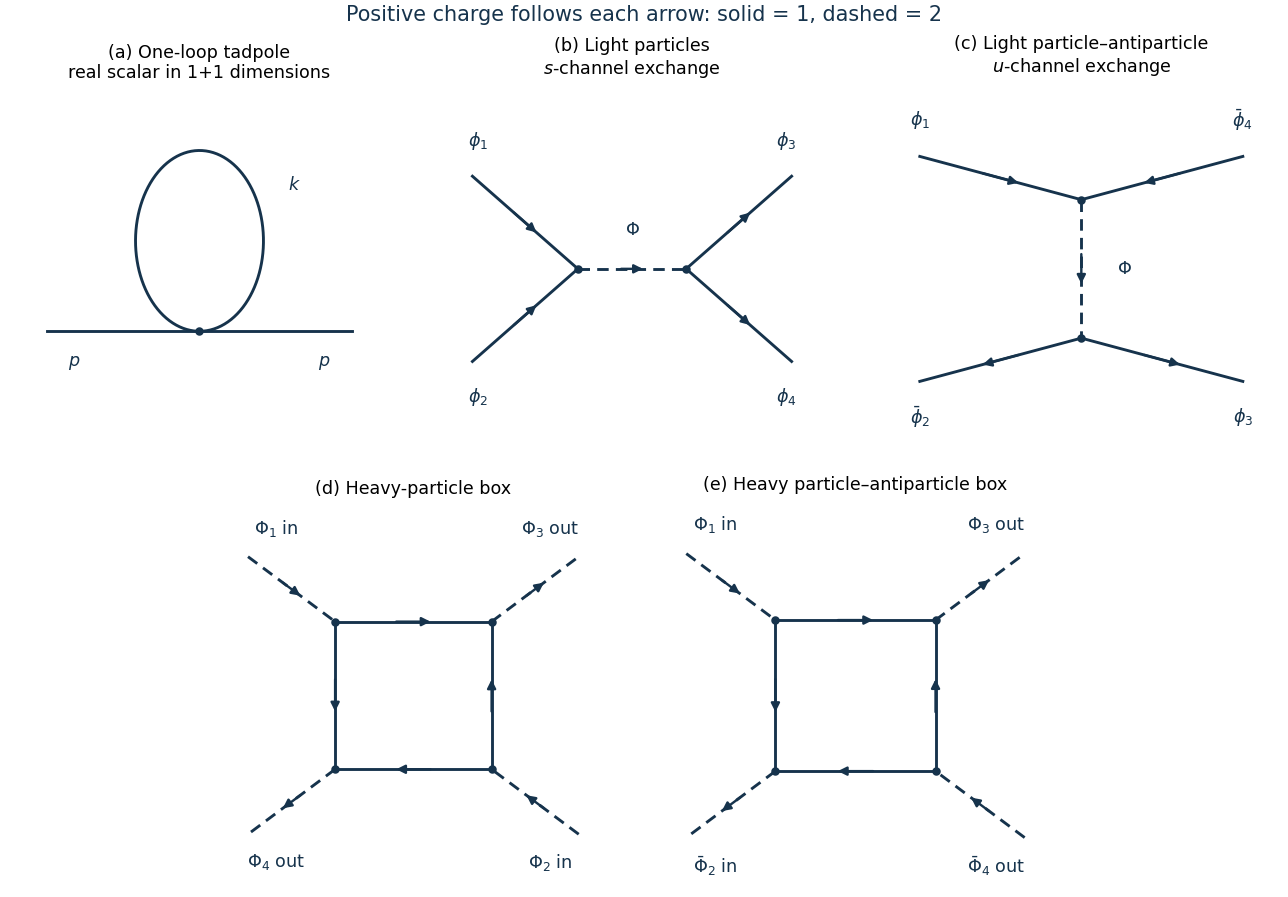
Original scalar diagrams: the two-dimensional tadpole, charge-conserving light-scalar exchange, and heavy-scalar box amplitudes. Dashed lines carry charge two; solid lines carry charge one.
Details. 
Define the self-energy by an insertion and a full scalar propagator before counterterms. The supplied cutoff regularization integral givesThusIt has no external momentum dependence. The correction to the unamputated two-point correlation function in momentum space isThe positive sign of raises the unrenormalized squared pole mass for .
Write , , and define the mass counterterm as a squared-mass coefficient:With the self-energy convention in b, the inverse scalar propagator is . Requiring the pole mass to equal therefore gives the on-shell renormalization scheme conditionAt one loop order, ; hence a unit pole residue also gives , andThe mass counterterm Feynman rule is , cancelling the tadpole diagram. A convention defining a positive mass subtraction by instead has ; specifying this convention avoids a spurious sign disagreement.
There is no one-loop wave-function renormalization because the tadpole diagram is independent of momentum. Each one-loop four-point bubble diagram has two scalar propagators, so its large Euclidean loop momentum integral behaves as and is ultraviolet finite. Thus no divergent quartic interaction counterterm is required. Finite coupling redefinitions remain possible. At higher loop orders, finite wave-function renormalization may be needed if unit pole residue is imposed; power counting only rules out its ultraviolet divergence.
Let count internal lines, independent loops, and interaction vertices of a connected Feynman diagram. The graph identity and the two inverse powers from each scalar propagator give its superficial degree of divergence:The same formula applies to every connected subgraph. Graphs with have negative superficial degree of divergence, but this alone does not remove a possible ultraviolet subdivergence. A one-vertex subgraph with external legs in the quartic scalar field theory can diverge only by a tadpole diagram, whose subtraction was fixed in c. Subtract every such tadpole diagram; every remaining loop subgraph then has and negative superficial degree of divergence. Its ultraviolet divergence is absent. Equivalently, normal ordering the quartic interaction removes all self-contractions at a single interaction vertex. Thus no new divergent field-dependent counterterm structure is needed, and in a normal-ordering subtraction scheme in two dimensions the one-loop mass subtraction exhausts these divergent coefficients.
The literal assertion that there are no further counterterm contributions in the on-shell renormalization scheme is stronger and generally false. A concrete counterexample is the two-loop sunset diagram. After analytic continuation below its three-particle threshold, the magnitude of its self-energy at contains the strictly positive finite integralThe integrable corners do not spoil convergence. Its nonzero value shifts the pole mass, requiring an additional finite mass counterterm if is to remain the exact pole mass; its derivative can likewise change the pole residue. These are compatible with the power counting result. If vacuum diagrams are retained rather than divided out in normalized correlation functions, a separate constant vacuum energy counterterm is also required: the one-vertex double-loop vacuum diagram is already divergent. The claim about the mass subtraction concerns field-dependent counterterms and normalized correlation functions.
The additional six-leg interaction vertex has Feynman rule . Since both interactions lack derivatives, the graph identity still gives , with . The difference is that a one-vertex contraction of the phi-six theory can leave four external legs: choosing the contracted pair gives . Its quartic interaction correction isConsequently a one-loop quartic interaction counterterm is now necessary:The one-loop mass counterterm from c is unchanged. Contracting four legs of a single six-leg interaction vertex gives double contractions, hence a two-loop raw self-energy . Its subtraction must include the quartic interaction counterterm insertion, rather than subtracting this raw expression in isolation.
All divergent field-dependent coefficients are most simply organized by the normal-ordering subtraction scheme in two dimensions. With , express a potential normal ordered at mass in ordinary fields:Thus its divergent subtraction coefficients, in this scheme, areIndeed the two-loop self-energy terms are , which the displayed mass counterterm cancels. The constant terms only affect vacuum energy. After removing all one-vertex self-contractions, every remaining subgraph is ultraviolet finite. Additional finite on-shell renormalization scheme adjustments are subject to the same qualification as d.
Articles by others on the same topic
There are currently no matching articles.