Use , the Minkowski metric , and . The momentum-space Feynman rules for the real scalar field areAt each interaction vertex impose two-dimensional momentum conservation; before removing the overall conservation factor this is . Integrate each independent loop momentum with , and divide a Feynman diagram by its symmetry factor. External lines carry the same scalar propagator in an unamputated two-point correlation function; they are removed in an amputated scattering amplitude.
The quadratic action is inverted with the Feynman i-epsilon prescription to obtain the scalar propagator. Expanding the Dyson series gives per insertion; the attachments in the Wick theorem cancel the factorial. Fourier integration over the insertion point supplies the momentum conservation factor. Automorphisms that leave the labelled external attachments fixed account for the remaining symmetry factor. In two spacetime dimensions the mass dimensions are and .
The one-loop one-particle irreducible correction is a tadpole diagram: two external lines meet one quartic interaction and the other two legs are joined. Interchanging the two ends of its loop gives the symmetry factor .
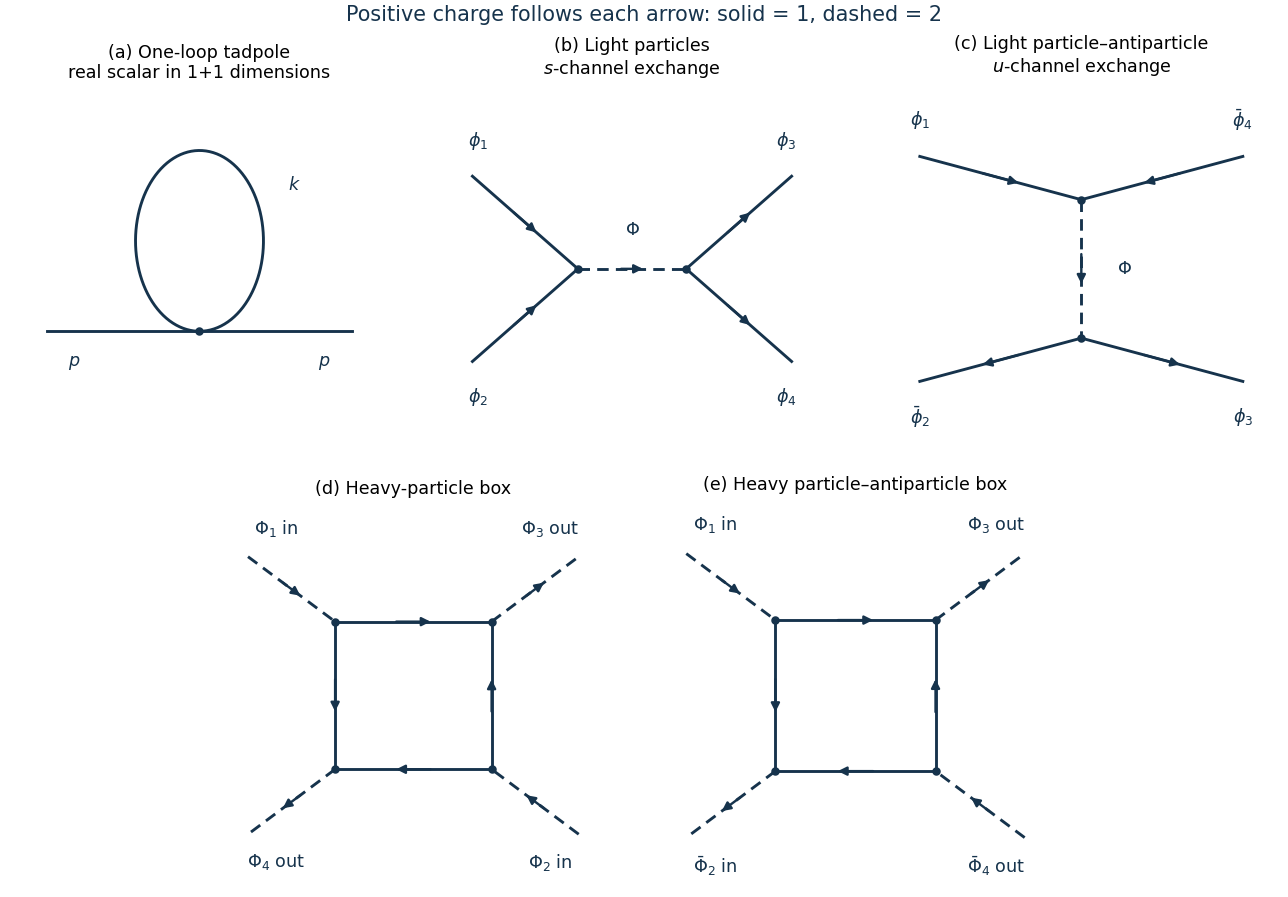
Original scalar diagrams: the two-dimensional tadpole, charge-conserving light-scalar exchange, and heavy-scalar box amplitudes. Dashed lines carry charge two; solid lines carry charge one.
Details. 
Define the self-energy by an insertion and a full scalar propagator before counterterms. The supplied cutoff regularization integral givesThusIt has no external momentum dependence. The correction to the unamputated two-point correlation function in momentum space isThe positive sign of raises the unrenormalized squared pole mass for .
Write , , and define the mass counterterm as a squared-mass coefficient:With the self-energy convention in b, the inverse scalar propagator is . Requiring the pole mass to equal therefore gives the on-shell renormalization scheme conditionAt one loop order, ; hence a unit pole residue also gives , andThe mass counterterm Feynman rule is , cancelling the tadpole diagram. A convention defining a positive mass subtraction by instead has ; specifying this convention avoids a spurious sign disagreement.
There is no one-loop wave-function renormalization because the tadpole diagram is independent of momentum. Each one-loop four-point bubble diagram has two scalar propagators, so its large Euclidean loop momentum integral behaves as and is ultraviolet finite. Thus no divergent quartic interaction counterterm is required. Finite coupling redefinitions remain possible. At higher loop orders, finite wave-function renormalization may be needed if unit pole residue is imposed; power counting only rules out its ultraviolet divergence.
Let count internal lines, independent loops, and interaction vertices of a connected Feynman diagram. The graph identity and the two inverse powers from each scalar propagator give its superficial degree of divergence:The same formula applies to every connected subgraph. Graphs with have negative superficial degree of divergence, but this alone does not remove a possible ultraviolet subdivergence. A one-vertex subgraph with external legs in the quartic scalar field theory can diverge only by a tadpole diagram, whose subtraction was fixed in c. Subtract every such tadpole diagram; every remaining loop subgraph then has and negative superficial degree of divergence. Its ultraviolet divergence is absent. Equivalently, normal ordering the quartic interaction removes all self-contractions at a single interaction vertex. Thus no new divergent field-dependent counterterm structure is needed, and in a normal-ordering subtraction scheme in two dimensions the one-loop mass subtraction exhausts these divergent coefficients.
The literal assertion that there are no further counterterm contributions in the on-shell renormalization scheme is stronger and generally false. A concrete counterexample is the two-loop sunset diagram. After analytic continuation below its three-particle threshold, the magnitude of its self-energy at contains the strictly positive finite integralThe integrable corners do not spoil convergence. Its nonzero value shifts the pole mass, requiring an additional finite mass counterterm if is to remain the exact pole mass; its derivative can likewise change the pole residue. These are compatible with the power counting result. If vacuum diagrams are retained rather than divided out in normalized correlation functions, a separate constant vacuum energy counterterm is also required: the one-vertex double-loop vacuum diagram is already divergent. The claim about the mass subtraction concerns field-dependent counterterms and normalized correlation functions.
The additional six-leg interaction vertex has Feynman rule . Since both interactions lack derivatives, the graph identity still gives , with . The difference is that a one-vertex contraction of the phi-six theory can leave four external legs: choosing the contracted pair gives . Its quartic interaction correction isConsequently a one-loop quartic interaction counterterm is now necessary:The one-loop mass counterterm from c is unchanged. Contracting four legs of a single six-leg interaction vertex gives double contractions, hence a two-loop raw self-energy . Its subtraction must include the quartic interaction counterterm insertion, rather than subtracting this raw expression in isolation.
All divergent field-dependent coefficients are most simply organized by the normal-ordering subtraction scheme in two dimensions. With , express a potential normal ordered at mass in ordinary fields:Thus its divergent subtraction coefficients, in this scheme, areIndeed the two-loop self-energy terms are , which the displayed mass counterterm cancels. The constant terms only affect vacuum energy. After removing all one-vertex self-contractions, every remaining subgraph is ultraviolet finite. Additional finite on-shell renormalization scheme adjustments are subject to the same qualification as d.
For nonzero real , the continuous internal symmetry of a classical field theory is the global U(1) symmetryThe kinetic terms and mass terms are invariant separately, while the phases in cancel. Independent phase rotations would instead require modulo , leaving one connected circle. Simultaneous complex conjugation is also a discrete symmetry, reversing the continuous charge; including it gives for generic parameters. At the continuous symmetry enlarges to .
The Noether current with particles assigned positive charges isFor example, put and . The Euler-Lagrange equations give and , with the factor already included in . Their sum vanishes. The Noether charge is conserved and, after normal ordering, countsThus a particle carries two units of the same conserved charge carried by a particle; their antiparticles carry the negatives. The interaction permits conversion of one particle into two particles when allowed by conservation of energy, while preserving this weighted number.
The two complex scalar fields have scalar propagatorscontractions of two unconjugated fields or two conjugated fields vanish. Draw an arrow on each line in the direction of positive conserved charge flow: a solid line carries one unit and a dashed line two units. A particle arrow follows its physical momentum; an antiparticle arrow opposes it.
There are two conjugate three-leg interaction vertices, both with Feynman rule : one has a charge-two arrow entering and two charge-one arrows leaving, and the other reverses every arrow. These describe the two conjugate terms and . The two identical attachments cancel the in the Lagrangian density. All crossed assignments are obtained by moving external lines between initial and final states while maintaining the arrows. There is no interaction vertex with three equal-sign charges.
Each interaction vertex conserves four-momentum, supplying with all momenta entering. Integrate each independent loop momentum with and divide by the Feynman-diagram symmetry factor. No minus sign is assigned to a closed scalar loop. These rules are for after amputating external lines and removing the overall four-momentum conservation factor.
Label the incoming four-momenta and the outgoing ones . Define the Mandelstam variables , , . Two incoming particles have conserved charge , so the only tree-level Feynman diagram is an -channel exchange, shown in panel (b) of b's figure. Each end converts two charge-one lines into one charge-two line. There are no - or -channel exchanges: an incoming and an outgoing particle at such an end would transfer zero charge, for which this theory has no cubic interaction vertex.The single Feynman diagram is already symmetric under exchanging the two outgoing particles. This does not add another copy of the scattering amplitude; the identical final-state symmetry factor enters the integrated scattering cross-section instead.
Take with the Mandelstam variables of i. The allowed tree-level Feynman diagram is the crossed -channel exchange in panel (c) of b's figure. At one end the incoming particle and outgoing antiparticle transfer charge ; the other end absorbs that charge. The zero-charge - and -channel assignments are forbidden by the interaction vertices. ThusIn the center-of-mass frame with , and . For , both scattering amplitudes approach . The elastic two-body Lorentz-invariant phase space and incident flux agree for the two experiments. Usingfor distinguishable final particles, and an extra factor when integrating the identical-particle final state over the whole sphere, givesThere is no additional division for identical incoming particles in the definition of a beam scattering cross-section. Before taking , the zero-momentum ratio is , provided the threshold is away from the heavy pole.
Near , the bare -channel scalar propagator makes fixed-order perturbation theory fail: repeated self-energy insertions contain powers of . The channel is open for , giving the leading decay widthResumming the self-energy gives a finite Breit-Wigner resonance cross section, with denominator near the pole, rather than an infinite scattering cross-section. Also, with lies outside the assumed nonrelativistic incoming kinematics; the ratio is not a resonance prediction.
Four external lines require four cubic interaction vertices, since each such interaction vertex contains only one heavy field. Their other eight endpoints must form four light internal lines. A connected Feynman diagram therefore has and : the leading contribution is a one-loop box diagram, of order , with four scalar propagators. Charge-two incoming and outgoing heavy lines attach alternately around the box, as shown in panel (d) of b's figure. Each incoming heavy line supplies the two outgoing light-charge arrows at its corner, and each outgoing heavy line absorbs them. With external labels fixed there is one such box and its symmetry factor is one.
For , the external energies are also small compared with , so expand the loop integrand in all external four-momenta. Its leading term isA Wick rotation and the Euclidean massive loop integral giveHence, more precisely than just its requested scaling,The mass dimension makes dimensionless, as a four-dimensional scattering amplitude should be. The leading amplitude has no extra identical-particle multiplicity.
Cross the second incoming heavy particle and one outgoing heavy particle in i to obtain . Panel (e) of b's figure shows the resulting box diagram. Its four light-charge arrows again alternate source and sink corners; it is the only connected order- topology. There is no tree exchange because every cubic interaction vertex has only one heavy leg. With , crossing does not affect the zero-external-momentum loop integral, soAn independent check is to integrate out the complex scalar field at constant . Its two real-component squared masses are . The one-loop quantum effective potential is thereforeExpanding the logarithms to fourth order in givesThus the effective Lagrangian has the positive local coefficient . Its external attachments give the common scattering amplitude in both channels. This also checks the box multiplicity and sign.
In terms of the Pauli matrices, , , . The Pauli matrix multiplication law implies and for . ConsequentlyThese diagonal and off-diagonal cases are exactly the Clifford algebra relationThe identity matrix is implicit on the right-hand side in the source. Useful conventions for the remaining parts are , for , and , , .
A parity symmetry in quantum field theory reverses spatial orientation, so its spatial matrix must lie in the determinant- component of the orthogonal group. In two spatial dimensions, reversing both coordinates gives , which has determinant and is a rotation through in the special orthogonal group in two dimensions. It cannot test a discrete orientation-reversing symmetry independent of ordinary rotations. Reflecting one coordinate, for example , has determinant and supplies the required parity symmetry in quantum field theory.
In three spatial dimensions, has determinant , so simultaneous inversion of all three coordinates is the standard choice. A single-coordinate reflection also reverses orientation there, and differs from by a proper rotation through . Thus, in a rotationally invariant theory, it tests the same discrete symmetry. The word is in the source specifies conventional representatives: the essential distinction is orientation reversal, rather than a unique choice of axis. Both transformations preserve the ordinary spatial integration measure through the absolute value of their Jacobian determinants.
Put and . Since and , the Dirac adjoint transforms asThe chain rule gives , with and no sum in this formula. The Clifford algebra givesMultiplication by therefore restores each kinetic term:However, the Dirac scalar bilinear changes sign because :Changing variables in the action has unit absolute Jacobian determinant. HenceA nonzero Dirac mass term for this single two-component field breaks parity symmetry in quantum field theory with the specified transformation.
The specified time reversal includes complex conjugating ; omitting that operation changes the answer. Put , , and . As in c, the Dirac adjoint in the source's transformed bilinear is . The conjugated Dirac operator has coefficient matricesCombining these coefficients with the chain rule signs and the Clifford algebra gives, without summing over ,For example the time coefficient is , and the second spatial coefficient is . Thus the kinetic term is invariant. The real Dirac mass term again reverses sign since . The spacetime integration has unit absolute Jacobian determinant, soEach operation reverses the sign of the mass, while their composition reverses it twice and preserves the kinetic term. In an operator formulation the complex conjugation of coefficients expresses the antiunitary operator character of time reversal; the transformation must not be treated as an ordinary unitary substitution with all 's held fixed. These statements concern the stated free action.
First conjugate the Dirac equation: . A matrix taking into another solution of the same Dirac equation must obeyBecause anticommutes with the real and commutes with the purely imaginary , a unitary choice isAny constant overall phase is equally valid. To verify invariance of the action, rather than only of its equation, keep the fermion exchange signs. Define the charge-conjugation matrix . It obeysFor a classical Grassmann field, interchanging two components contributes a minus sign; equivalently use normal ordering for quantum fermionic operators. ThusandThe last term integrates to a boundary term, vanishing with the usual decay or compatible boundary conditions. Both the kinetic term and the Dirac mass term therefore leave invariant under charge conjugation. Treating the components as commuting numbers would give the wrong mass-bilinear sign; the fermion statistics is essential.
Articles by others on the same topic
There are currently no matching articles.