Here is the cosmological scale factor, is cosmic time and is the Hubble parameter. With a length, labels positively curved, flat and negatively curved spatial sections. This is unrelated to Question 1's specific orbital energy. The density is mass-equivalent energy density: has energy-per-volume units. In the displayed Friedmann equation has units ; the geometric cosmological constant is . For a separately conserved fluid of constant equation of state , the cosmological perfect-fluid continuity equation gives , so : zero for pressureless matter and one for radiation. With several fluids, sum their densities in the expansion equation and evolve each separately.
Setting cosmological spatial curvature and the cosmological constant to zero gives the mass-equivalent cosmological critical density,Its energy-density version is ; keeping this distinction is necessary when dividing a radiation energy density by below.
In an Einstein-de Sitter universe, integrates to and . With ,Here are the two epoch redshifts relative to today. This is elapsed cosmic time, not comoving distance divided by .
For collisionless preservation of a Planck spectrum, use frequency redshift as well as photon-number conservation. Let , so a frequency bin now corresponds to and initially. Collisionless propagation conserves photon number in the corresponding comoving bin:For an initial blackbody spectrum, insert its Planck distribution to obtainThe factors from the numerator cancel the spectral dilution factor, while the exponent changes only the temperature. Integrating gives photon number density proportional to and radiation energy density proportional to . Conservation of total photon number alone would not guarantee a blackbody spectrum shape; the frequency-bin mapping and absence of injection or spectral redistribution are essential.
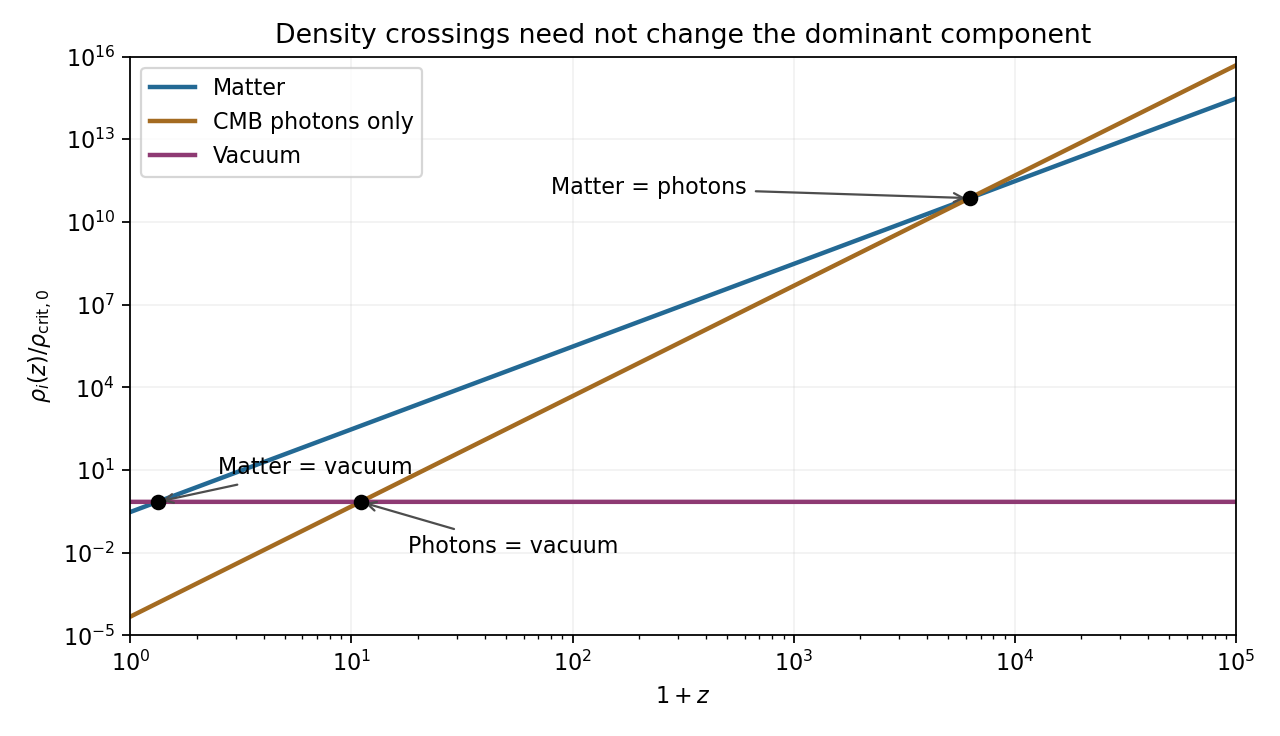
For the numerical density comparisons, the supplied Hubble constant is . Taking and givesThe radiation specified here is cosmic microwave background photons only. Adding a relic neutrino density would change the photon-only matter-radiation equality result. The rounded present matter and vacuum fractions sum to one without this small photon contribution; the requested pairwise density comparisons do not require silently renormalizing them.
For the final unlabelled flight-time request, insert the case-(c) value into the stipulated Einstein-de Sitter formula:The two model ages are approximately and years. This uses exactly the instructed matter-only model with the same . It is not an exact age difference in the matter-plus-vacuum cosmology; a high-redshift matter-era normalization using would be a different approximation.

Articles by others on the same topic
There are currently no matching articles.