[ref]
https://www.whatdotheyknow.com/request/natural_science_tripos_physics_e_2/response/2340776/attach/2/FOI%202023%20399%20Zahid%20materials.pdf?cookie_passthrough=1. Original public PDF, physical pages 458–461; dated 17 January 2012
Take overdots in this question to mean differentiation with respect to the orbiting particle's proper time . Write , and , with the specific angular momentum. Then the dimensionless timelike effective potential isThe last term is the relativistic correction to the Newtonian centrifugal-plus-gravitational potential. At large the two agree. Newtonian angular momentum gives an infinite inner centrifugal barrier for nonzero ; the relativistic correction lowers that barrier and permits plunge. The exterior problem starts at , where ; extrapolating the potential towards is not a static exterior description.
Circular orbits obeyThere are two extrema when : an inner maximum representing an unstable circular orbit and an outer minimum representing a stable one. At equality they merge at ; below it neither exists. More explicitly, evaluate the curvature at a circular orbit:Timelike circular orbits require . They are radially stable for , so the marginally stable inner limit is . The Newtonian potential instead has one stable minimum at , without an innermost stable circular orbit.
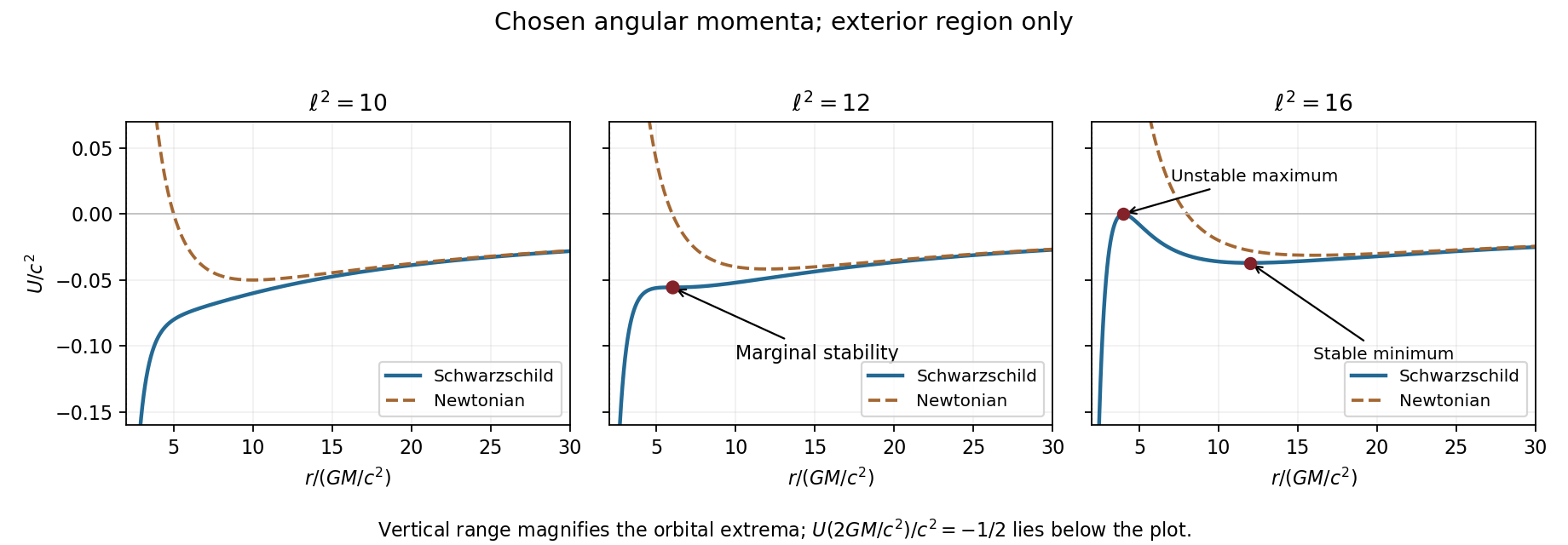
Schwarzschild and Newtonian potentials
. Details. For the Schwarzschild circular-orbit local speed in the question, is the Lorentz factor relative to a local Schwarzschild static observer, not . That observer's clock obeys . Since the particle passes with local speed , . Circular normalization givesThus at the innermost stable circular orbit. Using Schwarzschild time in place of the local clock would give a different speed.
For the conserved particle energy measured at infinity, substitute in the circular energy equation. Setting givesTake the positive root for a future-directed exterior orbit. It approaches at large radius. The marginally bound circular Schwarzschild orbit solves , giving and hence at finite radius. It is unstable; strictly bound circular orbits have , with . The phrase smallest bound orbit here denotes this marginal circular limit, not a prohibition on a bound-energy trajectory plunging below it.
At the innermost stable circular orbit,A radiatively efficient thin disc with a zero-torque inner boundary condition can therefore release about 5.7% of the accreted rest energy before the plunge. energy advection, stress at the inner edge and photon capture can alter the escaping luminosity, so this is a model efficiency rather than a universal emitted fraction.
For the Kerr ISCO spin limits of an equatorial prograde disc around a rapidly rotating Kerr black hole, the innermost stable circular orbit moves inward and its specific energy decreases. In the ideal extremal limit its Boyer-Lindquist radius tends to , , and the corresponding binding-energy efficiency tends to 42.3%. Retrograde rotation has the opposite trend: the extremal limit is , , giving about 3.8%. The prograde limiting coordinate radius does not identify a massive orbit with the null horizon generator.[ref]
Rotating Black Holes: Locally Nonrotating Frames, Energy Extraction, and Scalar Synchrotron Radiation by James M. Bardeen and others. §II, Eqs. 2.20–2.23 and Fig. 1, pp. 351–353
Finally . Dividing by this givesIts algebraic form is exactly Newtonian, but is the Schwarzschild spacetime areal radius and Schwarzschild time, normalized at infinity. Local clock rates, orbit stability and binding energy remain relativistic. With ,The marginally bound circular-orbit frequency is about . These Schwarzschild ISCO orbital frequencies and marginally bound frequencies are rotation frequencies per distant stationary observer's time, as intended by using . A static observer at finite radius instead divides both frequencies by , leaving their ratio unchanged. Identifying an observed quasi-periodic oscillation with the innermost stable circular orbit orbital frequency is an additional astrophysical assumption.
Here is the cosmological scale factor, is cosmic time and is the Hubble parameter. With a length, labels positively curved, flat and negatively curved spatial sections. This is unrelated to Question 1's specific orbital energy. The density is mass-equivalent energy density: has energy-per-volume units. In the displayed Friedmann equation has units ; the geometric cosmological constant is . For a separately conserved fluid of constant equation of state , the cosmological perfect-fluid continuity equation gives , so : zero for pressureless matter and one for radiation. With several fluids, sum their densities in the expansion equation and evolve each separately.
Setting cosmological spatial curvature and the cosmological constant to zero gives the mass-equivalent cosmological critical density,Its energy-density version is ; keeping this distinction is necessary when dividing a radiation energy density by below.
In an Einstein-de Sitter universe, integrates to and . With ,Here are the two epoch redshifts relative to today. This is elapsed cosmic time, not comoving distance divided by .
For collisionless preservation of a Planck spectrum, use frequency redshift as well as photon-number conservation. Let , so a frequency bin now corresponds to and initially. Collisionless propagation conserves photon number in the corresponding comoving bin:For an initial blackbody spectrum, insert its Planck distribution to obtainThe factors from the numerator cancel the spectral dilution factor, while the exponent changes only the temperature. Integrating gives photon number density proportional to and radiation energy density proportional to . Conservation of total photon number alone would not guarantee a blackbody spectrum shape; the frequency-bin mapping and absence of injection or spectral redistribution are essential.
For the numerical density comparisons, the supplied Hubble constant is . Taking and givesThe radiation specified here is cosmic microwave background photons only. Adding a relic neutrino density would change the photon-only matter-radiation equality result. The rounded present matter and vacuum fractions sum to one without this small photon contribution; the requested pairwise density comparisons do not require silently renormalizing them.
For the final unlabelled flight-time request, insert the case-(c) value into the stipulated Einstein-de Sitter formula:The two model ages are approximately and years. This uses exactly the instructed matter-only model with the same . It is not an exact age difference in the matter-plus-vacuum cosmology; a high-redshift matter-era normalization using would be a different approximation.
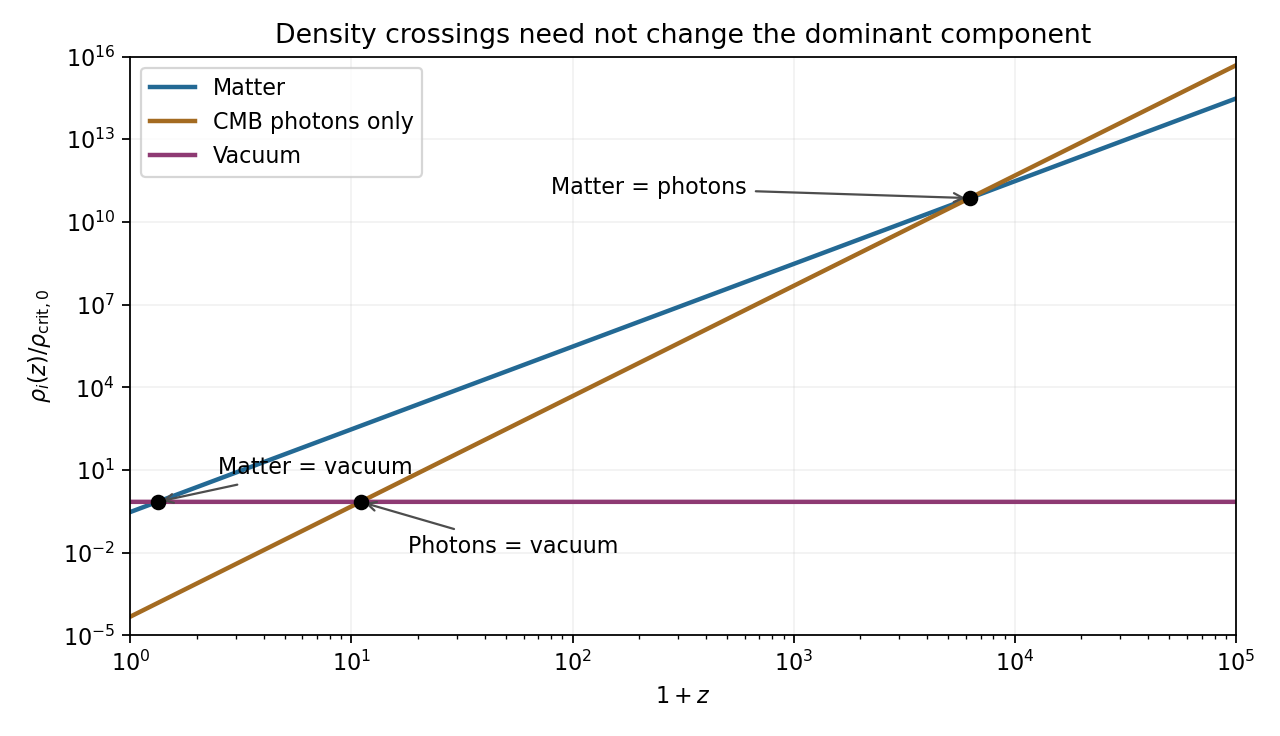


Density parameters at the same epoch share a common critical-density denominator. Thus compare the densities directly: and . Equality givesThis is the photon-only matter-radiation equality appropriate to the specified radiation density, not the equality including all relativistic species.
Vacuum density is constant for a true cosmological constant. Hence givesmatter-vacuum density equality is not the same event as the start of accelerating expansion: neglecting radiation, acceleration begins when .
Comparing photons with the constant vacuum density gives , soMatter dominates both at this crossing: its density in units of today's critical density is , compared with for each of the other components. radiation-vacuum density equality therefore does not itself mark a switch in the dominant component.
A donor star can feed a compact companion through Roche-lobe overflow near the inner Lagrange point, or through capture of a stellar wind. The transferred gas usually carries angular momentum; when its circularization radius exceeds the accretor's effective inner radius it forms an accretion disc. Outward angular momentum transport permits inward mass flow, while dissipation converts gravitational binding energy into heat and radiation. For a compact object with a surface ; for a black hole write , with efficiency determined by the flow and inner boundary. Optically thick disc regions emit a sum of thermal radiation spectrum components; a hot optically thin accretion corona can inverse-Compton scatter softer photons into a harder X-ray component. A black hole has no material surface on which to radiate a stellar boundary layer.
An explicit example is the wind-fed black-hole binary Cygnus X-1. Its massive stellar companion supplies gas, and the accretion flow produces strong X-ray emission.[ref]
Wind Accretion and State Transitions in Cygnus X-1 by D. R. Gies and others. abstract, H-alpha wind monitoring and X-ray-state comparison
Compact-object evidence comes from orbital dynamics rather than X-ray brightness alone. The single-lined binary mass function constrains the unseen mass; inclination, donor properties and distance refine it. Jerome A. Orosz and collaborators combined optical photometry, radial velocities, rotation and a distance constraint to obtain a black-hole mass of in their 2011 analysis. The inference depends on the stellar and orbital model, and that historical value should not be confused with a latest measurement.[ref]The Mass of the Black Hole in Cygnus X-1 by Jerome A. Orosz and others. abstract; dynamical modelling and observational constraints
Binary accretion converts orbital mass transfer into compact gravitational-energy release; a dynamical mass measurement identifies the accretor more securely than luminosity alone.
A positive cosmological constant contributes a constant vacuum energy density and negative pressure. In the time-unit convention of Question 2,It therefore causes accelerating expansion once its negative-pressure effect outweighs the decelerating components. Its density stays constant while matter dilutes, so a small early contribution can dominate late. For an isolated positive-vacuum component the scale factor grows exponentially. The cosmological constant problem is the mismatch between the small inferred vacuum density and generic quantum-field vacuum-energy expectations, rather than a failure of the background solution itself.
The key direct expansion evidence came from Type Ia supernova distance-redshift measurements. After light-curve and colour standardization, distant events were fainter than expected in simple decelerating matter-only models, indicating larger luminosity distances. Riess and collaborators' 1998 analysis and Perlmutter and collaborators' independent 42-supernova study favoured an accelerating low-matter-density cosmology with a positive vacuum contribution. Dust, source evolution, selection effects, photometric calibration and peculiar velocities must be controlled: faintness alone is not a model-independent measurement of .[ref]
Observational Evidence from Supernovae for an Accelerating Universe and a Cosmological Constant by Adam Riess and others. abstract; distance fitting and systematic-error discussion
[ref]Measurements of Omega and Lambda from 42 High-Redshift Supernovae by Saul Perlmutter and others. abstract; cosmological likelihoods and systematic checks
cosmic microwave background acoustic geometry and independent matter-density constraints help break the supernova parameter degeneracy: nearly flat geometry with substantially less than critical matter requires another component within the FLRW model. large-scale structure of the universe and distance measurements provide further consistency tests. The combined evidence supports a dark-energy contribution compatible with a constant; accelerating expansion by itself does not prove exactly constant vacuum energy or rule out every alternative gravity model.
A quasar is a luminous active galactic nucleus powered by gas accretion onto a supermassive black hole. The hot disc produces much of the optical/ultraviolet continuum; surrounding gas gives broad and narrow emission lines, while some systems have relativistic jets. A small emitting region is inferred from rapid variability, when beaming is absent. Sustaining a high luminosity from such a compact region favours accretion over ordinary stellar power. For approximately spherical, ionized hydrogen with electron-scattering opacity,Comparing luminosity with this Eddington scale constrains mass only after assumptions about anisotropy, opacity and accretion state. The emitted power obeys ; high binding-energy efficiency makes growth of a massive compact accretor energetically plausible.
Broad-line reverberation mapping estimates a gas radius from a continuum-to-line time lag, , and combines it with line velocity width to infer . Geometry, inclination and nongravitational gas motions enter the factor . Independent evidence for compact massive nuclei comes from resolved stellar or gas orbits in nearby galaxies. Andrea M. Ghez and collaborators' Galactic-centre stellar-orbit study fitted a common central potential and distance, demonstrating a compact dark mass of order four million solar masses; the Galactic centre is a low-luminosity example rather than a quasar.[ref]
quasars are an accretion phase of massive nuclear black holes; luminosity, variability and dynamical evidence constrain different aspects of that interpretation. A finite-resolution dark-mass measurement by itself is not a direct image of an event horizon.
The weak equivalence principle says that freely falling test bodies with identical initial conditions follow the same trajectory independently of composition, when nongravitational forces and appreciable self-gravity are negligible. In Newtonian language it implies universal gravitational-to-inertial mass ratio. The Einstein equivalence principle additionally requires local Lorentz invariance and local position invariance of nongravitational experiments: a sufficiently small freely falling laboratory realizes special relativity. The strong equivalence principle extends universality to gravitational experiments and self-gravitating bodies.
A falling elevator makes the local content clear. Uniform gravitational acceleration can be removed along a freely falling worldline by a suitable frame, but curvature cannot generally be removed over an extended region. Nearby geodesics have relative accelerationfor the displayed Riemann-sign convention. tidal forces therefore remain detectable even in free fall. Equivalence motivates a metric description and gravitational clock shifts, but does not uniquely select Einstein's field equations.
Tests compare accelerations of different materials, frequencies of clocks at different gravitational potentials, or the response of self-gravitating bodies. lunar laser ranging times pulses reflected by lunar retroreflectors and fits Earth-Moon motion in the Sun's field; a differential free-fall violation would add a characteristic periodic range perturbation. The fit must also model tides, station and reflector geometry and propagation delays, with solar-radiation pressure and reflector thermal effects checked as possible mimics. Williams and collaborators' 2012 analysis is a concrete example of this method, published after this examination.[ref]
Lunar Laser Ranging Tests of the Equivalence Principle by James G. Williams and others. §§2–4, pulse ranging, orbital fits and solar-radiation/thermal corrections
Equivalence is a local universality statement; tidal curvature and the detailed gravitational field equations are additional physics.
A galaxy cluster deflects light from background galaxies according to its projected gravitational field. In a thin gravitational lens approximation,The distances are angular-diameter distances; only mass in the appropriate foreground/background geometry lenses the chosen source this way. Near critical curves, strong gravitational lensing produces highly magnified arcs and multiple images of the same source. Farther out, weak gravitational lensing produces small coherent shear distortions, inferred statistically because individual galaxies have unknown intrinsic ellipticities. The measured reduced shear is . Transparent lensing obeys surface-brightness conservation in gravitational lensing at fixed source redshift while changing solid angle and integrated flux.
Strong-lensing image positions and source redshifts constrain the central projected mass; weak shear extends the map to larger radii. Multiple source planes help constrain geometry and degeneracies, but the mass-sheet degeneracy illustrates why image shapes alone do not uniquely fix absolute mass. Point-spread-function anisotropy, selection, shape calibration, cluster-member contamination, source redshift errors and unrelated line-of-sight structure require controls. Lensing does not require hydrostatic equilibrium, making it valuable for disturbed clusters, although interpretation still depends on the gravitational model.
An instructive observation is the merging Bullet Cluster: weak-lensing mass concentrations approximately follow the collisionless galaxies while the dominant visible baryonic plasma, traced by X-rays, is displaced. Clowe and collaborators combined ground-based and Hubble images for lensing reconstruction and compared them with the gas distribution, providing evidence for mass beyond the observed baryons.[ref]
Cluster lensing maps total projected gravitating mass and magnifies background sources; it does not by itself identify the microscopic dark-matter particle.
Articles by others on the same topic
There are currently no matching articles.