Take as particle proper time, dots as , and with . In the equatorial plane the geodesic Lagrangian isThe cyclic coordinates give and . Set the resulting constants to and respectively. The explicit second-order equations areThe polar equation is satisfied by , , consistently with spherical symmetry. The proper-time normalization supplies the third first integral:The normalization is ; it is distinct from choosing an arbitrary affine tangent's norm.
Stationarity and axial symmetry make the covariant time and azimuthal momenta constant. For physical momentum and coordinate in seconds, and . Thus is the conserved energy normalized at infinity and is the signed axial angular momentum. This is Killing energy with positive time signature; a convention with negative timelike norm uses the opposite contraction sign. The supplied covariant-momentum form of the geodesic equation makes these cyclic constants immediate, but its parametrization must be understood: for it is exactly as written. For physical , proper-time differentiation instead gives ; equivalently, the displayed mass-free form uses . This affine momentum normalization does not change either conservation law.
Multiply the normalization equation by and substitute the two cyclic integrals. Rearrangement gives the radial energy equationFor radial marginal escape and the future-directed constant is , because the speed at infinity vanishes. Choose the outward root:Hence the marginal escape geodesic in Schwarzschild spacetime hasThe constant has units of length to the power divided by time. This radius is an areal coordinate, not accumulated local proper distance.
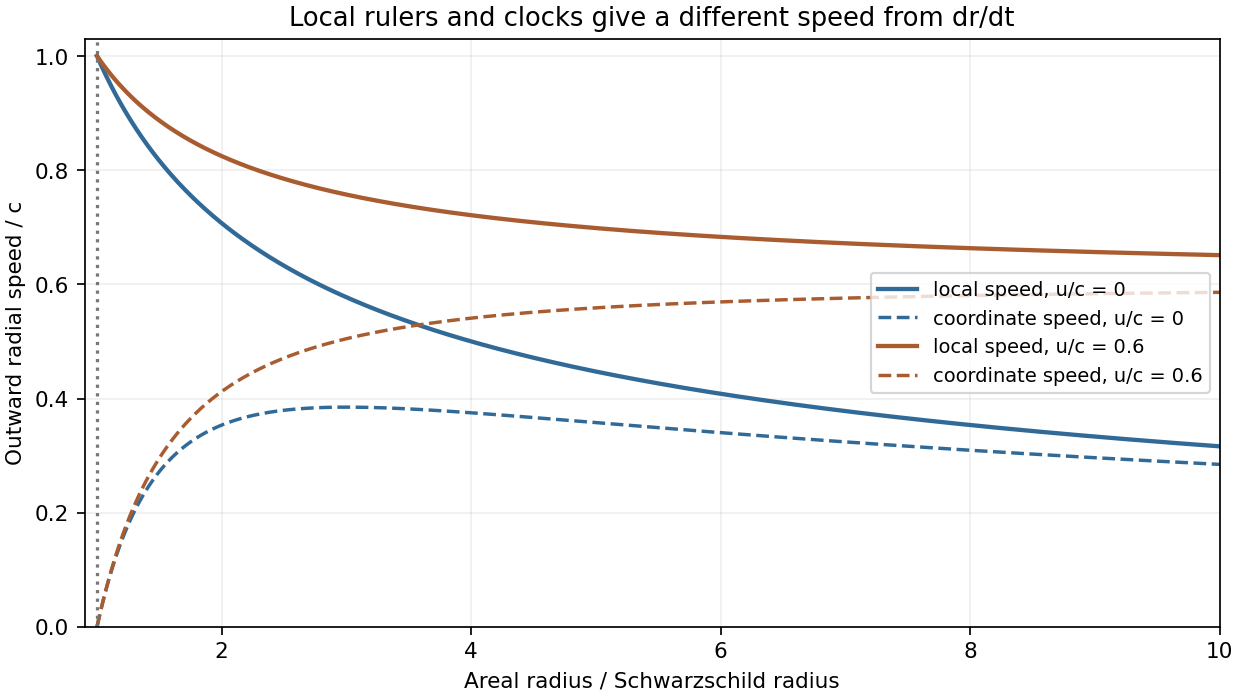
A Schwarzschild static observer at exterior radius uses local radial rulers and a local clock . Therefore the local radial speed of a Schwarzschild geodesic isFor the marginal trajectory this givesIts equality to is particular to ; the local definition, rather than that accidental equality, is the required observer measurement. The Schwarzschild-coordinate velocity is instead .
For nonzero asymptotic speed , the same energy constant is . Combining the radial equation with the local-ruler relation gives radial Schwarzschild escape with asymptotic speedThe positive root describes the outward particle, at radii on its trajectory with . Independently, a static observer has four-velocity in these coordinates, giving relative Lorentz factor and the same speed. As it tends to ; for it gives the preceding result. Its limiting value approaches as , but that is a limit through exterior observers: no static timelike observer exists on or inside the horizon.

Articles by others on the same topic
There are currently no matching articles.