Original solutions to the released 2016 paper. [ref]
https://www.whatdotheyknow.com/request/natural_science_tripos_physics_e_2/response/2340776/attach/2/FOI%202023%20399%20Zahid%20materials.pdf?cookie_passthrough=1#page=386. Original public PDF, physical pages 386–389; questions on pages 387–389
Use an affine parameter , with dots denoting its derivatives, and take so the metric is nondegenerate for . The geodesic Lagrangian is . The Euler-Lagrange equations giveor . The conserved cyclic angular momentum isThis is the cyclic angular momentum in a rotational metric, associated with the rotational Killing vector . Explicitly, by the angular equation.
Differentiating the Lagrangian and substituting both equations givesThus the squared tangent norm is constant. If is arc length, it equals one; its numerical value otherwise depends on affine normalization. An arbitrary nonaffine parametrization would not preserve this constant-speed statement.
Denote the parent rest mass by , the daughter rest masses by , and their total energies in any inertial frame by and . For an isolated disintegration with all products included, energy conservation gives . The corresponding kinetic energies are and . ConsequentlyEvery mass on the right is a rest mass, hence invariant under a Lorentz transformation. This proves the kinetic energy released by relativistic decay is frame independent even though either total kinetic energy separately is not. In the parent rest frame the initial kinetic energy vanishes and the final kinetic energy equals the energy associated with this mass defect. External energy input or omission of radiation would invalidate the energy-cancellation step; if photons are products, include their energies with zero rest-mass subtraction.
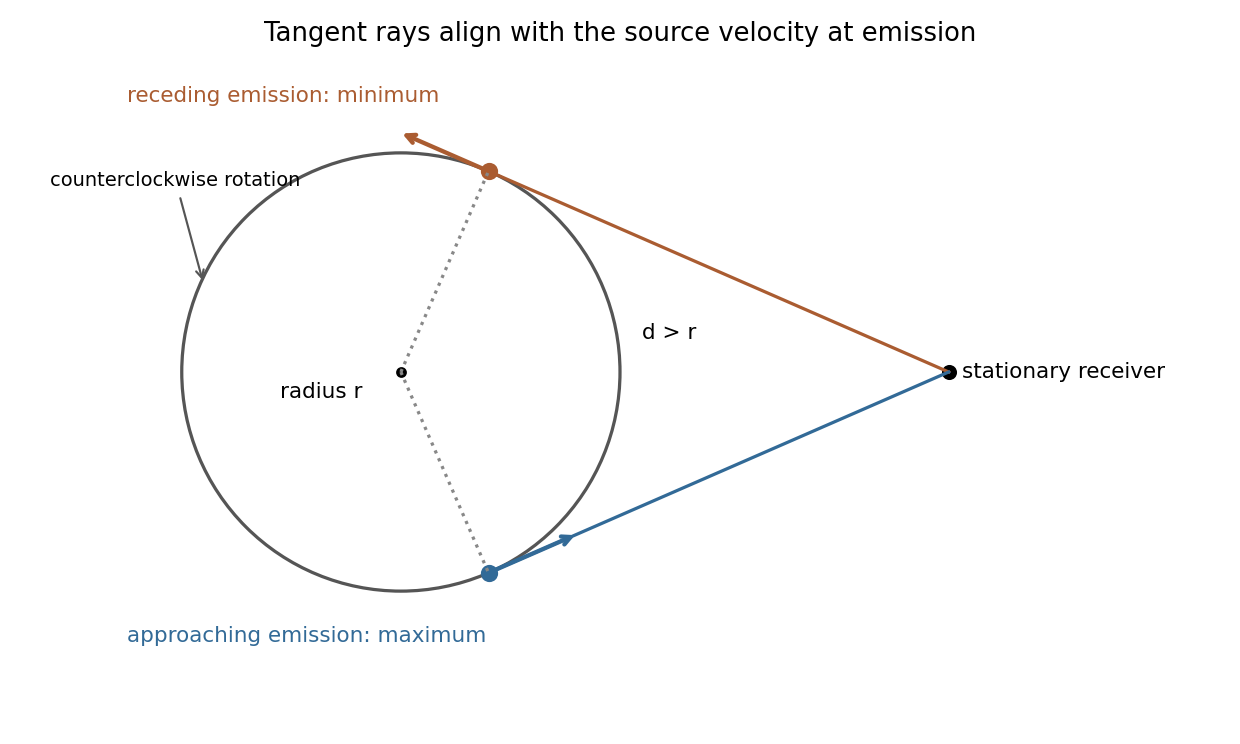
Put , and . For a photon emitted in laboratory direction toward the stationary receiver, its frequency there isSince the receiver lies outside the circle, two emission points have a line of sight tangent to the circle. At those points the source velocity is directly toward or away from the receiver, so . Thus the doppler extrema for a circularly moving source areThey do not depend on , provided ; changing changes the emission and reception phases of the extrema. Closest and farthest source positions instead have transverse velocity relative to that ray, and are not the extrema.
For the corotating receiver, velocities must be evaluated at the actual emission and reception events. An unobstructed vacuum ray satisfies , while rigid steady rotation gives . Therefore . The emitter and receiver have equal speed magnitudes, hence equal Lorentz factors. The frequency ratio of corotating clocks is consequentlyThus the rim receiver measures , independently of its angular separation. Different transit times or a Sagnac effect do not by themselves imply a frequency change between these identical-radius clocks. The model treats as a fixed proper clock frequency and assumes a signal path is available; it does not specify the disc's electromagnetic opacity.
The weak equivalence principle states that freely falling, sufficiently small test bodies have the same motion in a given gravitational field irrespective of composition or mass, neglecting their own gravity and nongravitational forces. In the Newtonian limit, makes this universality equivalent to a universal gravitational-to-inertial mass ratio, conventionally set to one.
The Einstein equivalence principle adds that local nongravitational experiments in a freely falling, nonrotating laboratory have the laws of special relativity, independent of the laboratory's position and velocity. At an event one can choose a local inertial frame with and . A freely falling observer feels no supporting force, while a supported observer can model a locally uniform gravitational field by an accelerated laboratory. This explains why freely moving particles follow timelike geodesics and light follows null geodesics when other interactions are negligible.
The locality qualification is essential. The Riemann curvature tensor generally remains nonzero; separated freely falling bodies have tidal relative acceleration, measured by geodesic deviation. A finite-size experiment can therefore distinguish a curved gravitational field from a merely accelerated coordinate description of flat spacetime. Equivalence alone also does not select the complete Einstein field equations.
A useful weak-field consequence is the upward photon shift over laboratory height . In an upward-accelerating laboratory the receiver gains recession velocity during the light flight, giving the same leading redshift. The Pound-Rebka experiment tested this with resonant absorption of 14.4-keV gamma rays over about 22.5 m. A controlled source velocity calibrated the Doppler sensitivity; interchanging source and absorber reversed the gravitational contribution while retaining an intrinsic source–absorber offset. Monitoring their temperature difference was essential because lattice-motion shifts could mimic the small signal.[ref]
Apparent Weight of Photons by Robert Vivian Pound and Glen Rebka. pp. 338–340, baseline, velocity calibration, reversed source/absorber positions and temperature corrections
This verifies a gravitational clock-shift prediction; by itself it is not a unique test selecting general relativity over every alternative metric theory.Consider an ideal spherical collapse with a vacuum exterior of constant mass . Once pressure support is insufficient, a surface can continue inward and cross the Schwarzschild event horizon in finite comoving proper time. An event horizon is a causal boundary: light emitted from inside cannot reach distant observers. It is not a material shell or, in the classical Schwarzschild solution, a local curvature singularity at .
The distant view of gravitational collapse differs from the surface clock's history. Exterior Schwarzschild time has for regular infall and diverges as the surface approaches the horizon. Outgoing radial light also takes an increasingly long coordinate time to escape: has a logarithmically divergent integral at the horizon. Signals received far away are progressively delayed and redshifted; both gravity and the inward emitter's Doppler shift contribute. photons carry less received energy and arrive at a lower rate, while the available escape directions also narrow.
Thus a distant observer does not receive a light signal announcing the crossing; the image fades and reddens rather than remaining a permanently bright frozen surface. A finite-band detector with finite sensitivity loses it in finite observation time. The divergence of one coordinate chart does not prevent the material crossing in finite proper time; horizon-regular coordinates describe that continuation. The pressureless Oppenheimer-Snyder model makes this distinction explicit, without representing all the pressure, rotation and radiation of a real stellar collapse.[ref]
On Continued Gravitational Contraction by J. Robert Oppenheimer and Hartland Snyder. abstract and pp. 455–459, finite comoving collapse time and redshifted distant description
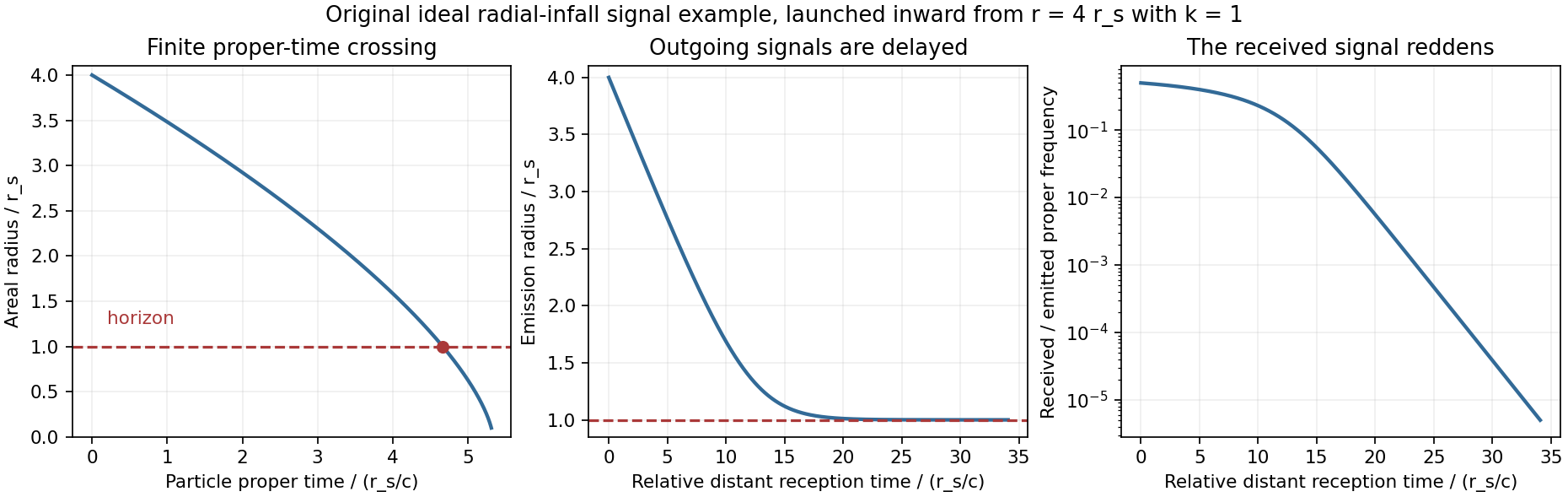
Original ideal radial-infall example separating finite proper-time crossing, delayed reception and fading frequency
. Details. The plotted example is a test-particle geodesic falling from rest at infinity, used to isolate the coordinate and signal effects; it is not a fitted stellar-collapse light curve. No actual observer can hover on the horizon to supply a static local frame there.
A light ray follows a null geodesic. For a weak, approximately spherical field and impact parameter , the asymptotic Schwarzschild light deflection isAt the solar limb this is about arcseconds, whereas a simple Newtonian fast-particle calculation gives half that value. The difference tests relativistic spacetime geometry beyond the universality of slow-body free fall. The quoted angle compares incoming and outgoing directions far from the deflector, not a locally measured turn at a sharp vertex.
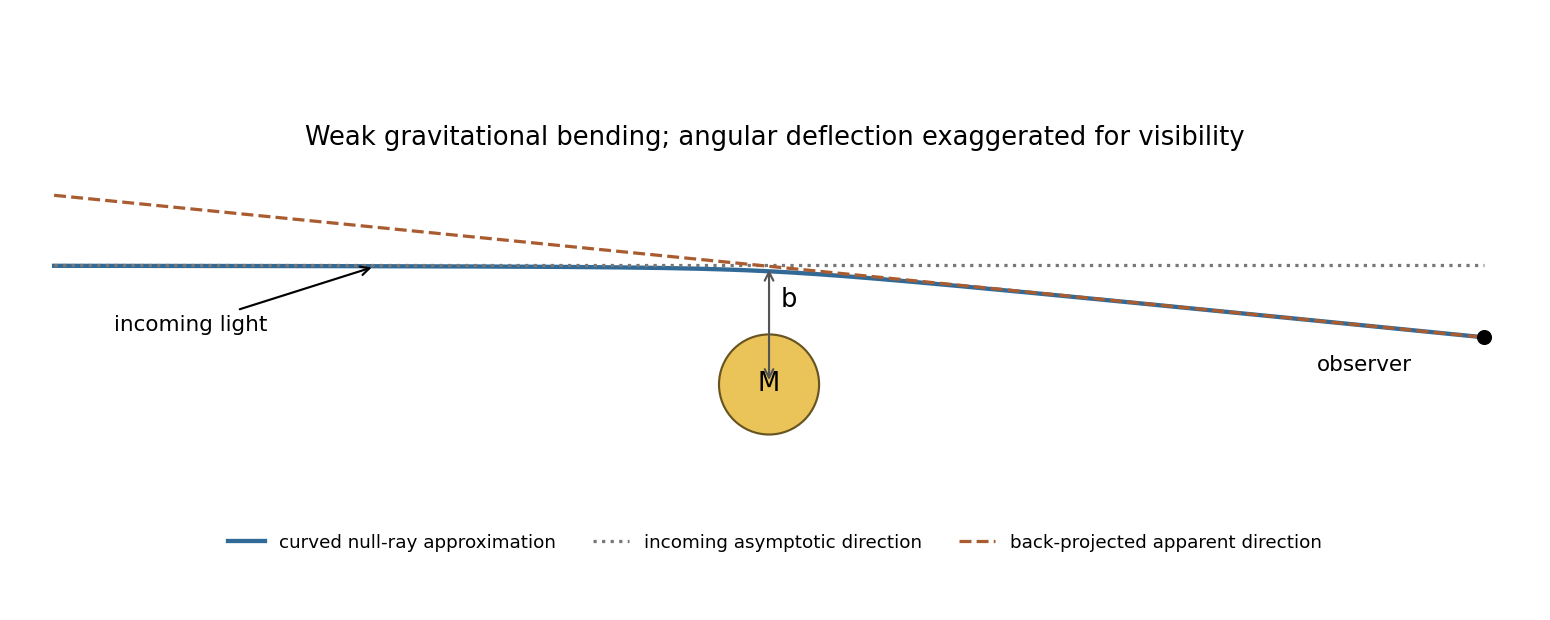
Original weak-deflection sketch with incoming direction, curved ray and apparent sky direction; the angle is exaggerated
. Details. For an eclipse measurement, photograph background stars near the obscured Sun and compare their apparent positions with reference plates taken when that field is away from the Sun. Back-projecting the deflected incoming light makes a star appear displaced outward from the Sun's apparent position. Fit the radial displacement against inverse angular separation from the Sun, while allowing plate translation, rotation and scale. The expected pattern must be separated from atmospheric refraction, optical distortion and changes of focus or scale, rather than inferred from one displaced star.
The 1919 expeditions obtained observations at Sobral and Príncipe, published by Frank Watson Dyson, Arthur Eddington and Charles Davidson in 1920. The original report compares eclipse and reference plates and discusses instrument scale and image-quality limitations; it should not be treated as an exact modern precision measurement.[ref]
A determination of the deflection of light by the Sun's gravitational field by Frank Watson Dyson and others. pp. 291–333, observing arrangements, reference photographs, plate reductions and final deflection comparisons
Repeated observations with independent instruments and calibrated reference fields test whether the displacement follows the predicted geometry. vacuum gravitational bending is achromatic to this order, a useful distinction from dispersive propagation effects.Use signature , coordinates and four-velocity normalized by . The derivative is the metric-compatible Levi-Civita connection. Fix the curvature sign by . Then the required contractions areWith , the contracted Bianchi identity gives . The Einstein field equations , with constant , therefore require covariant conservation of stress-energy. This is a consistency relation between geometry and the total matter/field source. It does not mean in arbitrary coordinates, nor guarantee a global conserved energy in an arbitrary curved spacetime. The geometric identity alone, without the field equations or matter dynamics, is not an equation of motion for a freely specified material source.
For relativistic dust, is proper rest-mass density, measured in the fluid rest frame, and is its timelike four-velocity with the normalization above. In a local Cartesian inertial frame , soAccordingly is momentum density and is energy flux in direction . The equality of momentum-density and energy-flux components after the appropriate factors of reflects the symmetry of the stress-energy tensor. In the comoving frame the spatial stress is zero, as required for pressureless matter.
Expand the dust conservation equation by the product rule:Contract with . metric compatibility and constant normalization give , leaving . Substitute this rest-mass continuity law back and divide by nonzero :This proves geodesic motion of uncharged dust along each fluid flow line. pressure forces or another exchange of momentum would change the argument; at zero density there is no dust worldline to constrain.
The electromagnetic field tensor is antisymmetric and has six independent components. In the stated local inertial coordinates choose and , givingThe fields are those measured by that local observer; changing observer mixes them through the Lorentz transformation of . With and , two independent quadratic contractions areThe second is a pseudoscalar: it is invariant under proper Lorentz transformations and changes sign under an orientation reversal. Opposite choices for the orientation tensor change its written sign. A nonzero null electromagnetic field can have both contractions zero, so the two numbers do not determine whether the tensor itself vanishes.
For charged relativistic dust, insert into the force-density equation:Contraction with again gives the continuity law, because by antisymmetry. After removing the continuity term,In a local inertial frame the spatial components reduce to and the temporal component gives . This is the relativistic Lorentz force, with gravity represented by the connection. The force is orthogonal to and preserves the rest-mass normalization. Matter alone now exchanges energy and momentum with the electromagnetic field; adding the field tensor's stress-energy restores zero divergence of the combined source.
Take as particle proper time, dots as , and with . In the equatorial plane the geodesic Lagrangian isThe cyclic coordinates give and . Set the resulting constants to and respectively. The explicit second-order equations areThe polar equation is satisfied by , , consistently with spherical symmetry. The proper-time normalization supplies the third first integral:The normalization is ; it is distinct from choosing an arbitrary affine tangent's norm.
Stationarity and axial symmetry make the covariant time and azimuthal momenta constant. For physical momentum and coordinate in seconds, and . Thus is the conserved energy normalized at infinity and is the signed axial angular momentum. This is Killing energy with positive time signature; a convention with negative timelike norm uses the opposite contraction sign. The supplied covariant-momentum form of the geodesic equation makes these cyclic constants immediate, but its parametrization must be understood: for it is exactly as written. For physical , proper-time differentiation instead gives ; equivalently, the displayed mass-free form uses . This affine momentum normalization does not change either conservation law.
Multiply the normalization equation by and substitute the two cyclic integrals. Rearrangement gives the radial energy equationFor radial marginal escape and the future-directed constant is , because the speed at infinity vanishes. Choose the outward root:Hence the marginal escape geodesic in Schwarzschild spacetime hasThe constant has units of length to the power divided by time. This radius is an areal coordinate, not accumulated local proper distance.
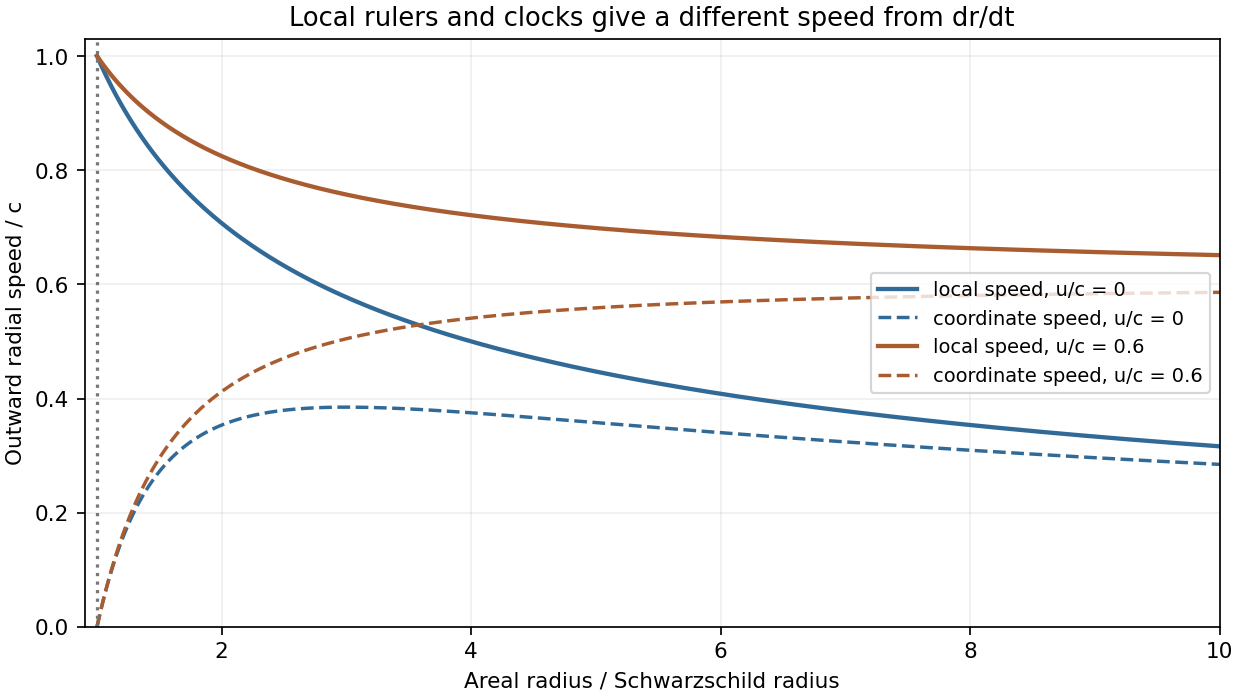
A Schwarzschild static observer at exterior radius uses local radial rulers and a local clock . Therefore the local radial speed of a Schwarzschild geodesic isFor the marginal trajectory this givesIts equality to is particular to ; the local definition, rather than that accidental equality, is the required observer measurement. The Schwarzschild-coordinate velocity is instead .
For nonzero asymptotic speed , the same energy constant is . Combining the radial equation with the local-ruler relation gives radial Schwarzschild escape with asymptotic speedThe positive root describes the outward particle, at radii on its trajectory with . Independently, a static observer has four-velocity in these coordinates, giving relative Lorentz factor and the same speed. As it tends to ; for it gives the preceding result. Its limiting value approaches as , but that is a limit through exterior observers: no static timelike observer exists on or inside the horizon.


Articles by others on the same topic
There are currently no matching articles.